Oct5
Scottish Country Dancing
Mon, Oct 5 · 7:00 pm
St Andrew’s Presbyterian Church 261 Christina St N Sarnia, ON

If you want to understand why your tax bill looks the way it does, you first have to navigate the jurisdictional mess that is Lambton County. We live in a […]
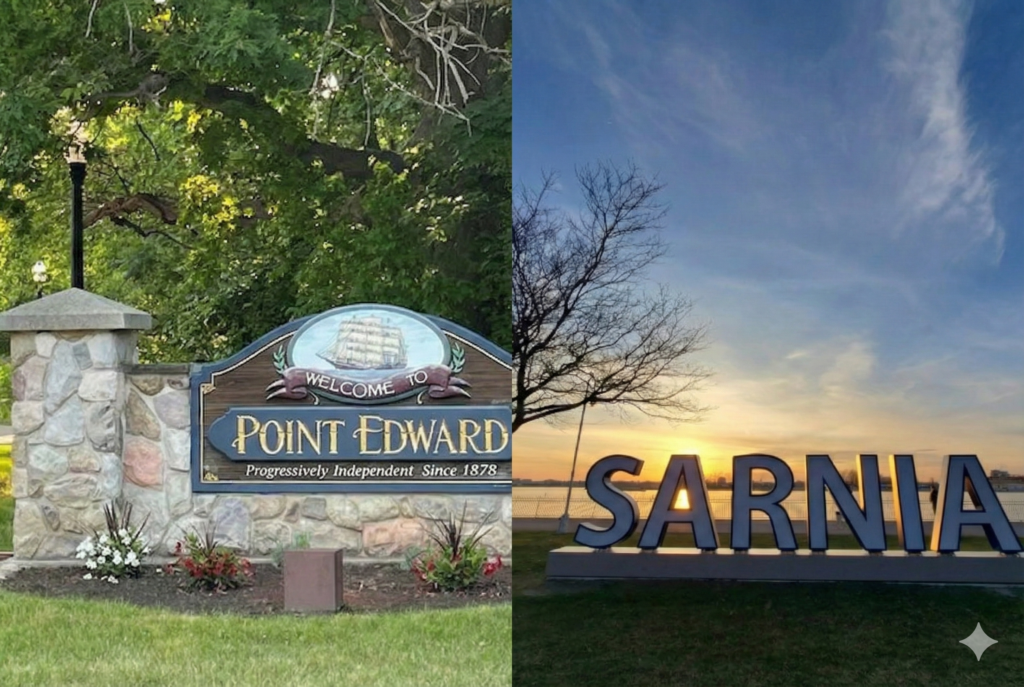
If you want to understand why your tax bill looks the way it does, you first have to navigate the jurisdictional mess that is Lambton County.
We live in a community where you can walk across a street and cross a municipal border, moving from a city of 72,000 to a village of 2,000. Both have their own councils, their own administrations, and their own budgets, yet both send a massive chunk of their tax revenue up the chain to the County of Lambton to manage things like housing, ambulances, and major roads.
It is a layer cake of bureaucracy that makes accountability difficult. But when you look at the finalized 2026 budgets for Sarnia and Point Edward side-by-side, the difference in how they are managing their slice of the pie reveals two very different philosophies on what "safety" and "community" actually cost.
In Sarnia, the headline is what didn't happen.
For years, the status quo assumption has been that police budgets only go up. The ask this year was for a new $91.1 million police headquarters—a massive capital injection into law enforcement infrastructure.
But when faced with the math, Sarnia Council blinked. To keep the tax increase manageable (3.95% inside the transit area), the police fortress was deferred.
What remained in the budget, however, is telling. While the police facility was put on ice, the City kept funding for things that actually build healthy neighborhoods: $2 million restored for the Bright’s Grove Library, $3.6 million for recreation spaces, and $11 million for the Wellington Street extension.
We often talk about "community safety" as if it is synonymous with policing. Sarnia’s 2026 budget inadvertently proves otherwise. By saying no to a $91 million police building, the city freed up the capacity to say yes to libraries and parks. It is a quiet admission that perhaps the best way to manage a city isn't to build thicker walls, but to build better community spaces.
The Cost of the Village
Cross the street into Point Edward, and you see the other side of the coin. The Village passed a 3.81% increase, but unlike Sarnia, they don't manage their own police force. They contract the Ontario Provincial Police (OPP).
The promise of the OPP contract model is usually stability and lower liability—you pay a fee, and the Province handles the rest. But this year’s budget shows the flaw in that logic. Point Edward’s increase is driven significantly by the rising cost of that policing contract. Even without a municipal force to manage, the cost of enforcement remains a heavy anchor on the budget, leaving the Village with little room to maneuver.
Because that money has to come from somewhere, the Village is leaning heavily on the basics of survival: water and sewers.
While Sarnia uses its larger customer base to absorb infrastructure costs (keeping rate increases moderate), Point Edward residents are seeing the bill for their independence.
Water rates in the Village are up 7.52% and sewer rates are up 9.40%. But the most regressive hit is a 50% jump in the fixed reserves charge on water bills.
This is where municipal finance becomes a class issue. A fixed charge doesn’t care about your income or your property value. It hits a tenant in a modest apartment exactly as hard as it hits the owner of a riverfront estate. It is effectively a penalty for being hooked up to the grid.
Both municipalities are facing a difficult future. Sarnia balanced this year’s books by dipping into reserves—a temporary fix that kicks the can down the road. Point Edward is learning that even with casino revenue, the lack of scale makes basic infrastructure expensive.
But the 2026 snapshot offers a rare contrast. Sarnia managed to protect its social infrastructure—libraries and community centers—by pausing the expansion of its police infrastructure. Point Edward, locked into provincial policing contracts and facing the expensive reality of small-scale utilities, is passing the cost onto the basic necessities of life.
It raises the question: if we weren’t so committed to these arbitrary borders and duplicating bureaucracies, could we afford to do both better?
Mon, Oct 5 · 7:00 pm
St Andrew’s Presbyterian Church 261 Christina St N Sarnia, ON
Tue, Oct 6 · 5:30 pm
The Bridge Patisserie Café 12 Michigan Ave Point Edward Point Edward, ON
Tue, Oct 6 · 6:00 pm
Black Gold Brewery 395 Fletcher St Petrolia, ON
A division of Sarnia Media Group Inc.
Locally Owned and Operated
© 2026 The Sarnia Journal