Oct5
Scottish Country Dancing
Mon, Oct 5 · 7:00 pm
St Andrew’s Presbyterian Church 261 Christina St N Sarnia, ON

The Sarnia Police Services Board invited you to speak, but it seems they had no intention of listening.
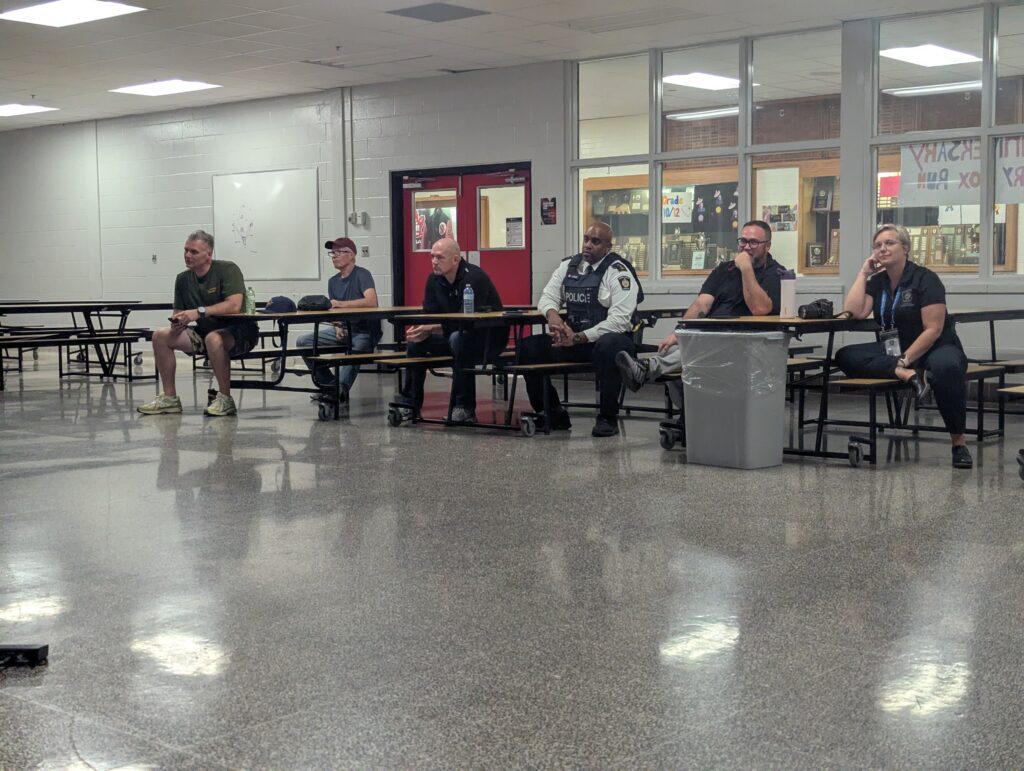
The Sarnia Police Services Board invited you to speak, but it seems they had no intention of listening. The recent series of "public consultations" on the police's next strategic plan were not an exercise in democracy; they were a masterclass in propaganda.
Billed as a chance for the community to help "prioritize our resources," these sessions were instead a carefully staged performance designed to sell the public on a decision the board made a year ago: to build a new, $90 million police fortress.
The performance began the moment the meetings did. Instead of an open dialogue, the community was first subjected to a nearly hour-long, one-way presentation by Chief Derek Davis and Board Chair Paul Wiersma, filled with dire warnings about the state of the current headquarters.
The centrepiece of this campaign was a professionally produced promotional video—a piece of taxpayer-funded marketing designed to create a sense of unavoidable crisis. In it, officers described a building patched together with "duct tape and prayers and gum," a women's locker room that "often smells of sewage," and a sally port so small that prisoners must be escorted through an "insecure parking lot."
I have since filed a Freedom of Information request to determine the video's cost.
Not to mention that these meetings seeking public input consisted of almost as many staff as there was members from the public.


Only after the sales pitch was complete was the public granted a microphone to ask questions or make comments.
As a professional strategic planner for the past 20 years, I know that genuine consultation gathers broad feedback before focusing on a predetermined solution. What was happening felt less like a consultation and more like an exercise in manufacturing public consent.
So, when my turn came, I challenged the integrity of the process itself:
"My question is about the process of this meeting. Your public announcements invited the community here tonight to participate in the development of your 2026 to 2028 strategic business plan. However, the first hour of this session has not been a broad open-ended consultation on community priorities. It has been a detailed one-way presentation making the case for a new police headquarters. Has the board already determined that a new headquarters is the central strategic priority, and if so, why was this session presented to the public as an open consultation on strategy, rather than what it actually appears to be—a campaign for a capital project?"
Audio of the entire conversation can be listened to below.
Chair Paul Wiersma’s response was not an answer, but a deflection. Rather than address the question of a pre-determined outcome, he polled the room, asking if anyone else felt they hadn't had a chance to speak—a classic diversion to avoid accountability. When I pressed for a simple "yes or no," the truth was finally admitted.
"The board has decided," Wiersma eventually conceded, "that we will build a new facility."
When asked for clarification, he confirmed the timeline: "Last year, the board approved a new facility. That is true, yes."
This pattern of evasion is the board’s primary function. It is not a body of civilian oversight; it is a shield, protecting the police service from scrutiny. When faced with data from their own reports showing a 24% spike in Sarnia’s Violent Crime Severity Index alongside a multi-million-dollar budget increase, the board refuses to engage with facts.
At the previous meeting, board member Kelly Ash responded to questions about the budget by invoking the trauma of an officer being stabbed, asking, "Should we have sent a social worker in there… who would not have survived that attack?" Councillor Ann Marie Gillis shifted blame for the mental health crisis to the province, stating, "we don't have the provincial money or a training to be social workers."
And now that the performance of public consultation is over, the official media campaign has begun.
Sarnia Police have launched a dedicated webpage for their new fortress, and the talking points are being deployed. In a recent CTV News story, Deputy Chief Michael Van Sickle claims they are “crawling over each other” in the current building.
The board is now publicly dismissing the inconvenient $4 million upgrade plan, with Van Sickle arguing the report only reviewed the building's structure, not "the operational needs of the force in an era of rising gun crime and community outreach”.
Board Chair Paul Wiersma frames the $90+ million expenditure as what is “best for the taxpayer,” warning that not building it now is just “kicking the can down the road.”
This spin conveniently ignores Mayor Mike Bradley, who told the same news outlet that taxpayers simply “cannot afford it” and would face a “hefty immediate tax increase” followed by years of 10% hikes to pay for it.
The script demands a new building. It requires ignoring the viable, $4.43 million repair and upgrade plan detailed in their own consultant's report—an option that was never seriously presented to the public.
It requires framing a systemic social crisis of addiction and mental health as an architectural problem that can only be solved with more, and better, cells. The video makes this point explicitly, arguing that while they have only six cells, a "modern organization would have far more" to handle the daily volume of prisoners. The Chief insists in the video that "modernization… doesn't mean buying all the new shiny things", yet the board is ignoring a cost-effective retrofit in favour of the shiniest object of all: a brand-new building. And it requires a complicit board willing to stage "consultations" to manufacture consent for it all.
If you can't tell already, this has nothing to do with safety and it's a grotesque misuse of public funds.
It’s about a legacy project and an expansion of police power, justified through a fraudulent public process. While the board perfects its democracy theatre, the real needs of our community—housing, mental health support, community services like recreation centres and addiction services—are starved of the very resources being funnelled into this fortress.
The board has made its decision.
The question now is whether the community and our city council will accept it and allow them to get away with it.
Mon, Oct 5 · 7:00 pm
St Andrew’s Presbyterian Church 261 Christina St N Sarnia, ON
Tue, Oct 6 · 5:30 pm
The Bridge Patisserie Café 12 Michigan Ave Point Edward Point Edward, ON
Tue, Oct 6 · 6:00 pm
Black Gold Brewery 395 Fletcher St Petrolia, ON
A division of Sarnia Media Group Inc.
Locally Owned and Operated
© 2026 The Sarnia Journal