Oct5
Scottish Country Dancing
Mon, Oct 5 · 7:00 pm
St Andrew’s Presbyterian Church 261 Christina St N Sarnia, ON

A major Ontario clinical trial has found that community paramedicine programs can cut 911 calls and improve health outcomes for vulnerable residents — evidence that directly supports Sarnia’s Project Right Response proposal.
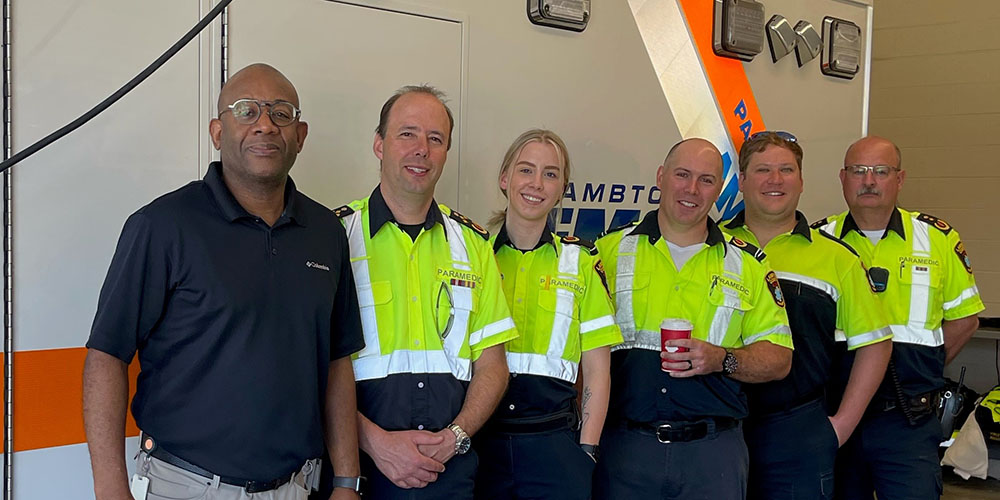
The 2019 study, published in Prehospital Emergency Care and led by Dr. Gina Agarwal of McMaster University, was the first large multi-site randomized controlled trial of its kind in North America. It was carried out in 30 public housing buildings across five Ontario communities, where older adults are known to be high users of emergency medical services.
In the trial, paramedics set up weekly health clinics inside the buildings. Residents could drop in for risk assessments, blood pressure checks, health education, and referrals to doctors or community programs. These sessions were designed not only to treat problems but to prevent crises before they became 911 calls.
A 19% reduction in EMS calls in intervention buildings compared to control buildings (statistically significant in a sensitivity analysis).
Blood pressure improvement: The average systolic blood pressure dropped by 3.65 mmHg, and the diastolic by 2.03 mmHg across participants.
Better quality of life: Participants recorded a measurable increase in quality-adjusted life years (QALY +0.06), along with significant improvements in self-care, usual activities, and reduced pain and discomfort.
Strong engagement: Nearly 40% of building residents participated, with 17,048 blood pressure readings recorded and 755 physician reports faxed to family doctors.
Researchers concluded that paramedic-led health programs not only reduced 911 demand but also improved the everyday health of older, low-income adults — a group that faces significant barriers to care.
Project Right Response would bring the same principles into Sarnia’s 911 system. Instead of sending police to non-violent crises like mental health calls, overdoses, or wellness checks, the plan proposes a Community Paramedic Response Unit (CPRU) under Lambton EMS. Police would remain available if a call turned violent or a crime was ongoing, but health professionals would be the first response.
The trial’s data show why this matters: when paramedics take the lead, the health system load decreases and residents fare better. For Sarnia, the shift could free police from thousands of non-criminal calls each year, shorten response times for serious crimes, and reduce pressure on emergency departments.
The strongest support for Project Right Response comes from Ontario itself. The study showed positive outcomes in neighbouring communities like Hamilton, Guelph-Wellington, York Region, Simcoe County, and Greater Sudbury. These research findings helped establish a new model that is now firmly embedded in Ontario’s health system, with 33 paramedic services delivering community clinics (CP@clinic) at 184 sites province-wide.
The findings are clear: when local health professionals take the lead, residents experience better outcomes and emergency services face less strain. Project Right Response applies this proven Canadian method locally, showing that non-violent crises can be addressed more effectively through health-led interventions. Ontario’s peer-reviewed data proves that putting health professionals, not police, at the front of health-driven emergencies delivers real, tangible results.
The trial also highlights the cost-effectiveness of health-led approaches. A steady reduction in 911 calls translates into fewer ambulance trips, fewer visits to already crowded emergency departments, and an overall lighter burden on first responders. Project Right Response argues that by diverting non-violent calls to a paramedic-led team, police are freed up to focus on crime and public safety, while paramedics are empowered to use their skills where they are most cost-effective — in health-focused, community-based care.
The Ontario trial shows that community paramedicine is not an experiment but a proven, evidence-based model. For Sarnia, Project Right Response represents a chance to put that evidence into practice: sending the right responder to the right call, easing pressure on police, and providing more compassionate care for residents in crisis.
Mon, Oct 5 · 7:00 pm
St Andrew’s Presbyterian Church 261 Christina St N Sarnia, ON
Tue, Oct 6 · 5:30 pm
The Bridge Patisserie Café 12 Michigan Ave Point Edward Point Edward, ON
Tue, Oct 6 · 6:00 pm
Black Gold Brewery 395 Fletcher St Petrolia, ON
A division of Sarnia Media Group Inc.
Locally Owned and Operated
© 2026 The Sarnia Journal