
If the Bill 5 megaprojects proposed by Ontario Premier Doug Ford — like mining in the Ring of Fire or building Highway 413 — push federally listed species, such as the boreal caribou or redside dace, to the brink, only the federal Species at Risk Act still stands in the way.
If the Bill 5 megaprojects proposed by Ontario Premier Doug Ford — like mining in the Ring of Fire or building Highway 413 — push federally listed species, such as the boreal caribou or redside dace, to the brink, only the federal Species at Risk Act still stands in the way.
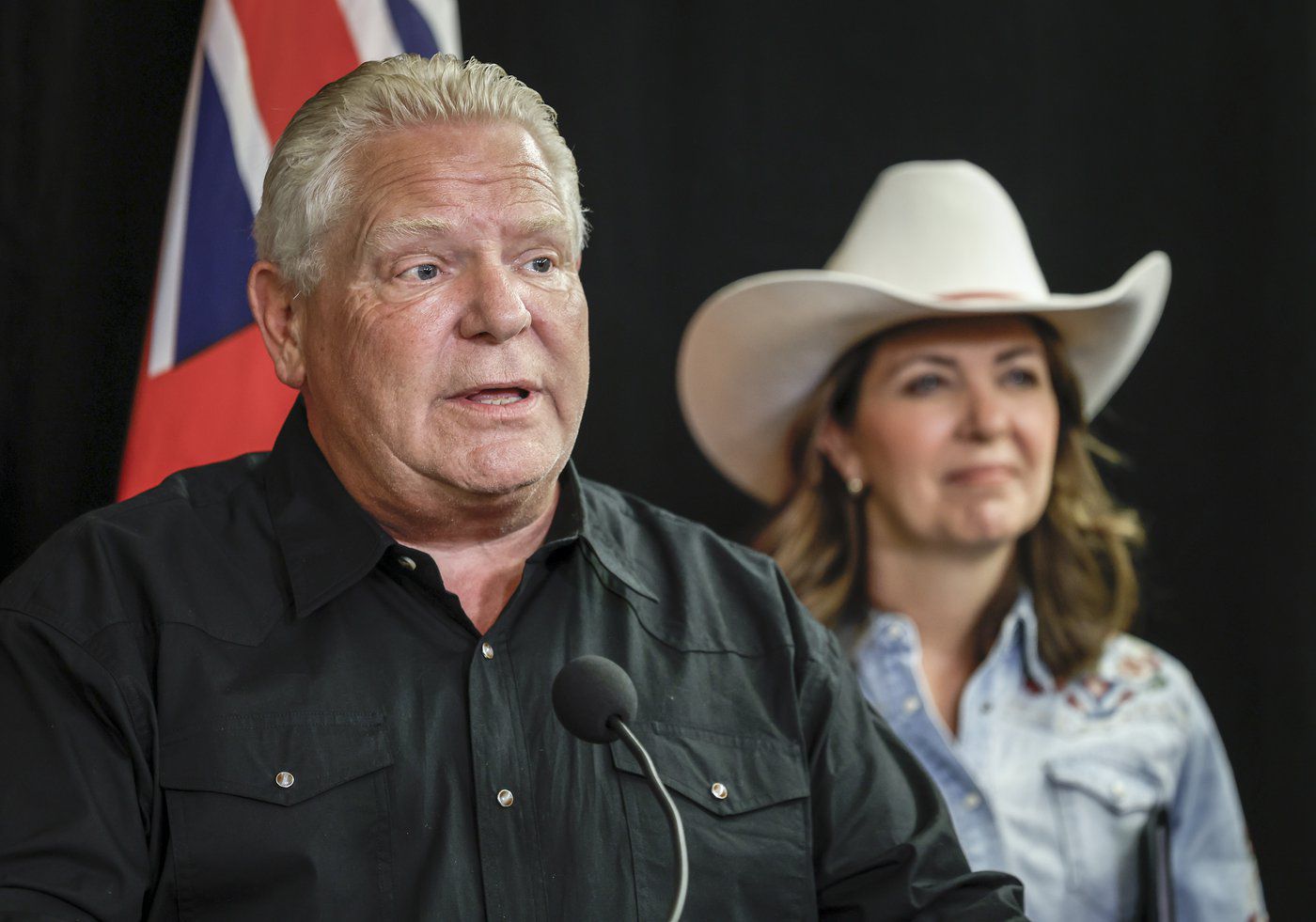
Now, Ford is demanding that Ottawa clear that last line of defence — and this time, he’s brought an ally: Alberta Premier Danielle Smith.
Backed by Alberta, Ford’s government is calling on Ottawa to repeal some of Canada’s key environmental laws, which experts warn are now the only measure preventing species’ extinction, climate backsliding and unchecked industrial expansion.
Both provinces want Ottawa to repeal the Impact Assessment Act, carbon-pricing legislation, clean electricity regulations and parts of the Species at Risk Act — many of which echo protections Ford has already weakened in Ontario.
In their joint letter, they claim provinces are better equipped to oversee environmental protection and federal rules amount to overreach, saying they “disproportionately harm” project development without delivering “any quantifiable benefits.”
The letter comes in the context of the recently passed Bill C-5, which accelerates projects deemed to be in the national interest by Prime Minister Mark Carney’s cabinet. Ford has submitted a list of his “nation-building projects” to Ottawa — including a proposed tunnel under Highway 401 and mining developments in the Ring of Fire — which experts say would likely face federal scrutiny under the same laws he now wants repealed, due to their impact on First Nations, wildlife and water.
Michael Drescher, associate professor at the University of Waterloo, said after Ontario passed its own project-acceleration law, the similarly named Bill 5 — which created Special Economic Zones allowing the province to suspend its own environmental laws — federal laws remain the only meaningful barrier. “That’s probably why they’re now pushing the federal government to rescind or repeal those laws,” he said.
Backed by Alberta, Ford’s government is calling on Ottawa to repeal some of Canada’s key environmental laws, which experts warn are now the only measure preventing species’ extinction, climate backsliding and unchecked industrial expansion.
Drescher questioned the provinces’ push to repeal federal environmental laws, arguing it’s unnecessary since Ottawa already has tools like Bill C-5 to exempt specific “nation-building” projects. He said the joint letter from Ontario and Alberta appears less about streamlining approvals and more like an effort to eliminate environmental safeguards altogether.

Drescher warned that repealing federal laws could undermine Canada’s international climate and biodiversity commitments, including those under the Paris Agreement — responsibilities that fall to the federal government, not the provinces.
While the federal government has dropped its carbon levy on consumers, the industrial carbon price remains in effect — requiring major polluters, such as steelmakers, cement plants and oil refineries, to pay for their emissions. Ontario, like Alberta, currently has its own industrial carbon pricing regime, which is expected to generate billions in revenue over eight years.
But the only reason it exists is because the federal backstop — upheld by the Supreme Court — requires provinces to have one. Both provinces have requested the backstop be removed.
Tim Gray, executive director at Environmental Defence, warns repealing the federal industrial carbon tax would lead Ontario to scrap its own system. “I think it’d be about five minutes before Ontario cancelled its [own] program,” Gray said. British Columbia did the same immediately after the federal government cancelled the consumer carbon tax in March, and for the same reason — the backstop no longer existed.
Without the federal backstop on the industrial carbon price, Ontario’s biggest industrial polluters would no longer have any incentive to reduce emissions. Canada’s efforts to transition to a cleaner, lower-emission economy would lose one of its key mechanisms, Gray added.
Gray also rejected the claim that the federal Impact Assessment Act blocks development. “It’s a project review mechanism… Not every project that every industry proposes is always a good idea,” he said. In most cases, he added, federal oversight improves outcomes by identifying environmental risks early and recommending mitigation strategies that benefit both the economy and the public.
Along with their joint letter, Ontario and Alberta signed a Memorandum of Understanding to promote a more “investment-friendly” regulatory environment for energy and trade infrastructure. The agreement also includes plans to cooperate on nuclear development, including both small-modular and large-scale reactor technologies.
Peter Graefe, a political science professor at McMaster University, said resource industries are pressuring governments to weaken environmental protections — and provinces like Ontario and Alberta are responding by demanding less federal oversight.
Graefe said this reflects a larger shift away from environmental protection and toward rapid resource extraction — a trend he believes includes the current federal government. While Ottawa may not repeal laws outright, he said it appears willing to soften them under pressure.
But he warned the political fallout could be significant. “The Liberal government is going to pay a bigger price with their electoral base if they agree to this,” Graefe said, adding it could push climate-focused voters toward the NDP or Greens.
Graefe said provinces may want federal backing to share the political fallout from controversial development. “If the federal government says yes, it’s not just the province anymore. They can say, ‘We’re doing all this — and it’s not just us.’”
If projects later stall or fail, provinces could shift the blame to Ottawa. “That’s an easy way to get out of it — to say, ‘The federal government blocked us,’ as opposed to, ‘It was a bad idea,’” he added.
Drescher said leaving environmental protection solely to provinces could have serious consequences. Pollution, habitat loss and species decline don’t stop at provincial borders, which is why federal involvement is essential, he added.
Without national standards, decisions made in one province can harm ecosystems and communities elsewhere, whether through shared waterways, migratory species or air pollution, Drescher said.g


