



Oct19
Ontario’s greenhouse gas plan could spell big trouble for Sarnia
Troy Shantz Ontario’s new ‘Cap and Trade’ legislation will have serious financial consequences for local industry and could even see refineries here forced to close down, a local union president warns.
Troy Shantz
Ontario’s new ‘Cap and Trade’ legislation will have serious financial consequences for local industry and could even see refineries here forced to close down, a local union president warns.
One quarter of the largest producers of greenhouse gas (GHG) emissions in the province are located in Sarnia-Lambton, said Mark Mathewson, president of Unifor, Local 848.
Under cap and trade, once they’ve surpassed a predetermined limit, they must purchase credits to offset further emissions, which will raise their cost of doing business in Ontario.
“If they’re having a challenge to produce in a region that is under cap and trade, they have the ability to move out of this zone and into another zone,” he said.
Under the legislation, companies that emit more than 25,000 tonnes of greenhouse gases annually must participate in the cap and trade program. Heavy emitters will be given a number of credits each year, (with one credit equaling one tonne of GHG).
After 50,000 tonnes however, they will be required to purchase more credits.
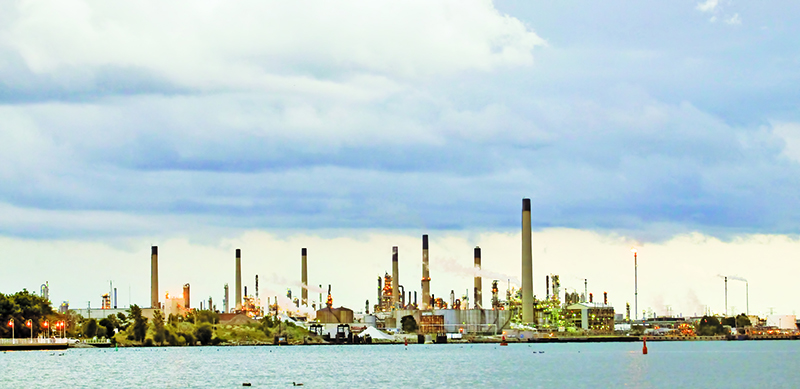
The Shell refinery in Corunna, for example, currently produces about 170,000 tonnes of GHG yearly. If Ontario set the initial price at $18 per carbon credit, as some have suggested, it would cost the refinery several million dollars in additional operating costs.
The price structure is still unclear, but Mathewson said if the price rose to the ceiling of $50 per credit after the first compliance period ends in 2020, the impact on local industry would be devastating.
Meanwhile, Prime Minister Justin Trudeau last week announced Ottawa’s own greenhouse gas plan, which would start at $10 per tonne and climb to $50 per tonne by 2022.
“These entities are corporations and their mandate is to make as much money for the shareholders as they can. Their mandate is not to make gasoline in Sarnia,” Mathewson said.
His fear has a name: carbon leakage. When the cost increases under any carbon tax system, business will move to a jurisdiction with more lenient emission legislations.
“The challenge that we have here is that our main competitor is the U.S. Gulf coast,” said George Mallay, general manager of the Sarnia-Lambton Economic Partnership.
“And they don’t have any of this stuff at all. And that’s a challenge for investment.”
But fearing the worst is premature, added Mallay, who noted local industry could also capitalize on the new legislation.
Under Ontario’s cap and trade regime companies that demonstrate sustainable, carbon-reducing projects, such as solar or wind, will earn credited.
Mallay said the growing number of local bio-based initiatives could be economically beneficial under cap and trade, as carbon credits are earned and resold, creating revenue.
“I think within the community here, there’s recognition that we need to develop environmentally sustainable solutions,” Mallay said.
“We also need to have policies that are progressive, but we don’t want to kill our economy.”
The general manager of the industry-funded Sarnia-Lambton Environmental Association said cap and trade does present a local challenge but believes industry will adapt.
“Let’s face it, some of our companies are large emitters because that’s the type of business they’re in. And they have to compete against jurisdictions that may not have cap and trade provisions in place, Dean Edwardson said.
“We’ll have to … determine the kind of investments we’re going to make to try and reduce these emissions if they haven’t already been made.”
More to read
Events
Oct19
Oct19
Oct19
Scottish Country Dancing
Mon, Oct 19 · 7:00 pm
St Andrew’s Presbyterian Church 261 Christina St N Sarnia, ON
Oct19
cineSARNIA presents Tuner
Mon, Oct 19 · 7:00 pm
Sarnia Public Library Theatre 124 Christina St. S. Sarnia, ON