
Revelree’s 2026 festival cancellation has sparked wider questions about Sarnia’s live-music scene. The answer may not be that local music is disappearing, but that big events face rising cost and risk while smaller shows remain scattered, under-promoted and hard to find.
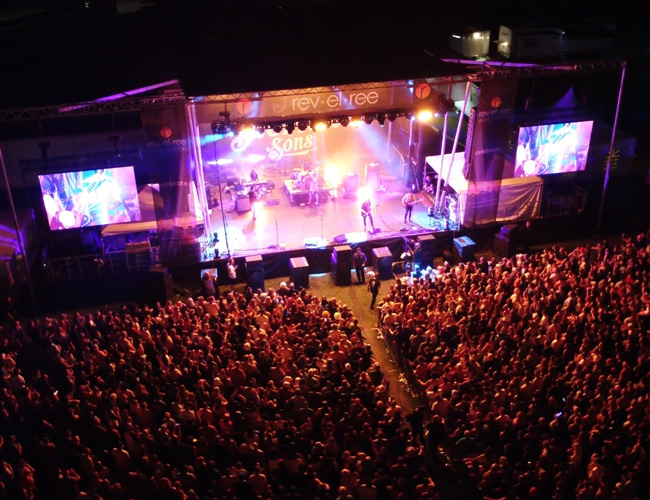
Revelree’s 2026 cancellation may have been the announcement that made people say it out loud, but the worry had already been building.
Where is BorderFest? What happened to Beats on the Street? Why do Sarnia’s larger summer music events, the ones that give people something to circle on the calendar, suddenly feel uncertain, quiet or gone?
Revelree is the confirmed news. Organizers announced this week that the 2026 festival will not take place, describing the decision as a pause and saying they are eyeing a return in 2027. Sarnia News Today reported festival director Scott Palko declined to get into specifics beyond the public statement that “unforeseen circumstances” had arisen very recently.
That lack of detail is understandable. Event organizers do not owe the public every private conversation, financial pressure or logistical problem behind a difficult decision. But the reaction shows the story is larger than one festival.
Revelree was not dormant. The Road to Revelree 2026 process was already underway, with showcases designed to give bands and artists a chance to win lineup spots at the 2026 festival. The series was promoted as a way for artists to earn a festival spot, build audiences and reach new listeners.
The machinery was already moving. Then it stopped.
For a city where people regularly complain there is not enough to do, that kind of pause lands hard. It is not just the loss of one weekend in Canatara Park. It is the sudden uncertainty around a growing event tied to local performers, summer tourism and civic identity.
But the answer is probably not as simple as saying Sarnia’s music scene is disappearing. The better explanation is that the city’s event scene is being squeezed in two different ways: smaller shows still happen, but are often hard to find; larger events are more visible, but harder to finance and risk.
At the smaller level, people involved in the scene point to venues like AJ’s, Maud’s and the Legion as places where live music still comes through. They also describe a familiar Sarnia problem: unless you are already following the right people on Facebook, hearing about shows through friends, or plugged into a venue’s orbit, it is easy to find out after an event has already happened.
That is a visibility problem.
At the festival level, the challenge is different. A large outdoor event is not just a bigger bar show. It involves artists, staging, fencing, lighting, sound, insurance, security, volunteers, sponsors, ticket sales, municipal co-ordination, marketing, weather planning and months of financial exposure before the first act plays.
That is a risk problem.
The public uncertainty around other events reinforces the feeling. Bluewater BorderFest has not, from available public information, issued an official 2026 cancellation announcement. Its website remains live, though some pages still reference past years. That distinction matters, rumour is not confirmation, and silence is not proof.
Still, residents were already asking about BorderFest and Revelree before Revelree’s cancellation was announced, with people debating whether the lack of announcements meant anything, with some commenters suggesting BorderFest would normally have said something by then, while others cautioned against reading too much into timing.
Beats on the Street appears to be in a similar public-information fog. Its own page describes it as a two-day downtown Sarnia event showcasing DJs, entertainers and live acts while raising money for charity. Local coverage shows it ran in 2025 in support of the Alzheimer Society Sarnia-Lambton, and a 2025 event page described it as the eighth annual Beats on the Street. But from available public information, its 2026 status is not clearly established.
That lack of clarity has consequences. When residents cannot easily tell what is happening, what is paused, what is cancelled, what is returning and what simply has not been announced yet, uncertainty becomes its own problem. A quiet website, an inactive social feed or a broad cancellation notice may each have reasonable explanations. Taken together, they leave the public reading Sarnia’s event calendar through fragments.
In that vacuum, rumour starts to feel like evidence.
Local events depend on confidence. People need to know whether to plan around them. Sponsors need to know whether they are attaching themselves to something stable. Artists need to know whether opportunities are real. Volunteers need time to commit. Visitors need dates. Local businesses need to prepare. Clear messaging cannot solve the cost of staging a festival, but unclear messaging can make a strained calendar feel even weaker.
There is also a wider industry context. Across Canada, the live-music sector has been under pressure from rising production costs, sponsorship uncertainty, higher operating expenses and changing audience behaviour. The Canadian Live Music Association reported that live music contributed $10.92 billion to Canada’s GDP in 2023 and supported more than 100,000 jobs, showing how economically significant the sector is.
That significance comes with costs. Festivals are tourism drivers, hospitality engines, local employment networks, artist-development platforms and marketing opportunities. The same machinery that makes them valuable also makes them expensive. Ontario’s recent decision to invest more than $20 million through Experience Ontario 2026 to support nearly 400 festivals and events suggests governments understand these events require infrastructure, money, labour, risk and planning.
Sarnia has learned that before. Bayfest, once one of the city’s signature music events, remains the historical shadow over this conversation. The circumstances are not identical, and Revelree should not be treated as Bayfest repeating itself. But the civic concern is familiar: Sarnia has already seen a major music festival become part of the city’s identity, only to discover that popularity does not guarantee permanence.
That is the warning in Revelree’s pause. Not that organizers failed. Not that residents failed. The warning is that the model may be thinner than people realize.
Big events need a lot to go right. Sponsors have to commit. Ticket buyers have to move early enough to give organizers confidence. Artists have to be available at prices that make sense for a mid-sized market. Insurance, security and infrastructure have to be affordable. Weather has to co-operate. Volunteers and organizers have to carry months of pressure for one weekend that can still be disrupted by forces outside their control.
Smaller shows face the opposite challenge. Their costs may be lower, but their visibility is weaker. They need venues, posters, calendars, social sharing, local coverage and enough audience habits to make going out feel normal. If people only hear about shows through scattered Facebook posts and word of mouth, the scene may be healthier than it looks, but it will still feel invisible to anyone outside the loop.
That is how a city can have music and still feel quiet.
Revelree’s statement leaves room for something more hopeful. While the main festival will not happen in 2026, organizers say they remain committed to future live-music events, Road to Revelree artists, an upcoming partnership with the Alzheimer Society of Sarnia-Lambton, and additional live-music events through the summer and fall.
That should not be overlooked. A paused festival does not mean a dead scene. But it should still be taken seriously.
A city’s cultural life rarely disappears all at once. It thins out. A festival pauses. A lineup never drops. A website stays on last year’s dates. A sponsor moves on. A volunteer burns out. A local artist loses a stage. A resident stops checking what is happening because they assume the answer is nothing.
Then, eventually, people ask why the city feels smaller than it used to.
The real story may not be that Sarnia’s music scene is gone. It may be that the systems around it, the money, the messaging, the promotion, the confidence and the capacity, are under strain.
Revelree’s pause made that visible. Now the question is whether Sarnia hears the warning before more of the music fades.


