
A historical feature tracing the shift from smoke-filled hallways to stricter rules at St. Joseph’s Hospital during a changing era in healthcare.
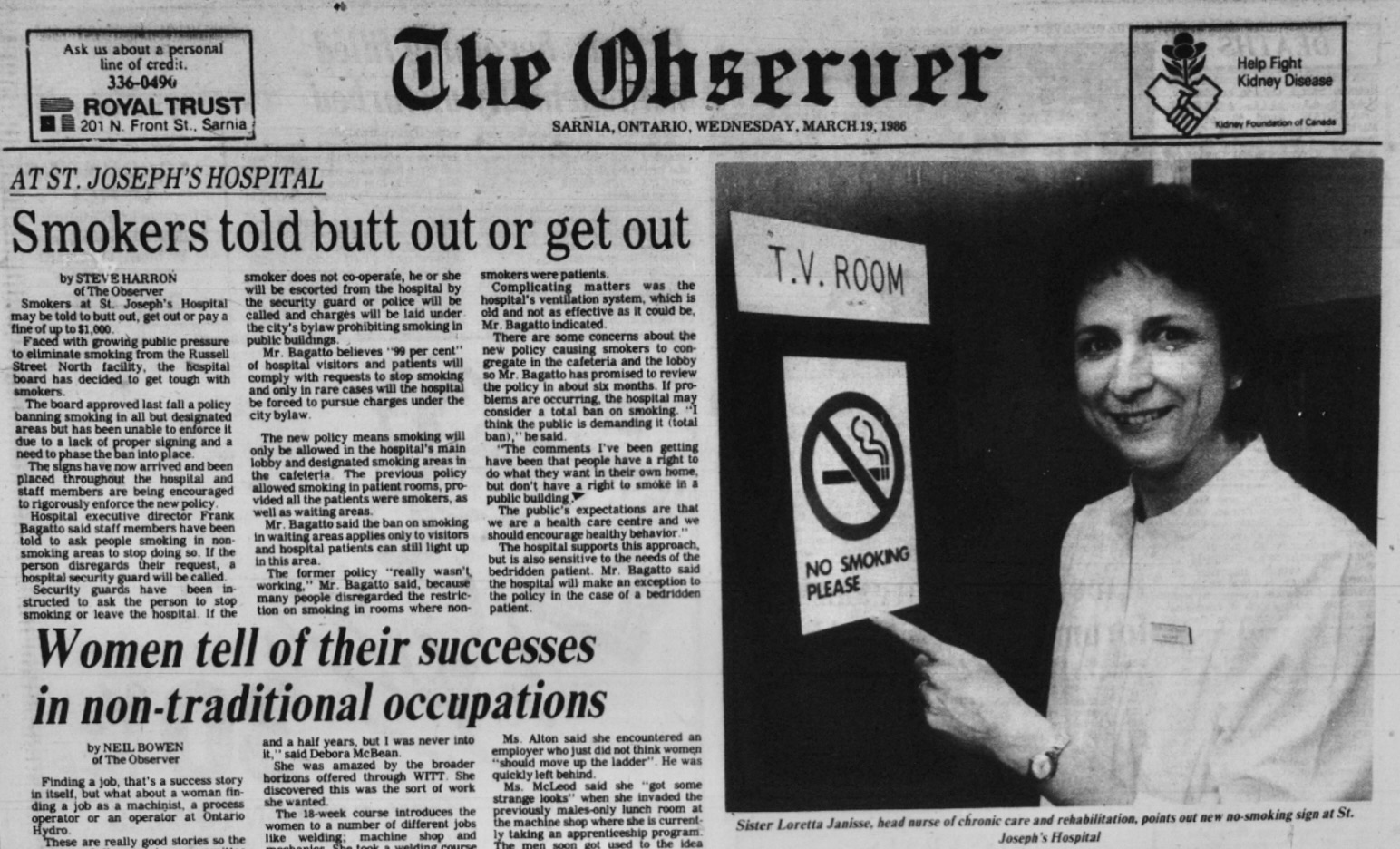
There was a time, not all that long ago, when the phrase “step outside for a smoke” was totally unnecessary in a hospital.
At St. Joseph’s Hospital in Sarnia, smoking wasn’t just happening, it was part of the daily backdrop. Patients smoked, visitors smoked, and if you were walking through the building, there was a decent chance you would pass an ashtray before you passed a hand sanitizer station.
Local news from the time captures a moment when hospital leadership decided enough was enough. Smokers were given a straightforward message: put it out, take it outside, or risk a fine of up to $1,000 under city bylaws. Not exactly the kind of discharge plan anyone was hoping for.
The policy itself had already been approved the year before, in 1985. Smoking was supposed to be limited to designated areas like the lobby and certain areas of the cafeteria only. In theory, it sounded reasonable. In practice, it relied heavily on people following the rules, which, as it turns out, is not always how things go.
Signs went up. People ignored them.
So the hospital took the next step. Staff were encouraged to step in and politely, or not so politely, ask people to stop smoking. If that didn’t work, security would be called. If that didn’t work, things could escalate further and the police would be called.
At the time, smoking hadn’t been completely banned. There were still designated areas, and yes, even the main lobby made the list. But the walls were closing in. Smoking in patient rooms was on its way out, and even admitted patients were expected to follow the rules.
Hospital leadership seemed optimistic that most people would comply without much fuss. The estimate was that nearly everyone would fall in line, with only a small number needing a reminder. St Joseph's executive director Frank Bagatto said that he believed "99 per cent" of hospital visitors and patients would comply with requests to stop smoking.
There were also practical concerns. Could the ventilation system at St. Joe's handle all this smoke in designated areas? Was it better to just ban it entirely? Even then, the idea of a full ban was floating around, though not quite ready to land.
And, in a detail that perfectly captures the era, exceptions could still be made for bedridden patients. Because if you couldn’t leave your hospital bed, the thinking went, perhaps the cigarette should come to you on the nurse's cart.
Zooming out, St. Joseph’s was hardly alone in this. For decades, hospitals and smoking went hand in hand in ways that feel almost unbelievable now. Cigarettes were handed out to patients like after-dinner mints. In some units, they were used as incentives. Healthcare workers smoked too, sometimes just down the hall from where patients were being treated for conditions we now directly link to tobacco use.
It took time, and a growing pile of medical evidence, to change that culture. By the 1980s, the shift was well underway. Policies tightened, designated smoking rooms started to disappear, and hospitals began to wrestle with a basic question: can you really promote health while allowing smoking indoors?
The answer, eventually, became no.
What followed was a steady march toward fully smoke-free hospitals. Provincial laws caught up, indoor smoking bans became standard, and hospital grounds themselves were gradually included. The ashtrays disappeared. The signs changed. The expectation became clear.
Today, the idea of lighting a cigarette inside a hospital sounds completely bizarre. But it wasn’t always that way. It took policy, pressure, and a fair bit of persistence to get there.
And just like that, the only thing left burning in hospitals was the budget.
Wednesday, March 19, 1986
by STEVE HARRON
Smokers at St. Joseph’s Hospital may be told to butt out, get out or pay a fine of up to $1,000.
Faced with growing public pressure to eliminate smoking from the Russell Street North facility, the hospital board has decided to get tough with smokers.
The board approved last fall a policy banning smoking in all but designated areas but has been unable to enforce it due to a lack of proper signage and a need to phase the ban into place.
The signs have now arrived and been placed throughout the hospital and staff members are being encouraged to rigorously enforce the new policy.
Hospital executive director Frank Bagatto said staff members have been told to ask people smoking in non-smoking areas to stop doing so. If the person disregards their request, a hospital security guard will be called.
Security guards have been instructed to ask the person to stop smoking or leave the hospital. If the smoker does not cooperate, he or she will be escorted from the hospital by the security guard or police will be called and charges will be laid under the city’s bylaw prohibiting smoking in public buildings.
Mr. Bagatto believes “99 per cent” of hospital visitors and patients will comply with requests to stop smoking and only in rare cases will the hospital be forced to pursue charges under the city bylaw.
The new policy means smoking will only be allowed in the hospital’s main lobby and designated smoking areas in the cafeteria. The previous policy allowed smoking in patient rooms, provided all the patients were smokers, as well as waiting areas.
Mr. Bagatto said the ban on smoking in waiting areas applies only to visitors and hospital patients can still light up in this area.
The former policy “really wasn’t working,” Mr. Bagatto said, because many people disregarded the restriction on smoking in rooms where non-smokers were patients.
Complicating matters was the hospital’s ventilation system, which is not as effective as it could be, Mr. Bagatto indicated.
There are some concerns about the new policy causing smokers to congregate in the cafeteria and the lobby so Mr. Bagatto has promised to review the policy in about six months. If problems are occurring, the hospital may consider a total ban on smoking. “I think the public is demanding it (total ban),” he said.
"The comments I’ve been getting have been that people have a right to do what they want in their own home, but don’t have a right to smoke in a public building.
The public’s expectations are that we are a health care centre and we should encourage healthy behavior.”
The hospital supports this approach, but is also sensitive to the needs of the bedridden patient. Mr. Bagatto said the hospital will make an exception to the policy in the case of a bedridden patient.


