
Sarnia’s police board says it stopped pushing a new headquarters after the mayor’s veto. But in the same meeting, the service says its needs are unchanged and repeats that a new build was its preferred long-term solution. This deep dive breaks down the transcript, the law, and SPS’s own materials, and shows a shift in messaging, not a clear shift in position.
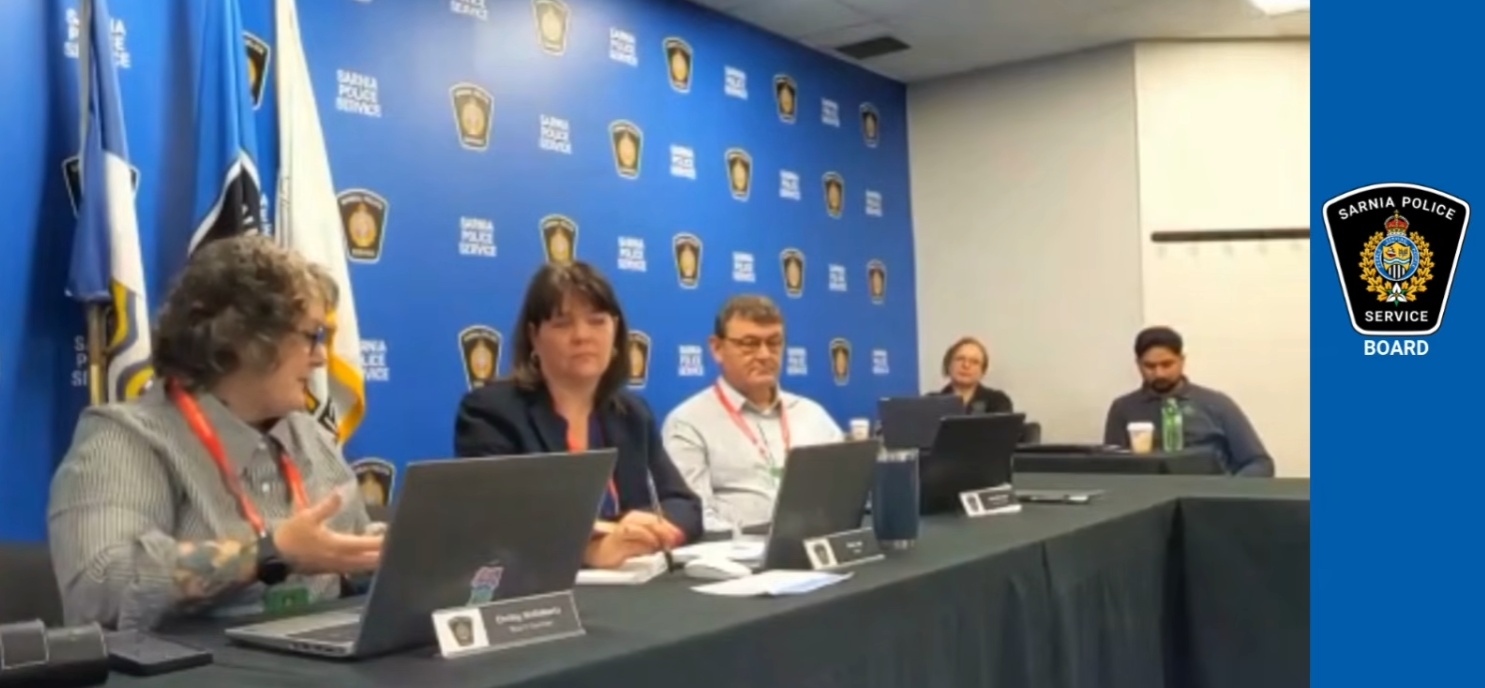
Every resident who cares about policing in Sarnia should watch the Sarnia Police Service Board meetings for themselves. The board’s own page lists its past meetings, including the March 26, 2026 meeting, and a March 27 board release links directly to the recording. Whatever position a person takes on the police budget, the OPP debate, or the proposed facility, there is no substitute for hearing what the board and service say in their own words.
That matters because, once you actually watch the meeting, a much clearer picture emerges than the one now being offered in summary form. On one hand, the board tries to reassure the public that it is no longer “pushing” a new building. On the other, the service and board continue to describe the facility problem in language that preserves the same underlying conclusion: the current building is inadequate, the service’s needs are unchanged, and the board’s long-term view still favours a new build. The most important point is not that the board passed some fresh post-veto motion. It is that the meeting does not show a real reversal. It shows a narrowing in presentation after political resistance.
The cleanest contradiction in the transcript is simple. Chief Derek Davis says, “nothing’s changed in regards to our build, our needs are unchanged,” adding that while capital was not provided in the budget, the repair issues were not magically erased. He then lists the “very real issues” that remain in the building and stresses that the commonly cited repair number speaks only to the building itself, “nothing to do with what we require as a police service for operations.”
Later in the same meeting, Chair Kelly Ash says “we haven’t mentioned a new building since the budget,” and insists the board is “no longer” pushing that area and is instead looking at alternatives. That line will likely be used as the board’s defence. But almost immediately after that narrowing claim, the chief restates the board’s actual conclusion: “the board’s decision in the end of the day was that a new build was the most efficient and effective long-term solution.” That is not a minor slip. It goes to the heart of the issue. A board cannot persuasively claim the building project is no longer its position while, in the same discussion, reaffirming both unchanged needs and its prior conclusion that a new build was the best long-term answer.
The fairest reading of the meeting is narrower than either side’s most convenient talking point. The transcript does not show the board passing a fresh formal endorsement of a new headquarters after the mayor’s veto. But it also does not show the board abandoning that conclusion. What it shows is a tactical shift: less open promotion of the same project, paired with continued insistence that the underlying need remains. That reading is reinforced by the board’s own March 27, 2026 release, issued after the meeting, which says funding for an SPS replacement facility was not provided in the mayor’s 2026 budget, but that “significant deficiencies” remain and that those “unavoidable requirements” must still be addressed through temporary and long-term solutions requiring “additional and necessary capital funding.”
That post-meeting release is worth lingering on, because it strips away the comforting fiction that the issue has somehow been put to bed. The release does not say the board has concluded repairs alone are enough. It does not say the service has retreated from its prior analysis. It says the deficiencies remain, the capital problem remains, and the board is still pursuing both temporary and long-term solutions. The rhetoric softens. The premise does not.
The same continuity appears on SPS’s live “Police Facility Project” page. As of now, the page still tells the public that the July 2025 architect presentation “outlines why a new facility is necessary.” It still says the March 2024 space needs assessment “outlines why a new facility is necessary,” and it still says the June 2023 building condition assessment found the headquarters needs $4.45 million in critical repairs “while a new facility is recommended.” In the FAQ section, SPS goes further, telling the public that a second report looked at police-specific needs, “explored various options,” and “recommended a new facility as the most viable decision.”
That matters because it undercuts the idea that the service and board have simply moved on. Even if no new motion has been passed, SPS is still publicly maintaining a page that argues a new facility is necessary and that the more police-specific report recommended one as the most viable option. If the public is being asked to believe the project is no longer being advanced, the public is entitled to notice that the official institutional messaging still says otherwise.
There is also a legal sleight of hand in the meeting that deserves more scrutiny than it has received. The chair frames the board’s facility concerns as tied to what must be done under the Community Safety and Policing Act. But the statute itself is general, not specific. Ontario’s official text says police service boards “shall ensure adequate and effective policing” is provided in the area for which they are responsible. The province’s Adequate and Effective Policing regulation likewise says a policing function must be provided “to an extent and in a manner that is reasonable,” having regard to listed factors. Neither of those provisions says Sarnia must build a new headquarters. Neither prescribes a particular building size, design, site, or capital project.
That distinction is not academic. It is central. The law sets a standard. It does not dictate a blueprint. The CSPA requires outcomes: adequate and effective policing. It does not, on its face, require one specific facility solution over all others. Even SPS’s own board page describes the board as the civilian body governing the service, responsible for adequate and effective policing and for setting objectives, priorities, budgets, and policy. That is governance authority. It is not a statutory command that one particular building proposal must be adopted.
So when the board presents its chosen facility path as though it is effectively required by the Act, that overstates what the legislation does. The stronger, more accurate formulation would be this: the board believes a new facility is the best way to meet its statutory obligations. That is a judgment call. It may be a defensible judgment call. But it is still a judgment call. The transcript itself points in that direction. The chief does not say the Act mandates a new building. He says the board concluded that a new build was “the most efficient and effective long-term solution.” “Most efficient and effective” is comparative language. It describes preference and assessment, not legal compulsion.
SPS’s own public documents reinforce that point. The facility page says reports “recommended” a new facility and describes it as the “most viable decision.” The November 19, 2025 letter from Chief Davis says the current project proposal “is needed to address the current and future needs of policing in our city exclusively.” But even there, the argument is built on need, reports, and planning judgments, not on any cited statutory clause saying a new building is mandatory.
This is where the board’s repeated “we studied alternatives” defence should also be understood properly. It may be true. SPS’s own FAQ says the second report “explored various options,” and the chief says in the meeting that different models, alternatives, and offsite options were examined before the board concluded a new build was best. But that is a process claim, not a substitute for proof.
In this debate, what remains notably absent from the board’s public argument is a clear, measurable threshold showing that only one solution would satisfy the law. No ministry order has been cited. No compliance notice has been identified. No specific performance benchmark has been publicly pointed to and said: this is the standard we are failing right now, and this is why only a new facility solves it. What the public gets instead is a broad assertion of need, supported by reports and internal conclusions, but still presented in language that can slide too easily from “our preferred solution” into “what the law requires.”
The meeting also reveals something else worth taking seriously: a governance dynamic that residents should notice. The chief speaks most directly about needs, operational conclusions, and the long-term logic of the project. Board members, by contrast, spend more energy managing the framing: insisting they are not pushing the building, emphasizing alternatives, and trying to reposition the public narrative after the veto. That division matters. It suggests the operational case is still being advanced by the service, while the board’s role, at least in this discussion, is increasingly one of position management.
That is not a trivial concern, because police boards are supposed to oversee policing, not manage media narratives. SPS’s own board page describes the board as the civilian governing body responsible for oversight, budget, priorities, and the chief. Yet the broader institutional pattern shows a service and board spending obvious energy responding to criticism and shaping public interpretation. Chief Davis’s November 19 letter complained about “a local news outlet” with an alleged agenda, and the March 6 SPS release complained about “a handful of individuals” spreading “purposeful disinformation” before directing the public to a curated list of video highlights from a prior board meeting. That does not prove bad faith on its own. But it does show an institution that is highly conscious of narrative and increasingly willing to use official channels to contest it.
That same institutional instinct helps explain why the service’s lighter social-media output keeps becoming part of the conversation. On March 20, SPS issued a media release and facebook post about a man arrested “within hours of his bail release,” emphasizing that a search found “ten tubs of fresh Ben and Jerry’s Ice Cream inside his bag,” then attached a quote from the chief about community safety and accountability. Residents can decide for themselves whether that kind of post reflects wise communication, but it is not hard to see why it attracts ridicule. In a city already debating police budgets, facilities, and governance, polished low-stakes content of that kind can read less like urgent public safety information and more like brand management. At minimum, it shows how little room there is for SPS to misread the public mood.
The larger lesson from this meeting is not that every criticism of the board is automatically right. It is that the public deserves more precision than it has been getting. If the board wants to say it has not passed a new post-veto motion for a facility, say that. If it wants to say it is exploring alternatives because the previous funding path was blocked, say that. But it should not be allowed to blur those points into the impression that its long-term position has materially changed when the transcript, the facility page, and the board’s own post-meeting release all say otherwise.
Nor should residents accept the claim that the law itself dictates a specific facility outcome when the Act and regulation cited by the province are written at a much higher level of generality. The law requires adequate and effective policing. It does not, on its own, settle the capital debate for Sarnia. That debate still belongs to the public, to council, and to the board’s own ability to justify its conclusions with evidence instead of letting recommendations harden into assumed necessity.
That is why people should watch these meetings. Not because everyone will come away agreeing, but because the most revealing things are often not said in the official summaries afterward. They are said in the hedges, the contradictions, the phrases that narrow one claim while quietly preserving another, and in the moments when a board trying to sound settled ends up showing that the real fight is far from over.


