
Sarnia’s Urban Forest Management Plan marks a shift in how the city understands trees, no longer as landscaping, but as infrastructure. With limited canopy, and constrained staffing, the city is increasingly relying on its urban forest to do work traditional systems struggle to handle. The question is whether that shift reflects a plan, or a constraint.
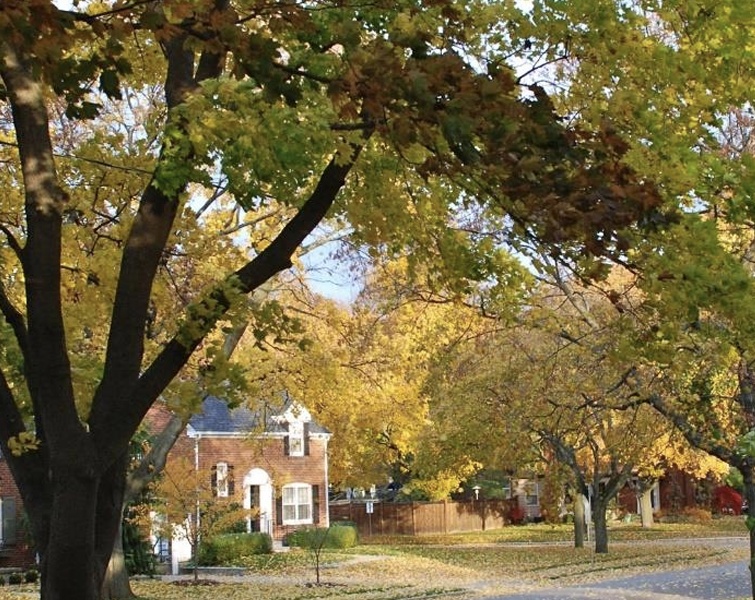
For most of Sarnia’s history, trees were not something the city depended on. They lined streets, filled parks, and made neighbourhoods feel complete. They were part of how a place looked, not how it functioned.
That is no longer how the city describes them.
Sarnia’s Urban Forest Management Plan, adopted in 2025, defines the urban forest as a system, one that includes not just trees, but soils, growing conditions, and their relationship to the city’s built infrastructure. It calls for that system to be managed, tracked, and integrated into the city’s broader asset management framework. That is a significant shift in language. It is how cities describe infrastructure.
And increasingly, that is what trees are becoming.
The reason is not aesthetic. It is practical. Sarnia’s tree canopy currently covers about 17 percent of the city, with roughly 22 percent coverage in the urban area. That canopy is now expected to do more than provide shade or improve appearance. It is expected to absorb stormwater before it reaches pipes, reduce heat in built environments, and ease pressure on systems that are aging and expensive to replace.
The urban forest is being asked to function alongside infrastructure, not as a replacement, but as a support system for it.
That shift reflects a broader reality. Sarnia’s infrastructure has an estimated replacement value of approximately $4.6 billion, along with a significant long-term funding gap for maintaining it. Much of that infrastructure was built during a period of expansion, when the long-term costs of maintaining it were not yet fully visible. Today, the challenge is no longer growth. It is upkeep.
And the cost of that upkeep is rising.
In that context, the role of trees begins to change. The Urban Forest Management Plan describes the urban forest as climate adaptation infrastructure, noting that it will play a role in managing higher temperatures, heavier rainfall, and more extreme weather. Trees reduce runoff before it enters storm systems. They lower temperatures in built areas. They reduce the load on infrastructure that was not designed for current conditions.
They are doing work.
Work that, in many cases, existing infrastructure struggles to handle on its own.
But recognizing that role is not the same as being able to support it. The plan itself makes that clear. Sarnia’s forestry program is described as largely reactive and constrained by staffing and resources. A small team is responsible for maintenance, emergency response, and a growing number of service demands. At the same time, approximately 87 percent of the urban forest exists on private land, outside direct municipal control.
That creates a structural tension. The city is beginning to depend on its urban forest as infrastructure, but it does not fully control it, and it does not yet have the capacity to manage it at the level infrastructure typically requires.
This is where the shift becomes more than policy. It becomes constraint.
Across Ontario, municipalities are increasingly turning to natural systems not only because they recognize their value, but because traditional infrastructure is expensive to replace and difficult to expand. Trees are part of that shift. Not because they are new, but because they are already there.
The challenge is that trees do not behave like other infrastructure. They cannot be installed on demand, scaled quickly, or replaced on short timelines. When they are lost, the effects are not immediate, but they are long-term. A pipe can be rebuilt in months. A tree canopy takes decades.
Sarnia’s plan acknowledges that reality. It calls for better data, stronger coordination across departments, and a more proactive approach to managing the urban forest over time. But those changes require something the plan itself identifies as limited: capacity, funding, and sustained long-term commitment.
Which brings the issue back to something simpler.
Sarnia is beginning to treat trees as infrastructure because they now perform infrastructure functions. They manage water, manage heat, and reduce strain on systems the city cannot easily replace. But they are still governed, funded, and protected as if they are optional.
That is the tension at the centre of the plan. The role of trees is expanding. The expectations placed on them are growing. But the systems required to support that role are still catching up.
Because once trees are understood as infrastructure, the implication is clear. They are no longer something the city adds.
They are something the city depends on, and like any infrastructure, the cost of neglect does not appear all at once. It accumulates quietly, until it shows up somewhere else.


