
Debates about a proposed new Sarnia Police Service headquarters often focus on city council and the mayor. But under Ontario law, the responsibility for determining policing needs, including whether a new facility is required, sits primarily with the Sarnia Police Service Board. That structure raises a central governance question, if the board is responsible for overseeing policing decisions, should it also be the institution most directly held accountable when those decisions are debated?
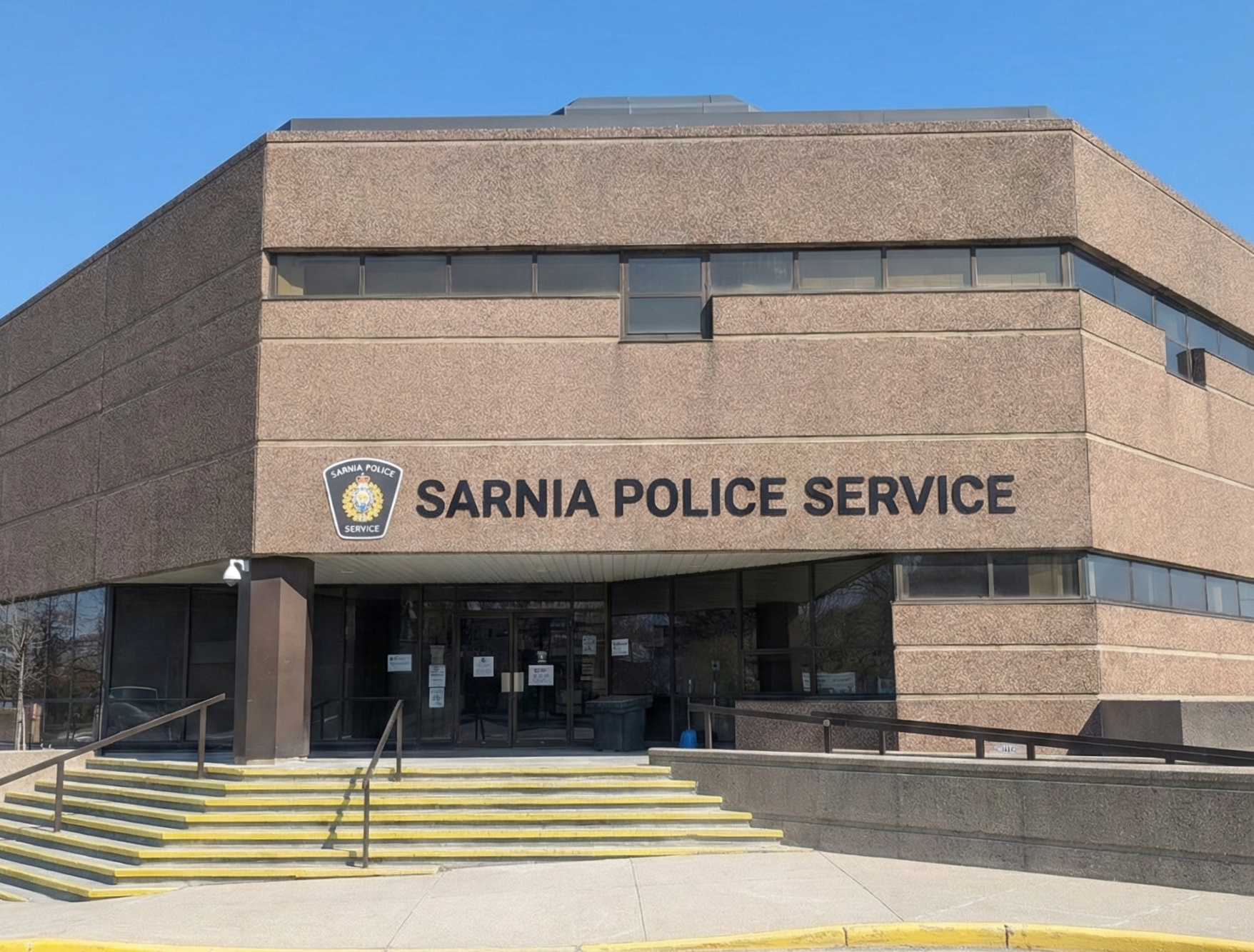
The argument over a new police headquarters in Sarnia has been framed as a fight at city hall, council votes, budget pressures, and the mayor’s veto.
But that is not where the question begins.
Before council ever decides whether to pay for a new building, another institution is supposed to decide whether that building is needed at all, the Sarnia Police Service Board.
Under Ontario’s Community Safety and Policing Act, municipal police services are governed by civilian boards responsible for ensuring “adequate and effective policing.” These boards oversee the police service, set priorities, hire and supervise police leadership, and approve policing budgets before they are forwarded to council.
In Sarnia, the board currently consists of Kelly Ash (Chair), Anne Marie Gillis (Vice-Chair), Joan Knight, Chrissy McRoberts, and Jerry Bernardo. Together, they oversee a police service with an annual operating budget in the tens of millions of dollars, along with long-term decisions about staffing, equipment, and facilities.
That includes determining whether the current headquarters is adequate, or whether a new one is required.
This distinction matters. City council ultimately decides whether to fund major projects, but under Ontario’s policing system, the police board is primarily responsible for evaluating what policing requires. That includes reviewing and assessing the case for major investments before they ever reach council.
The way that case is built helps explain the current debate.
Public materials related to the proposed police facility show that the issue is not based on a single finding, but on two different types of assessments. One looked at the physical condition of the current building and identified approximately $4.45 million in repairs required to maintain it. The other focused on operational needs, whether the building meets the space, layout, and functional requirements of modern policing.
Those are two different questions. One asks whether the building can be repaired. The other asks whether the building still works for how policing operates today. The first is largely an engineering question. The second is a policing question, and the information used to answer it largely comes from the police service itself.
That is not unusual. It reflects how policing governance is structured.
Police boards are responsible for overseeing police services, but much of the information they rely on, operational reports, statistical analysis, and planning documents, is produced within the police service and presented to the board for review. Provincial reporting requirements follow the same pattern. Reports on issues such as hate-bias incidents and missing-person investigations are compiled internally and submitted to the board as part of its oversight role.
Budget proposals move the same way. They are developed within the police service, reviewed and approved by the police board, and then forwarded to council for funding consideration.
This creates a structural challenge that researchers have examined for years. Police services hold detailed knowledge about their operations, staffing needs, investigative work, equipment, and facilities, while police boards are responsible for oversight but are not operational policing bodies.
The result is what governance researchers describe as information asymmetry: the organization being overseen holds most of the detailed knowledge, while the oversight body must evaluate proposals based on that information.
Academic studies of Canadian police governance have repeatedly identified this issue. Research has found that police boards can face difficulty independently evaluating complex proposals when the technical information required to assess them originates within the police service.
Other research has noted that police boards often operate with limited staff and research capacity, which can make independent analysis of major operational or capital decisions more difficult.
This is not just a theoretical concern. It has appeared in real-world cases.
Following the 2010 G20 summit in Toronto, an independent review found that the Toronto Police Services Board had not received key operational planning documents before the policing operation took place. Without those documents, the board could not fully evaluate the strategy in advance.
The point is not that Sarnia faces the same situation. It is that the same governance model, civilian oversight relying on information provided by the police service, exists in both cases. And when that model is tested, the ability of boards to independently scrutinize decisions becomes critical.
That brings the focus back to Sarnia.
The debate over a new police headquarters is not only about cost. It is about process, how the need for that building is evaluated, and who is responsible for testing that case before it reaches taxpayers.
Under Ontario’s system, that responsibility sits with the Sarnia Police Service Board.
If the case for a new headquarters is strong, the board is expected to test it and stand behind it. If the case is weak, the board is expected to question it. And if the board ultimately supports the project, it is the board, not just council, that is responsible for explaining why.
Because in Sarnia, the decision about whether a new police headquarters is needed does not start at city hall.
It starts with the people responsible for overseeing the police service itself.


