Oct5
Scottish Country Dancing
Mon, Oct 5 · 7:00 pm
St Andrew’s Presbyterian Church 261 Christina St N Sarnia, ON

Sarnia’s airport is no longer simply a debate about restoring flights. With scheduled passenger service gone since 2020, the city is now weighing a more complicated question: what role should the airport play in Sarnia’s future, and what level of public investment does that role justify? Recent public records show a facility that still supports emergency, corporate, charter, and border-entry functions, even as council continues searching for a financially workable long-term model.
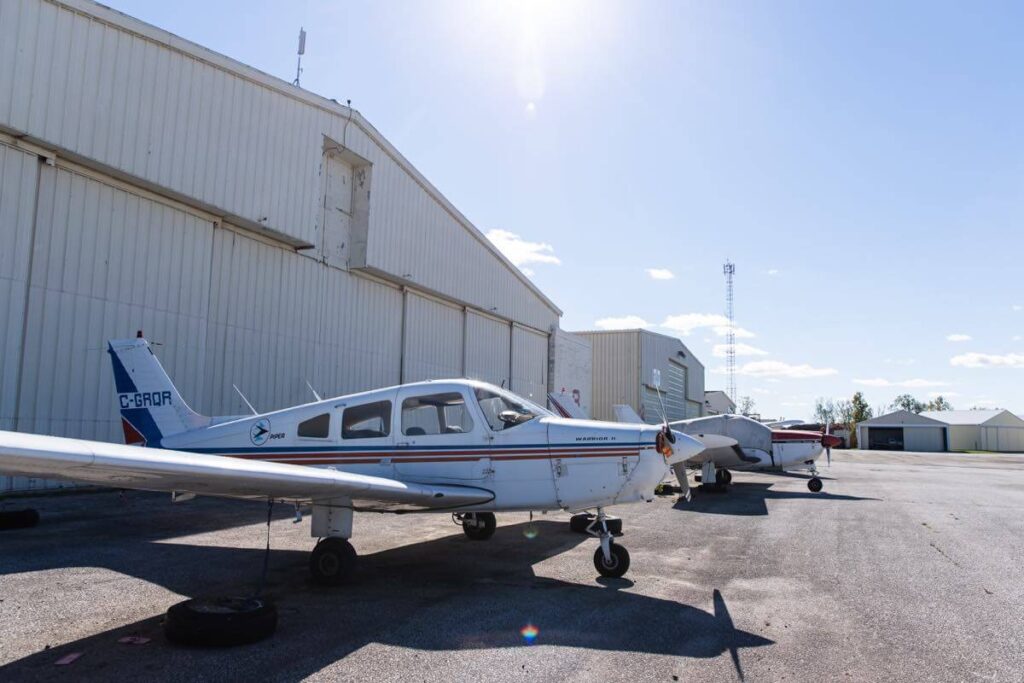
For many years, the Sarnia Chris Hadfield Airport sat in the background of civic life.
It was there. Aircraft came and went. Emergency services relied on it. Businesses used it. The runway remained part of the city’s physical and economic landscape whether most residents thought about it or not.
That changed after 2020.
The city’s own public consultation materials say scheduled service was lost in 2020, and that the airport has required municipal operating funding since 2021. Blackburn reporting identifies the break more specifically: Air Canada ended scheduled flights to Sarnia in July 2020.
That loss did not shut the airport down. It changed what kind of airport Sarnia had.
Today, the facility still has two runways, including a 5,106-foot primary runway, maintains instrument approaches on Runways 15 and 33, and continues operating as a certified airport under city ownership with Scottsdale Aviation managing day-to-day operations on the city’s behalf. The airport’s own operations page also says the site currently supports six private businesses and four private hangar tenants, along with two fixed-base operators, one serving airline-style ground handling and one serving general aviation.
It also remains an international gateway in a limited but meaningful sense. The airport is designated by the Canada Border Services Agency as an Airport of Entry/30, meaning it can clear scheduled or unscheduled aircraft, travellers, and cargo, with up to 30 passengers processed at the airport.
Those details matter because they show the airport is not simply an empty runway waiting for commercial flights to return. It remains an active piece of transportation infrastructure.
That activity includes specialized and emergency-related functions that rarely dominate the public debate. Transport Canada said in 2022 that local and regional airports like Sarnia’s support air ambulance, search and rescue, and other essential services, and that residents depend on them not only for business and personal travel but also for access to routine and emergency medical care in larger centres. In the same announcement, Ottawa awarded $370,000 through the Airports Capital Assistance Program for a runway and taxiway sweeper to support winter operations.
The airport’s own recent operations profile also suggests a level of complexity that is easy to underestimate. The site still supports baggage handling and passenger processing through its terminal-side operator, and the airport master plan notes that outbound checked baggage was screened through a dedicated CATSA position adjacent to the check-in area when scheduled service was active.
In other words, the airport did not revert to a simple rural airstrip when airline service disappeared. It remained a regulated, serviced aviation facility with infrastructure built for more than occasional private use.
The city has been trying to decide what that means ever since.
The consultation record alone shows how much attention the question has received. On the city’s airport public-input page, staff describe extensive consultation since the loss of scheduled service in 2020. That record includes a 2020 airport survey and open house with 27 written submissions, 231 survey responses, and 41 attendees; an Airport Action Working Group formed in 2021 with representation from business, labour, agriculture, tourism, industry, Scottsdale Aviation, and citizen appointees; and the 2022 airport master plan process, which included 837 resident responses, 25 business responses, 58 attendees at an open house, and 50 stakeholder interviews. The city’s later Economic Development Master Plan consultation added another 713 survey respondents, 79 focus-group participants, and 21 one-to-one interviews touching on the airport’s role in the city’s future.
That is not the record of an asset the city has ignored. It is the record of a city trying, over several years, to decide what kind of airport it still wants to have.
By February 2025, the issue came to a head. The same consultation page records that council unanimously approved a motion on February 10, 2025 directing staff to advance a framework toward long-term investment in the airport. But the page also makes clear that the vote did not settle the financial or operational questions. It says the decision to invest was only a first step, and that staff would report back on governance, funding, administration, and operations before future allocations were decided.
That language gets to the heart of the issue. The airport debate in Sarnia is no longer only about whether flights return. It is about governance, operating models, and the long-term cost of keeping a strategic asset viable.
Recent proposals show how fluid that conversation remains.
In March 2026, council considered a one-year pilot project that would connect Sarnia passengers to Toronto Pearson through a Landline Air Canada bus link, allowing bags to be tagged at Sarnia’s airport and booked as part of one itinerary. According to Blackburn reporting, the pilot would cost $375,000, with the city pursuing an agreement for Tourism Sarnia-Lambton to cover half, leaving a potential city share of $187,500. Council approved advancing the agreement on a 7-2 vote.
That proposal is revealing because it treats the airport less as a standalone regional airline terminal and more as a transportation node inside a broader network.
It also shows how the city’s thinking has shifted.
The airport is no longer being discussed only in terms of restoring the old model. Instead, council and staff are testing a series of alternatives: subsidy-backed operations, municipal-corporation governance, hybrid transportation links, and long-term development options. The airport consultation page explicitly says council’s investment-versus-divestment decision must be considered holistically, including operating, maintenance, and capital contributions, staff resources, and council oversight.
The city’s own documents therefore suggest a more precise way to understand the airport question.
This is not simply a debate about whether Sarnia should have an airport. Sarnia already has one.
The real debate is about what kind of public asset the airport now is.
Is it primarily a strategic transportation facility for emergency access, business aviation, charters, and border clearance? Is it an economic-development asset the city believes still has long-term value? Is it a transportation hub that now needs a different model than traditional regional passenger service?
The answer appears to be some combination of all three.
What the public record does not show is a simple, self-sustaining solution.
Instead, it shows a city working through a more difficult reality: the airport still performs real functions, still supports active tenants and operators, still provides capabilities that would be difficult to rebuild from scratch, and still occupies a place in the city’s future-facing economic plans. At the same time, its long-term role is no longer self-explanatory in the way it may have once seemed.
It is a question about how a smaller city decides which assets remain worth carrying forward, and on what terms.
Mon, Oct 5 · 7:00 pm
St Andrew’s Presbyterian Church 261 Christina St N Sarnia, ON
Tue, Oct 6 · 5:30 pm
The Bridge Patisserie Café 12 Michigan Ave Point Edward Point Edward, ON
Tue, Oct 6 · 6:00 pm
Black Gold Brewery 395 Fletcher St Petrolia, ON
A division of Sarnia Media Group Inc.
Locally Owned and Operated
© 2026 The Sarnia Journal