Oct5
Scottish Country Dancing
Mon, Oct 5 · 7:00 pm
St Andrew’s Presbyterian Church 261 Christina St N Sarnia, ON

Sarnia’s proposed $91-million police headquarters has sparked a rare clash between the mayor, city council, and the police board. But the deeper question may be whether the city is adopting a policing model shaped in a much larger region, one built for Halton’s scale and resources rather than Sarnia’s fiscal reality.
The Sarnia Police headquarters on Christina Street has served the city for decades. Now the building sits at the centre of one of the most consequential infrastructure debates Sarnia has faced in years.
City officials are weighing a proposal for a new police headquarters estimated at roughly $91 million, a project that has already triggered a rare political confrontation between the mayor’s office, city council, and the Sarnia Police Services Board. The dispute has raised questions about affordability, governance, and the long-term direction of policing in the city.
But the debate is about more than a building. It is about the broader model of policing now being advanced, and whether that model fits Sarnia’s scale and fiscal reality.
To understand why the issue has become so contentious, it helps to start in Halton.
Halton Regional Police Service operates in one of Ontario’s fastest-growing regions west of Toronto. The service covers more than 600,000 residents across rapidly expanding suburban municipalities. Strong population growth and a broad tax base have allowed the region to invest heavily in modern policing technology and infrastructure.
Halton has become known for its technology-forward policing model. The service has received national recognition for innovation in data systems and records management tools used across Canadian police agencies. It has also pursued major facility projects designed to support long-term population growth.
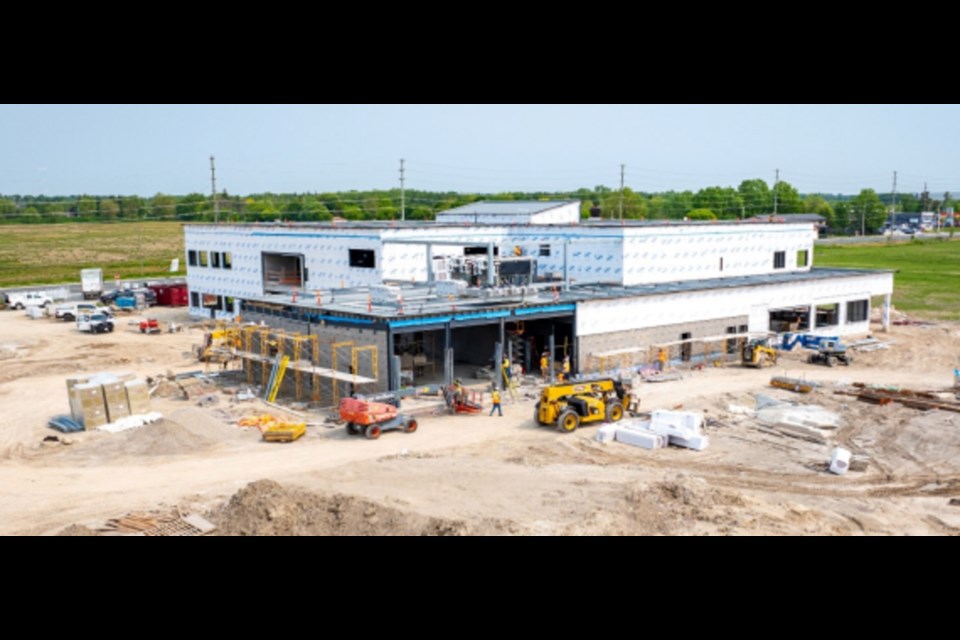
Halton’s approach to policing infrastructure offers a useful example of the environment where that model developed. In 2024 the region began construction on a new 66,000-square-foot 1 District police station in the Hornby area, a facility intended to serve the rapidly growing communities of Milton and Halton Hills. Regional officials said the project was necessary because population growth had outpaced the capacity of the existing Milton station. Construction began in May 2024 and the facility is expected to open in 2026.
In a region experiencing rapid suburban growth, projects like this are often framed as necessary to keep pace with expanding populations and rising service demands. Halton Regional Police serves more than 600,000 residents, and long-term planning assumes continued growth across the region.
Sarnia operates at a very different scale.
The city has a population of roughly 75,000 residents, meaning the financial impact of large capital projects is distributed across a far smaller tax base. A policing facility designed to meet the needs of a large regional service can therefore have very different fiscal implications when applied in a smaller municipality.
This difference in scale does not mean modernization is unnecessary. Police facilities eventually require upgrades or replacement in any city. But it does raise a question about proportionality. Infrastructure investments that represent routine expansion in a rapidly growing region can become far more consequential financial commitments in a smaller city with different economic conditions.
When leadership moves between police services, the institutional assumptions that shaped those systems often move with them.
Chief Derek Davis arrived in Sarnia in 2022 after a long career with Halton Regional Police Service. Since his appointment, several senior leadership positions within the Sarnia Police Service have also been filled by individuals who previously worked in Halton.
Leadership mobility of this kind is common in policing. Chiefs frequently recruit trusted colleagues they have worked with before, and professional networks across Ontario police services are tight. But when multiple senior leaders share the same institutional background, the operational frameworks developed in that environment can follow them.
Those frameworks often include expectations about technology, infrastructure, and what modern policing requires.
The pattern appears in several areas of Sarnia’s policing strategy.
First, there is the leadership structure itself. The presence of multiple senior figures with experience in the same regional police service reflects how professional networks shape the composition of modern police leadership teams.
Second, the pattern appears in technology and communications infrastructure. The Sarnia Police Service website was developed by JAK Media at a cost of approximately $25,000, according to documents obtained through Freedom of Information. The amount fell below the procurement threshold requiring a formal Request for Proposal under board policy.
JAK Media also developed the website for Halton Regional Police Service, Chief Davis’s former department, and publicly lists only Halton and Sarnia police services among its clients.
The contract itself is modest in financial terms. But it illustrates how systems and service providers that worked successfully in one jurisdiction often appear again when leadership moves elsewhere.
In public administration, this process is known as institutional diffusion, the spread of organizational practices, technologies, and operational models through professional networks.
Third, the pattern appears at the largest scale: infrastructure planning.
The proposed Sarnia headquarters is framed as a modern policing facility designed to integrate technology, improve operational efficiency, and support future growth. The language surrounding the project, modernization, readiness, and long-term operational capacity, closely mirrors the modernization frameworks adopted by larger regional police services like Halton.
None of these examples alone would prove a broader shift in policing philosophy. Taken together, however, they illustrate how institutional models often travel when leadership does.
None of this should be surprising. Police leaders frequently move between services, and modernization projects are common across the province. Larger police services often adopt new technologies first, and smaller agencies frequently follow. The issue facing Sarnia is not whether modernization should occur at all. It is whether a policing framework developed in a much larger and rapidly growing region, with very different financial capacity, translates appropriately to a city of Sarnia’s size.
Supporters of the project argue that modernization is unavoidable. Police leadership has maintained that the current headquarters no longer meets the needs of a modern police service and that delaying construction will only increase costs in the future.
At the same time, earlier engineering reports commissioned by the board indicated the existing building remains structurally sound and could continue operating with roughly $4.4 million in essential repairs.
Those competing assessments have contributed to the growing political conflict around the project.
The dispute escalated when Mayor Mike Bradley used strong-mayor powers to veto funding associated with the proposal, arguing that the long-term borrowing required would place too heavy a burden on local taxpayers. City council has been divided on the issue, while the Sarnia Police Services Board has maintained that it must determine the resources required to operate the service effectively under provincial policing legislation.
When disagreements over infrastructure reach the level of mayoral vetoes and public disputes between elected officials and police governance bodies, the issue has clearly moved beyond routine capital planning.
It becomes a debate about institutional direction.
Large regional police services like Halton often become early adopters of new technologies and infrastructure models because their scale and tax base allow them to absorb the cost and risk. When leadership from those services moves to smaller municipalities, those same models can follow through institutional familiarity and professional networks.
The question now facing Sarnia is whether a policing framework developed in a rapidly growing suburban region translates appropriately to a smaller city with very different fiscal realities.
Infrastructure decisions last far longer than the political debates that produce them.
The choices cities make about buildings, technology, and institutional models today shape budgets and priorities for decades to come. Sarnia is now deciding not just whether to build a new police headquarters, but whether the policing model that evolved in Halton is the one that should define the city’s future.
Mon, Oct 5 · 7:00 pm
St Andrew’s Presbyterian Church 261 Christina St N Sarnia, ON
Tue, Oct 6 · 5:30 pm
The Bridge Patisserie Café 12 Michigan Ave Point Edward Point Edward, ON
Tue, Oct 6 · 6:00 pm
Black Gold Brewery 395 Fletcher St Petrolia, ON
A division of Sarnia Media Group Inc.
Locally Owned and Operated
© 2026 The Sarnia Journal