
A front page article published nearly three decades ago is offering an unexpected mirror to Sarnia’s present.
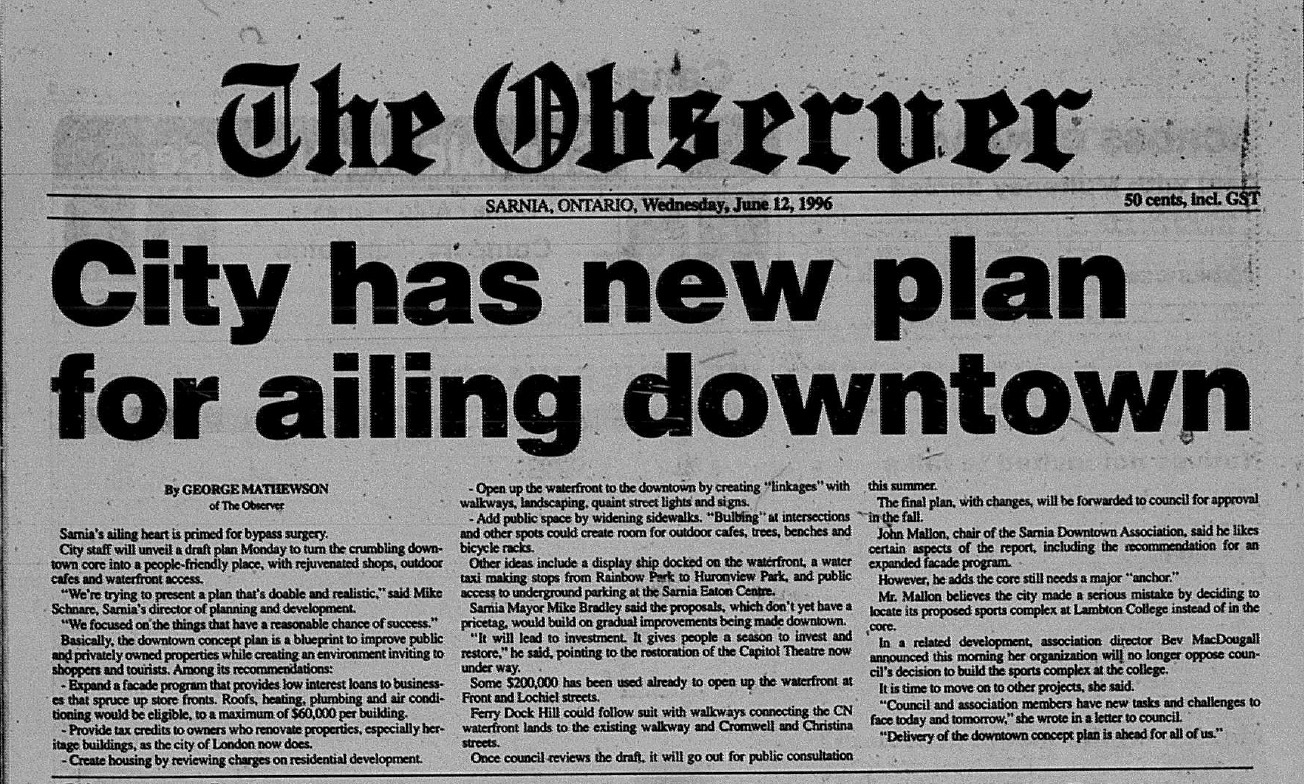
On June 12, 1996, The Observer ran a headline that read: “City has new plan for ailing downtown.” The article described a struggling core in need of revitalization, with municipal leaders preparing to introduce a strategy aimed at reversing decline and attracting people back to the city centre.
The language used at the time is strikingly similar to conversations still happening today.
Downtown was described as “crumbling.” Officials spoke about transforming it into a more people-friendly destination with renewed storefronts, outdoor cafes and improved waterfront access. The proposed solutions included façade improvement loans for businesses, tax incentives for property redevelopment, wider sidewalks, trees and benches, patio space, bike racks and stronger pedestrian connections.
Perhaps most notable was the emphasis on linking the waterfront to the downtown core, a priority that continues to dominate municipal planning discussions in 2026.
The 1996 plan also identified the need for a major downtown “anchor” to draw visitors and activity into the area, with concerns raised even then about locating major facilities outside the core rather than within it.
Nearly 30 years later, many of the same priorities remain unresolved.
The City of Sarnia continues to pursue waterfront integration through projects such as the Downtown Waterfront Master Plan and redevelopment work at Ferry Dock Hill, both intended to strengthen physical and visual connections between the shoreline and downtown.
Financial incentives for property improvements remain in place through Community Improvement Plans, which offer grants and loans for redevelopment and façade upgrades in downtown and Mitton Village. Federal and provincial programs, including the My Main Street initiative, have also provided funding to help businesses open or expand in the core.
Parking access, streetscape improvements and beautification efforts are still regular topics of municipal debate. Downtown groups continue to advocate for investment to attract visitors and support existing businesses. Questions about the need for stronger anchor attractions remain part of the conversation.
Taken together, the comparison raises an uncomfortable but important question: how much progress has truly been made?
Sarnia is not alone in facing these challenges. Many mid-sized Canadian cities have struggled with downtown decline as retail patterns shifted to suburban power centres, malls and online shopping. Industrial economic transitions and changing lifestyle patterns have also altered how residents use city cores.
But the 1996 article highlights something more specific — the persistence of the same problems despite decades of planning, reports, initiatives, and good will.
Successive councils have recognized the importance of downtown. Strategies have been created, funding programs introduced and projects launched. Yet the continued need for revitalization suggests that structural challenges have proven difficult to overcome, and that incremental approaches may not have produced the transformative change once envisioned.
For residents reading that 1996 headline today, the sense of déjà vu is hard to ignore.
Three decades later, the vocabulary has barely changed. Waterfront linkages. Façade incentives. Anchor attractions. Streetscape improvements. Public consultation.
The same goals. The same language. The same hopes. The same promises.
Planning alone does not revive a downtown. Results do.
Thirty years of near-identical conversations demand a harder question than whether downtown needs help. That much has been clear since 1996.
The real question is this: what can we do differently now?
SARNIA, ONTARIO, June 12, 1996
By GEORGE MATHEWSON
of The Observer
Sarnia’s ailing heart is primed for bypass surgery.
City staff will unveil a draft plan Monday to turn the crumbling downtown core into a people-friendly place, with rejuvenated shops, outdoor cafes and waterfront access.
“We’re trying to present a plan that’s doable and realistic,” said Mike Schnarr, Sarnia’s director of planning and development. “We focused on the things that have a reasonable chance of success.”
Basically, the downtown concept plan is a blueprint to improve public and privately owned properties while creating an environment inviting to shoppers and tourists. Among its recommendations:
• Expand a facade program that provides low interest loans to businesses that spruce up store fronts. Roofs, heating, plumbing and air conditioning would be eligible, to a maximum of $60,000 per building.
• Provide tax credits to owners who renovate properties, especially heritage buildings, as the city of London now does.
• Create housing by reviewing charges on residential development.
• Open up the waterfront to the downtown by creating “linkages” with walkways, landscaping, quaint street lights and signs.
• Add public space by widening sidewalks. “Bulbing” at intersections and other spots could create room for outdoor cafes, trees, benches and bicycle racks.
Other ideas include a display ship docked on the waterfront, a water taxi making stops from Rainbow Park to Huronview Park, and public access to underground parking at the Sarnia Eaton Centre.
Sarnia Mayor Mike Bradley said the proposals, which don’t yet have a price tag, would build on gradual improvements being made downtown.
“It will lead to investment. It gives people a reason to invest and restore,” he said, pointing to the restoration of the Capitol Theatre now under way.
Some $200,000 has been used already to open up the waterfront at Front and Lochiel streets.
Ferry Dock Hill could follow suit with walkways connecting the CN waterfront lands to the existing walkway and Cromwell and Christina streets.
Once council reviews the draft, it will go out for public consultation this summer.
The final plan, with changes, will be forwarded to council for approval in the fall.
John Mallon, chair of the Sarnia Downtown Association, said he likes certain aspects of the report, including the recommendation for an expanded facade program.
However, he adds the core still needs a major “anchor.”
Mr. Mallon believes the city made a serious mistake by deciding to locate its proposed sports complex at Lambton College instead of in the core.
In a related development, association director Bev MacDougall announced this morning her organization will no longer oppose council’s decision to build the sports complex at the college. It is time to move on to other projects, she said.
“Council and association members have new tasks and challenges to face today and tomorrow,” she wrote in a letter to council. “Delivery of the downtown concept plan is ahead for all of us.”


