Oct5
Scottish Country Dancing
Mon, Oct 5 · 7:00 pm
St Andrew’s Presbyterian Church 261 Christina St N Sarnia, ON

In Nathan’s latest column, he confronts a legal threat from the Sarnia Police Service following a retraction, arguing that the department is using public funds for high-priced lawyers while fast-tracking a $230 million headquarters. He contrasts the Chief’s $260,000 salary against the financial struggles of local taxpayers and independent media.
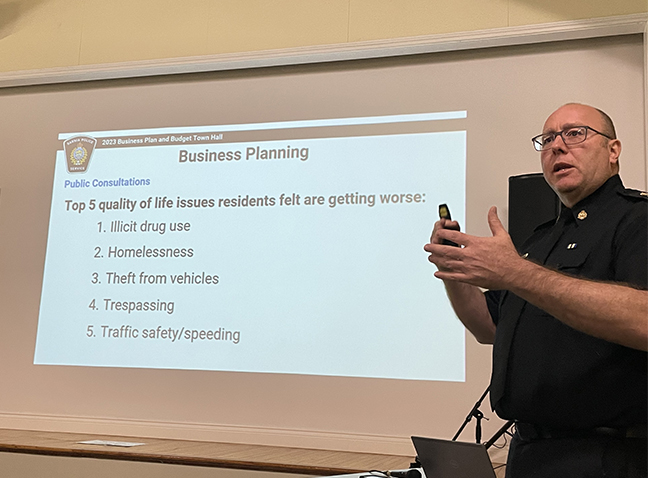

On February 21, the Sarnia Police Service (SPS) published an official statement on their Facebook page stating they were removing a media release "due to a publication ban that we learned of after posting." I took the Service’s official word at face value and reported on their public statement indicating uncertainty regarding the applicability of a publication ban.
The response was a formal legal notice from a Toronto law firm.
It appears the Service was not in breach of the law; their original public statement was later clarified as incorrect. To satisfy the Libel and Slander Act, we have retracted the original headline. While the Service’s social media channels shared this retraction as a victory, it serves as a documented example of inconsistent institutional communication.
We must look past the "serious harm" the Chief claims I have caused his reputation and look at the material incentives at play. Chief Derek Davis earns approximately $260,000 per year—more than triple the entire annual operating budget of the Sarnia Journal. One public salary could fund three independent, local work-owned organizations. Yet, backed by a $36.7 million operating budget, the Service still hired a Toronto partner to respond to local media coverage through external legal counsel.
This is not a personality conflict; it is an audit of empire-building. Since Chief Davis took office in 2022, the police operating budget has increased by an average of approximately $3 million per year. This is a massive, ongoing transfer of community wealth into an expanding police apparatus.
The physical manifestation of this expansion is a proposed new headquarters. While Sarnia homeowners struggle with inflation and a 30-year debt trap, the Board is fast-tracking a facility that has been estimated in planning and architectural documents at figures exceeding $120 million. When standard municipal financing over 30 years is applied, total costs could approach $230 million.
On February 27, the Board signalled their response to community calls for a "police reset" by extending Chief Davis’s contract until 2032. This move insulates the current leadership from accountability for nearly another decade, even as that leadership uses public funds to respond to and contain reputational risk arising from local media coverage.
The Service has its contract extension, its Toronto partners, and its $230 million capital expansion plan. But we have the receipts. I have published the full letter from Hudson Sinclair LLP alongside this column. The Chief has his "win" on social media today. But the people of Sarnia still have the 30-year debt.
This struggle for transparency is not isolated to our city limits. From local police budget expansion to state practices of population containment and resource extraction internationally, the underlying logic remains the same: the institution must be fortified, and the people must be managed. This is the hallmark of a scarcity mindset—a belief held by those in power that institutions must grow larger, stronger, and more controlling to survive.
It is a logic of containment that we see reflected in the populism of the broader political landscape, where legal battles and "tough on crime" posturing are used to mask the abandonment of the worker, the poor, and the marginalized. But this carceral logic is beginning to crack. Whether it is a $230 million vanity police fortress or the systems of occupation being challenged globally, the demand for a way of living that values flourishing over fortification is becoming impossible to ignore.
The public record is clear, and the conversation isn't over.
Editor's note: The amount per year was updated to reflect the annual amount of increases, not the sum of three years which is previously noted.
Mon, Oct 5 · 7:00 pm
St Andrew’s Presbyterian Church 261 Christina St N Sarnia, ON
Tue, Oct 6 · 5:30 pm
The Bridge Patisserie Café 12 Michigan Ave Point Edward Point Edward, ON
Tue, Oct 6 · 6:00 pm
Black Gold Brewery 395 Fletcher St Petrolia, ON
A division of Sarnia Media Group Inc.
Locally Owned and Operated
© 2026 The Sarnia Journal