


Oct14
The $91-million police HQ Is dead. Now fix the one we own.
The $91-million police HQ is dead. Now Sarnia must fund the repairs needed to keep its existing station usable, and demand answers about how known problems were handled. From the million-dollar stairs to an $11.6-million repair and upgrade forecast over ten years, our latest opinion argues for breaking the cycle of deferred maintenance and preventable crises.
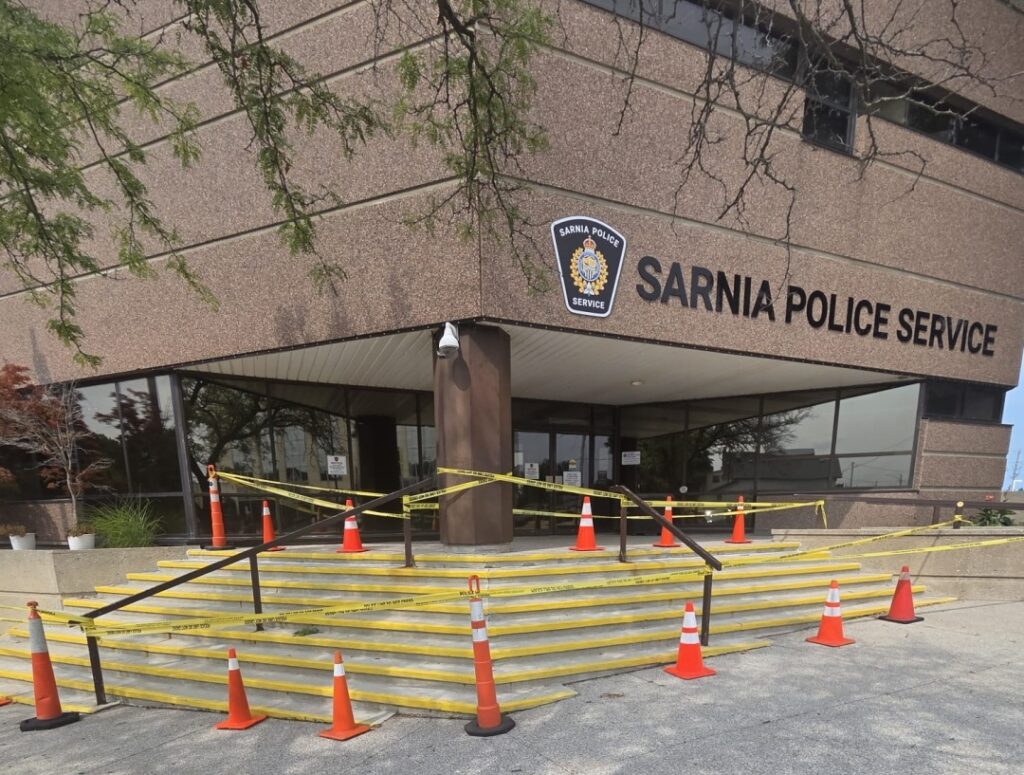
Sarnia fought the proposed $91-million police headquarters and stopped it. The police service’s own September budget report now says construction of a new headquarters is no longer under consideration. That leaves the city with a responsibility to make the building at 555 Christina Street North work.
That responsibility comes with a substantial bill. The service is seeking roughly $3.5 million for immediate capital work in 2027. Its forecast for facility repairs and upgrades totals about $11.6 million from 2027 through 2036, including the first year’s building work. These are planning estimates, but the needs behind them deserve serious attention.
Residents who opposed the new headquarters should support necessary repairs to the existing one. Keeping a public building carries an obligation to look after it. Refusing both replacement and the investment needed to keep the current station usable would make a failure of the decision we fought for.
In my view, Sarnia has a terrible habit of letting maintenance slide, allowing predictable problems to become urgent, and then looking longingly at a shiny replacement. By then, the repair bill itself becomes part of the argument against the building. We need to break that habit, starting with the police headquarters.
The proposed $1-million entrance and stair replacement illustrates both why repairs deserve funding and why the public deserves answers.
The front stairs also form the roof and ceiling over part of the basement gym. According to the police report, water has penetrated that structure, causing leakage and mould underneath. Previous repairs have deteriorated, the surface coating is separating, and the entrance has accessibility deficiencies. The report says the Ministry of Labour has ordered the stairs closed.
Replacing that entrance involves a structure over occupied space, waterproofing and safe public access. The $1-million allowance still needs to be tested through detailed engineering and competitive pricing. But describing the job as merely replacing some steps leaves out what makes it substantial.
More troubling is how long the warning has been on paper. Dillon Consulting’s June 2023 assessment recorded moisture penetration and deterioration in the concrete ceiling beneath the entrance. It recommended identifying and resolving the water source, along with further review for potential structural deterioration.
Three years later, the service is reporting that the stairs have been closed and seeking money for replacement. The police board and service leadership owe residents a clear account of what happened between those two reports: what was investigated, what repairs were completed, what was deferred and how the stairs reached their current condition.
The records do not establish how much earlier intervention would have saved. They do establish that the warning existed. A condition assessment should produce assigned responsibility, scheduled work and a funding decision. Commissioning a report is only the beginning of looking after a building.
Maintaining the headquarters should never have depended on the outcome of the replacement debate. Whatever future was being considered, employees and the public still had to use the existing station. A proposal for another building was never a maintenance plan for this one.
The same concern appears elsewhere in the current report. A $40,000 refrigerant monitoring system has been repeatedly recommended by the service’s heating and cooling contractor. Deficiencies in the emergency assistance system for officers handling prisoners have been raised several times by the workplace health and safety committee. Recommendations like these need a documented response and a timetable.
It would be inaccurate to say nothing has been budgeted for the headquarters. The city’s 2026 budget included $400,000 for facility repairs and upgrades. The test, however, is whether funding and completed work keep pace with known needs. A repair allocation does not, by itself, answer what happened to a particular warning.
Nor should every item in the new forecast be described as the price of neglect. Some components wear out even with proper maintenance. Some work adapts the building to current operations.
The $1.5-million sally port project, for example, would expand and rehabilitate the secure vehicle entrance used to bring prisoners into the station. The report says the prisoner transport vehicle does not fit, forcing loading and unloading into an unsecured outdoor area. It also describes flooding and a deteriorating floor.
The proposed $250,000 fuel tank replacement would address the risk posed by an aging underground tank before a failure creates a contamination problem. That is precisely the kind of preventive investment a responsible owner should make.
So are timely replacements of air-handling equipment, windows and other building systems scheduled for attention in later years. Preventing the next crisis requires acting on the warnings already in front of us and setting money aside for the work we know is coming.
The headquarters was built in 1987. Forty years is an age, not an expiry date. Peterborough’s headquarters opened in 1968, and the city is retaining it through a renovation plan that also adds capacity at a second property. Older buildings can remain useful when communities invest in adapting them.
That example does not erase Sarnia’s particular constraints. Dillon examined alternatives and recommended a new headquarters. The current repair program will not resolve every issue involving cells, training, parking and other space requirements. The $11.6-million forecast is a program of facility work, not a guarantee that every policing accommodation problem is solved.
But the $91-million proposal is dead, and the obligation to maintain the current station is immediate. Its limitations make careful planning more important. They do not excuse letting known defects worsen.
Council should fund the necessary work. The board should turn this forecast into a funded maintenance plan, with clear priorities, scheduled work, annual reserve contributions and public reporting on what gets completed. Each project should have a clear scope and a defensible price, and major repairs should come with an explanation of the useful service they are expected to deliver.
Funding the immediate package must be followed by a credible plan for the years beyond it. Residents deserve lasting value from these investments and a commitment to maintaining the building their money is being spent on.
We should be angry that known building problems remain unresolved. Withholding the money to fix them would only deepen the failure. Sarnia has rejected the expensive new headquarters. Now it needs to make a success of keeping the one it owns.
A foreseeable repair should be a budget decision, not the beginning of the next crisis.
More to read
Events
Oct14
Sarnia Artists’ Workshop Awards/ Peg Kivi Solo Exhibition
Wed, Oct 14 · 11:00 am
The Lawrence House Centre for the Arts 127 Christina St. South Sarnia, ON
Oct14
Corunna Legion Br 447, Corunna – CATCH THE ACE
Wed, Oct 14 · 12:00 pm
Corunna Legion Br 447 350 Albert/Beckwith Streets Corunna, ON
Oct14
Oct14