



Oct23
Michele Bowering honoured for goat dairy leadership during international year of the woman farmer
Michele Bowering, co-owner of Great Lakes Goat Dairy in Wyoming, received recognition for her goat milk production and advocacy during the International Year of the Woman Farmer. The award highlights women’s essential contributions to Lambton County’s local agri-food sector.
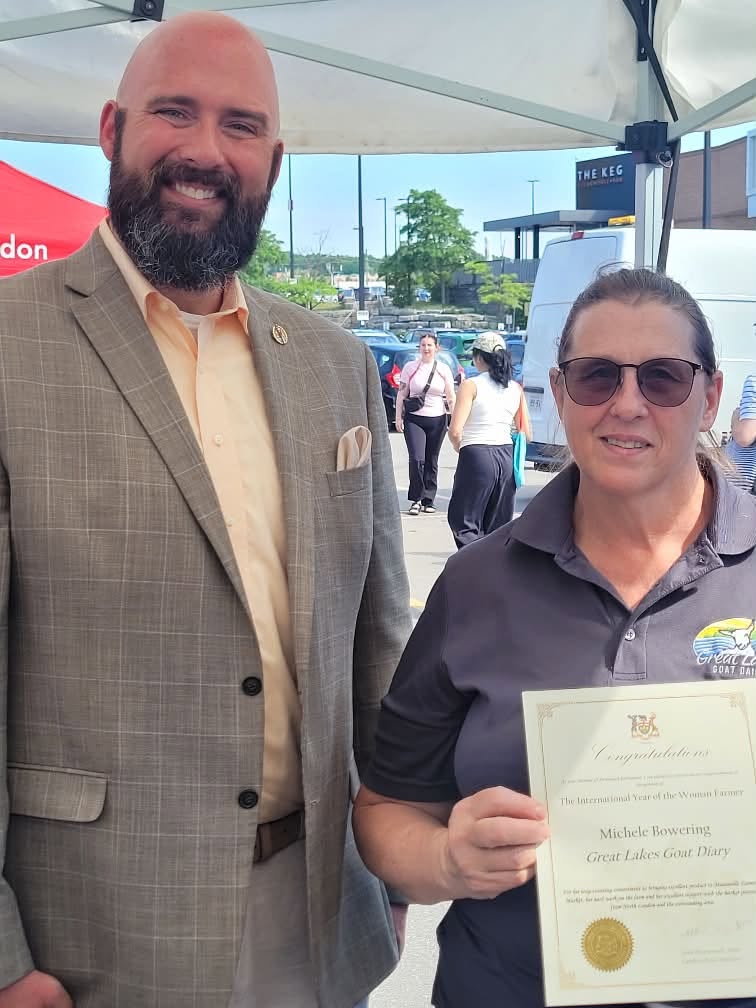
Michele Bowering of Great Lakes Goat Dairy in Wyoming earned a Certificate of Recognition for her goat dairy work and industry advocacy. It comes during the International Year of the Woman Farmer, spotlighting women’s key contributions to the region’s agri-food sector.
In the rolling farm country of Lambton County, Great Lakes Goat Dairy stands as a working example of local value kept close to home. At its storefront on Camlachie Road in Wyoming, customers buy fresh goat cheese and curds made from milk produced on family farms across Southwestern Ontario. One of the people who helped build that independent processing business, Michele Bowering, received formal recognition this month for her leadership in goat milk production and processing.
The Certificate of Recognition was presented July 3 at the Masonville Market in London by Terence Kernaghan, MPP for London North Centre and Shadow Minister for Small Business. The honour forms part of events marking 2026 as the International Year of the Woman Farmer, proclaimed by the Food and Agriculture Organization of the United Nations. The year draws attention to the fact that women comprise roughly 41 per cent of the global agricultural workforce and perform essential work in food production, sustainability and rural economies that has too often gone unacknowledged.
Bowering, together with her husband Dave, operates a goat dairy just north of London in Middlesex Centre. Milk from their herd travels to the Wyoming facility, where it is turned into artisan cheeses and fresh curds under the Great Lakes Goat Dairy label. The products are sold through farmers’ markets across the region, including those serving Sarnia-Lambton communities. Bowering also serves as president of Ontario Goat, the provincial association that represents dairy, meat and fibre goat producers on issues ranging from trade and tariffs to market access.
Her work sits inside larger shifts in Ontario agriculture. In June, the province approved creation of the Dairy Goat Farmers of Ontario milk board, giving goat producers new capacity for research, training and collective marketing through a levy system. The process has sparked debate over transparency and inclusion, particularly for Amish and Mennonite producers who represent a significant share of the sector and cited religious objections to participating in the vote. Leaders like Bowering have pressed for governance structures that reflect the actual makeup of the industry rather than defaulting to models designed for larger, conventional operations.
Women have long carried heavy loads in Canadian farming while facing structural barriers: succession practices that historically directed land and capital toward sons, tighter access to credit and technical services, and the added weight of balancing farm labour with household responsibilities. The outdated image of the woman farmer as a “hobby” operator tending horses, flowers or roadside stands still lingers in some quarters, even as women step into ownership, processing and advocacy roles. The UN designation and local honours push back against that framing by naming the contributions plainly.
Great Lakes Goat Dairy itself grew from a desire by founding partners to control their own processing instead of shipping raw milk elsewhere. The Wyoming plant and retail outlet now anchor a family-linked network that includes the Bowering farm. In Lambton County, where small and mid-sized operations still define much of the rural landscape, businesses like this one circulate economic activity locally rather than letting it drain toward distant corporate handlers.
Residents can taste the results directly. The Wyoming storefront welcomes visitors, and Great Lakes products appear at area farmers’ markets. Nearby, other small-scale producers continue to strengthen community ties through sustainable methods.
More to read
Events
Oct23
Oct23
Sarnia Artists’ Workshop Awards/ Peg Kivi Solo Exhibition
Fri, Oct 23 · 11:00 am
The Lawrence House Centre for the Arts 127 Christina St. South Sarnia, ON
Oct23
Oct23
More Murder, More Mayhem Historic Trolley Tour
Fri, Oct 23 · 5:30 pm
Port Huron Museums Carnegie Museum

