Oct5
Scottish Country Dancing
Mon, Oct 5 · 7:00 pm
St Andrew’s Presbyterian Church 261 Christina St N Sarnia, ON

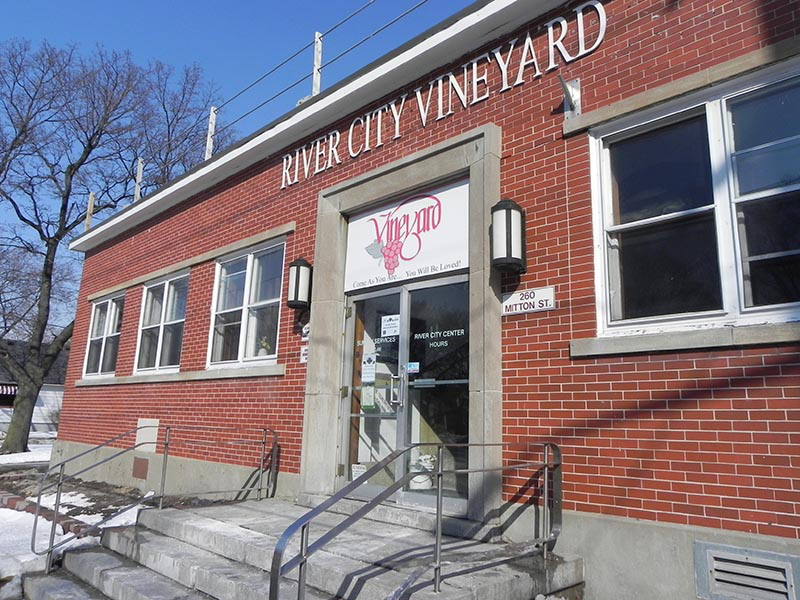
While politicians celebrated the “transformational” launch of the HART Hub this week, I sat down with men at River City Vineyard who argue the new facility is less about healing addiction and more about managing the poor.
On Monday, local politicians and health officials gathered in the cafeteria of the former SCITS high school to celebrate a "transformational moment" for Sarnia-Lambton. There were speeches, a ribbon cutting, and a palpable sense of relief that the new HART Hub—a facility backed by a share of the province's $550 million investment—was finally opening its doors.
But a few days earlier, I was sitting in a very different room, just a few blocks away.
There were no ribbons. There was no funding announcement. There was just a circle of men at River City Vineyard introducing themselves by the last thing they had to eat—Ramen noodles, Fritos, and black coffee—before telling me why the system celebrating itself down the street had left them for dead.
"It’s a machine, man—money and drugs." said Bill (a pseudonym), who has been sober for over two years thanks to the shelter’s high-accountability community.
To the Province of Ontario, the HART Hub is the solution to the visibility of homelessness. It promises to move people out of parks and into "treatment." But to the men I spoke with—men who have actually navigated the withdrawal, the waitlists, and the bureaucracy—it looks less like a helping hand and more like a holding cell.
The province’s own announcement makes the agenda clear: HART Hubs "will not offer safer supply, supervised drug consumption or needle exchange programs".
This isn't a medical decision; it’s an ideological purge. As a recent report by the Canadian Drug Policy Coalition warns, mandating abstinence in residential treatment puts users at a "greatly elevated risk of overdose" if they return to the street. Yet, the state is stripping away the survival tools that keep poor people alive today in exchange for a state-approved definition of "recovery" tomorrow.
We don't strip functional alcoholics in Bright’s Grove of their safety nets. We don't force executives with cocaine habits to surrender their autonomy. We do this to the poor.
As Ian, a resident at the Vineyard, put it bluntly: "Rich people do more drugs than we do. They can actually afford it. They’re just not complaining about it right now."
He’s right. The HART Hub isn't just a medical facility; it is a mechanism to manage the people who have been discarded by our economy.
The disconnect between the official narrative and the street reality is starkest when you look at the numbers.
The HART Hub offers 30 "transitional recovery beds" where people can stay for up to 18 months. Ideally, this gives them time to stabilize. But what happens on month 19?
I asked Melissa Fitzpatrick, the County’s General Manager of Social Services, that exact question. She confirmed that while the Hub has 30 transitional beds, the associated program has only 26 permanent supportive housing units available.
You don’t need to be a statistician to see the bottleneck. We are spending millions to create a funnel that narrows at the bottom. As Ian told me: "It’s just gonna put a Band-Aid on it. Move it to the next one".
The men at the Vineyard see this clearly. They fear the new Hub is just a way to "surveil" them, to put up fences and hide the problem where the public can’t see it, without actually solving the housing crisis that waits for them on the other side.
While officials at the launch touted the "collaborative effort" and "compassionate care" of the new Hub, the stories from the ground paint a picture of a medical system that is often cold, transactional, and designed to create dependency.
Ian spent 13 years on a Suboxone program. He described a system that was happy to dispense medication indefinitely but offered zero pressure or pathway to actually get off it. "They got their money and out the door," he said. "It made me feel sad, really. It was like, I'm stuck like this".
Contrast that with the Vineyard. It doesn’t have $6.3 million a year. It doesn’t have a team of bureaucrats managing stats. What it has is mutual aid—a community that functions like a family.
We don’t operate like a collective in our capitalist society; there is power and money at the top, and everyone else is left down here to fend for themselves. But at the Vineyard, you aren't a number; you are a participant in your own survival.
As Terry, a resident who found sobriety there, told me: "This place showed me what family is… I know that I'll end up using again [if I leave]. Not that I would ever fall back into it [daily]… but I know what would happen".
At the Vineyard, they stopped running. They built their own life raft.
In the official announcement, Associate Minister Vijay Thanigasalam claims this new system is about "keeping the community safe".
But the men at the Vineyard hear that dog whistle loud and clear. "Safety," in this context, doesn’t mean keeping them alive; it means keeping them invisible. They fear the new Hub is just a way to displace them from public view.
Listening to the men at the Vineyard, I was struck by a different definition of success. It wasn't about "beds" or "outcomes." It was about the dignity of being treated like a human being, not a problem to be managed.
"I took and took and took from my community," Kalan, a former user turned staff, told me. "Now I’m able to finally give back… That makes me feel so good inside. I don’t even care about the paycheck".
That is the one thing the $6 million HART Hub cannot buy: the feeling of being needed, not just treated.
As Sarnia applauds this new "transformational" facility, we need to ask ourselves if we are actually building a path out of addiction, or if we are just creating a more expensive, more invisible holding pen for the victims of our economy.
The men at the Vineyard already know their answer. It’s time we started listening to them.
Editor’s note: A previous version of the article had Kalan as a volunteer but he is staff.
Mon, Oct 5 · 7:00 pm
St Andrew’s Presbyterian Church 261 Christina St N Sarnia, ON
Tue, Oct 6 · 5:30 pm
The Bridge Patisserie Café 12 Michigan Ave Point Edward Point Edward, ON
Tue, Oct 6 · 6:00 pm
Black Gold Brewery 395 Fletcher St Petrolia, ON
A division of Sarnia Media Group Inc.
Locally Owned and Operated
© 2026 The Sarnia Journal