Oct5
Scottish Country Dancing
Mon, Oct 5 · 7:00 pm
St Andrew’s Presbyterian Church 261 Christina St N Sarnia, ON

In a recent Sarnia Police Services Board meeting , Chief Derek Davis performed a high-stakes defence of a budget that has ballooned by approximately 45% over four years.
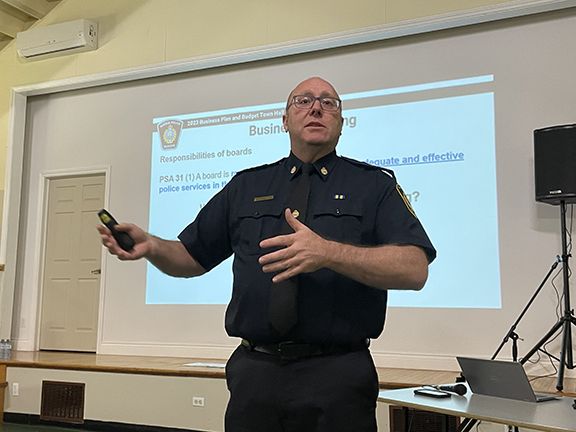
In a recent Sarnia Police Services Board meeting, Chief Derek Davis performed a high-stakes defence of a budget that has ballooned by approximately 45% over four years. Davis claimed in this presentation that he "generally tries to stay out of the politics because it's not our place to wade into that," yet he delivered a masterclass in political manipulation by hijacking the narrative to suit his own ends.
He had the audacity to frame decades of institutional failure and "underfunding" as a backdrop for his own supposed heroics; heroics that conveniently carry a 45% budget increase. This wasn't a report; it was a shakedown, redefining years of neglect as a reason to demand even more taxpayer money for his personal vision of a police empire.
By flooding the room with selective statistics, he attempted to frame the conversation around his own administrative deliverables rather than the actual safety of the community. He assured the board that he is simply the one executing the orders of his bosses, yet he spent twenty minutes spinning a tale that makes him look like the only man capable of saving a sinking ship.
It is the classic "I’m not a politician" trope—the exact phrase used by those currently deep in the political trenches.
The Chief spoke with pride about increased enforcement, noting that arrests are up 37%, criminal code charges are up 66%, and traffic enforcement has skyrocketed by 200%. However, if the conviction rate has not matched that 66% charge increase, the Chief is not delivering justice; he is simply increasing the workload on his own officers by forcing them to produce meaningless paperwork.
Furthermore, a 200% increase in traffic tickets does not prove a safer Sarnia; it merely suggests an enforcement strategy that forces local officers to antagonize the very neighbours they live next to, all to fulfill the Chief’s "administrative deliverables".
To the administration, these numbers are results, but to a citizen, they look like an aggressive focus on low-level revenue while deeper issues like the overdose crisis remain unaddressed. Davis repeatedly leaned on a rescue narrative, claiming he arrived to find "decades of frankly neglect and underfunding". Yet, the Chief has been at the helm for nearly four years. In that time, he has actively ignored the reality of a building that has served the community for 40 years. Instead of focusing on the foundational infrastructure he inherited, the administration has pivoted toward an "operational crisis" narrative to leverage a new, massive facility.
Perhaps most troubling was the Chief’s use of his own staff to deflect accountability. In response to Council exploring alternative police delivery models like the OPP, he framed a legal, democratic inquiry as a "strong message" of disrespect to the men and women of the organization. This is a classic political manoeuvre. Real stewardship does not hide behind the emotions of the front line to protect a budget; it answers the hard questions about where the money is actually going.
The Chief's performance makes it clear: he is driving a personal vision, not a community one. If he truly cared about Sarnia over his own narrative, he would engage with critics rather than disregarding facts and calling opposition "misinformation." The Chief simply ignores the hard questions (or briefly acknowledges them and dismisses them with generalized comments) and then spins presentations around his manufactured narrative—even going so far as to spend $10,000 on marketing to try and convince the community of his vision.
If he really wasn't a politician, he would be upfront with the information that actually defines the safety of our community. How about some answers to questions that would give us a better idea of how Sarnia is doing because of the role SPS plays?
The taxpayer expects value, not just a bigger bill for a personal narrative. If the Chief was as transparent as he claims, he wouldn’t need twenty minutes to spin a story—he would just answer the questions.
Mon, Oct 5 · 7:00 pm
St Andrew’s Presbyterian Church 261 Christina St N Sarnia, ON
Tue, Oct 6 · 5:30 pm
The Bridge Patisserie Café 12 Michigan Ave Point Edward Point Edward, ON
Tue, Oct 6 · 6:00 pm
Black Gold Brewery 395 Fletcher St Petrolia, ON
A division of Sarnia Media Group Inc.
Locally Owned and Operated
© 2026 The Sarnia Journal