Oct5
Scottish Country Dancing
Mon, Oct 5 · 7:00 pm
St Andrew’s Presbyterian Church 261 Christina St N Sarnia, ON

In this week’s column, Nathan examines how the Sarnia police strategically transformed a minor traffic incident involving a stolen tractor-trailer into a public shaming campaign, effectively punishing two men before they’ve even faced a judge.
Last month I broke down how the Sarnia Police Service (SPS) turned a bizarre story about a man in a hot tub into a carefully crafted lesson in fear. This week, we’re back at it, because the SPS has once again provided a perfect example of how they use their media releases not just to inform, but to control a narrative and punish people long before they’ve had their day in court.
I am trying to help us learn to see past the headlines and how copaganda works, especially in a small community like Sarnia. It’s about understanding that police press releases aren’t objective news—they are public relations documents designed to justify budgets, expand power, and reinforce a very specific worldview. Let’s break down their latest effort.
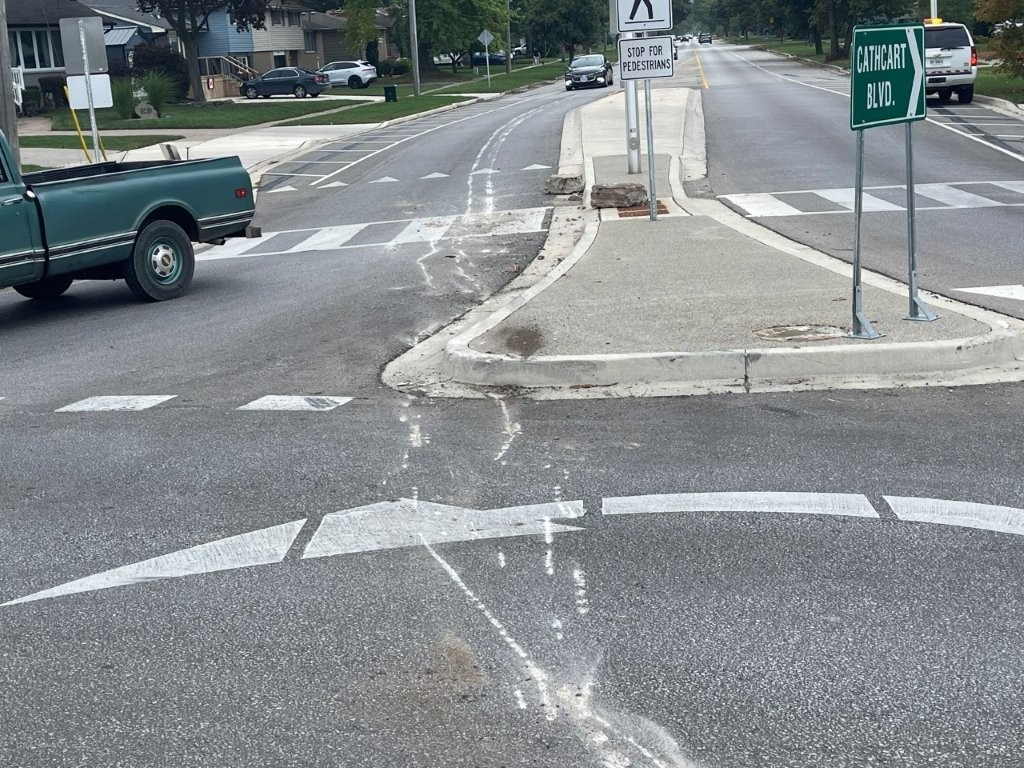
On September 25, the SPS reported that a tractor-trailer had a minor collision with the roundabout at Cathcart and Indian.¹ The story they want you to hear is simple and heroic: a diligent officer, attending a routine traffic mishap, uncovered a more sinister plot. "Upon investigation," the officer discovered the trailer was stolen from Peel Region.
With that single phrase, a mundane traffic foul-up is transformed into a win for law and order. The incident led to the arrest of Ali MUHAMMAD, 27, and Khurran MOHAMMAD, 49, who were charged with "Possession of Property Obtained By Crime."
But the real story here isn’t about a stolen trailer. It’s about the power to name and shame.
Just as we saw with the man labeled "no fixed address" in the hot tub incident, the SPS once again publicly released the full names, ages, and hometowns of two men who have been charged but not convicted.
Let’s be clear about what this means. In a courtroom, you are presumed innocent until proven guilty. In an SPS media release, you are guilty the moment they hit "publish." That accusation, amplified by the police crest and official language, creates a permanent digital stain. It can cost people their jobs, their housing, and their standing in the community, regardless of whether the charges are later dropped or they are found not guilty.
This isn’t about public safety; it is a raw exercise of power. It’s a tool to publicly brand people as "criminals"—a verdict that belongs to the courts, not the police communications department. The use of all-caps for their names is a deliberate stylistic choice to make them stand out, to mark them as subjects of the carceral state.
The structure of the release follows a predictable formula designed to make police seem essential at all times.
Justify the Presence: Why was an armed officer needed for a traffic incident that City Works personnel were already cleaning up? The release answers this by having the officer "discover" the stolen trailer. This frames police not as responders to emergencies, but as detectives who find crime lurking under the surface of everyday life. It argues for their necessity everywhere.
Prioritize Property Over People: The most serious charge laid is for possession of stolen property. The story isn't about the potential danger to drivers or the damage to public infrastructure; it's about reclaiming a piece of capital for a business in another region. It reinforces the core function of modern policing: protecting property.
Erase All Context: Who are these men? What are the circumstances behind the stolen trailer? Was it part of a sophisticated theft ring or an act of desperation? The release offers no details because context complicates the simple hero-villain narrative. By reducing these individuals to their names and charges, the police present a world where crime is a simple matter of bad people doing bad things, and the only solution is to arrest them.
This media release is not news. It is a strategic message. It tells us that we should be afraid, that danger is hidden in plain sight, and that only the police can protect us from it. It normalizes the public shaming of our neighbours and reinforces the idea that more policing, not more community support, is the answer to our problems.
So the next time you see a headline from the Sarnia Police, ask yourself: What story are they trying to tell? Who is the hero, and who is the villain? And most importantly, what are they leaving out?
Mon, Oct 5 · 7:00 pm
St Andrew’s Presbyterian Church 261 Christina St N Sarnia, ON
Tue, Oct 6 · 5:30 pm
The Bridge Patisserie Café 12 Michigan Ave Point Edward Point Edward, ON
Tue, Oct 6 · 6:00 pm
Black Gold Brewery 395 Fletcher St Petrolia, ON
A division of Sarnia Media Group Inc.
Locally Owned and Operated
© 2026 The Sarnia Journal