Oct5
Scottish Country Dancing
Mon, Oct 5 · 7:00 pm
St Andrew’s Presbyterian Church 261 Christina St N Sarnia, ON

The Sarnia Police Service is staging a spectacle of competency by displaying seized candy bars and cheap socks to justify an inflated budget while ignoring the root causes of poverty.
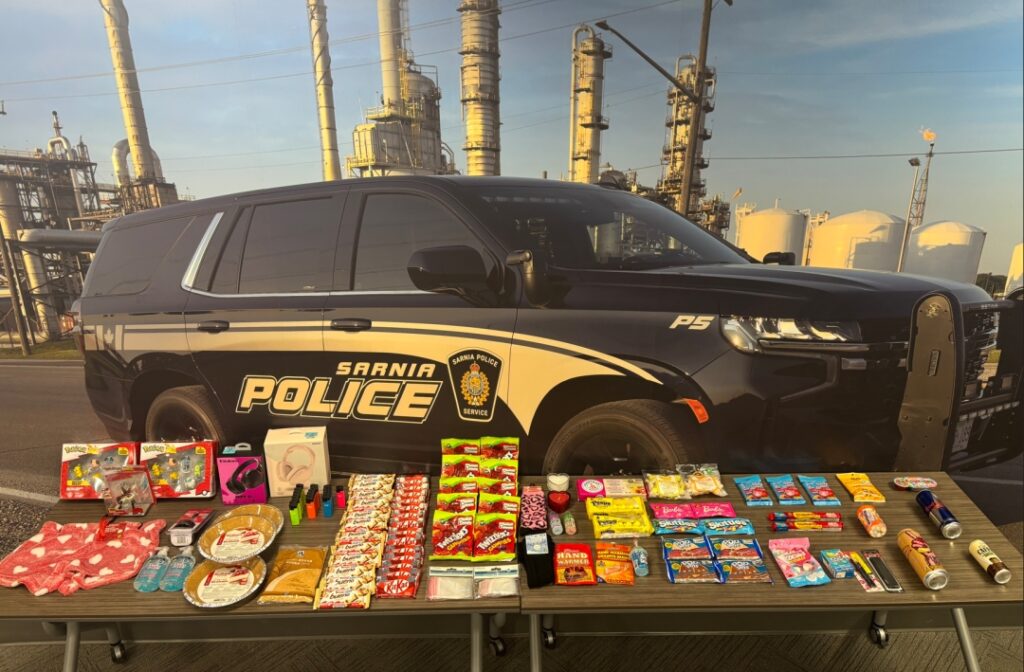
I want you to look closely at the photo the Sarnia Police Service just released.
It is staged with the aesthetic of a major cartel takedown. You have the heavy-duty police interceptor looming in the background. You have the industrial skyline of Chemical Valley rising behind it, suggesting a gritty, high-stakes war on crime. And in the foreground, laid out on a table like kilos of seized heroin, is the haul.
Zoom in. It isn’t fentanyl. It isn’t illegal firearms. It isn’t the proceeds of a crime ring.
It is a pile of Oh Henry bars. Some bags of potato chips. A few pairs of socks. A bottle of foundation. A handful of Pokémon figurines.
This is not a parody. This is the "performance of safety." This is your police force using a tactic called "Copaganda" to convince you that their massive budget is justified because they successfully recovered a bag of groceries.
The press release accompanying these photos reads like an action movie script. Officers were "patrolling" Quinn Drive. They "recognized a male" who was "known to them." They engaged in "surveillance."
Let’s decode that language. Quinn Drive is a commercial hub of big-box stores. The police weren't cracking a case; they were looping a parking lot waiting for poor people to do what poor people do when they are desperate.
The phrase "known to them" is a tool of "othering." It marks these individuals—Alex, Darryl, and Kebrina—as a permanent criminal underclass. It tells you, the reader, that these aren't your neighbours. They are the "usual suspects." They are enemies to be hunted.
This framing turns a sad, mundane act of survival—stealing food and low-value goods—into a tactical victory. They want you to believe Sarnia is under siege by hordes of shoplifters so you will thank them for standing on the thin blue line between you and a stolen bag of Skittles.
French philosopher Guy Debord wrote about "The Society of the Spectacle," where images replace reality. That is exactly what we are seeing here.
This arrest didn't happen to stop crime. It happened to be photographed. The image of the "saved" candy bars is more important to the police than the actual reduction of theft.
They are producing content, not safety. They are manufacturing a visual narrative of competence to distract you from the reality on the ground.
And what is that reality? We have a housing crisis. We have a drug toxicity crisis. We have deep, structural poverty in Sarnia. But the police cannot solve those problems. So instead, they stage a trophy shot of junk food and say, "Look, we did something."
There is a darker side to this social media post. Sociologist Sarah Lageson calls this "Digital Punishment."
Even if these charges are dropped, or if these people were stealing to feed an addiction or a child, they have now been publicly shamed. The police have bypassed the court system to deliver immediate social death via Facebook likes.
The press release lists their full names and ages. It details their "interactions" with police. It strips them of privacy and dignity before a judge has even banged a gavel. It is extra-judicial punishment designed to humiliate.
We need to talk about the economics of this "bust."
Think about the cost of the cruiser in that photo. Think about the salaries of the uniformed officers who spent hours patrolling, arresting, processing, and holding bail hearings for three people. Think about the court costs.
Now look at the value of the stolen goods. One report cites $142. The other items are worth perhaps a few hundred dollars combined.
We are spending thousands of dollars in taxpayer money to protect the profit margins of multi-billion dollar corporations like Walmart and Shoppers Drug Mart. We are deploying armed officers to act as loss-prevention security guards for the billionaire class.
This is where the concept of "Carceral Humanism" fails. The police try to frame this as a community service. But putting a woman stealing snacks in handcuffs does not make Sarnia safer. It just makes Sarnia more expensive.
This column is not a defense of theft as many of my detractors will most certainly accuse me of. Rather, it is a critique of how we choose to address it.
The Sarnia Police Service wants you to look at this photo and feel safer. They want you to see their new headquarters and their budget increase as necessary investments.
I look at this photo and see a failure of imagination. I see a city that refuses to treat the root causes of poverty, choosing instead to criminalize the symptoms.
Real safety isn't a table full of recovered chips and a neighbour in a jail cell. Real safety is housing. Real safety is harm reduction. Real safety is a local economy that works for workers, not just the big box stores on Quinn Drive.
Until we understand that, we are just paying for a very expensive photo op.
Mon, Oct 5 · 7:00 pm
St Andrew’s Presbyterian Church 261 Christina St N Sarnia, ON
Tue, Oct 6 · 5:30 pm
The Bridge Patisserie Café 12 Michigan Ave Point Edward Point Edward, ON
Tue, Oct 6 · 6:00 pm
Black Gold Brewery 395 Fletcher St Petrolia, ON
A division of Sarnia Media Group Inc.
Locally Owned and Operated
© 2026 The Sarnia Journal