Oct5
Scottish Country Dancing
Mon, Oct 5 · 7:00 pm
St Andrew’s Presbyterian Church 261 Christina St N Sarnia, ON

In Nathan’s latest column, he argues that a recent council exchange regarding Confederation Street zoning highlights the fatal disconnect between bureaucratic rule-following and the organic, messy reality of how a city actually grows.
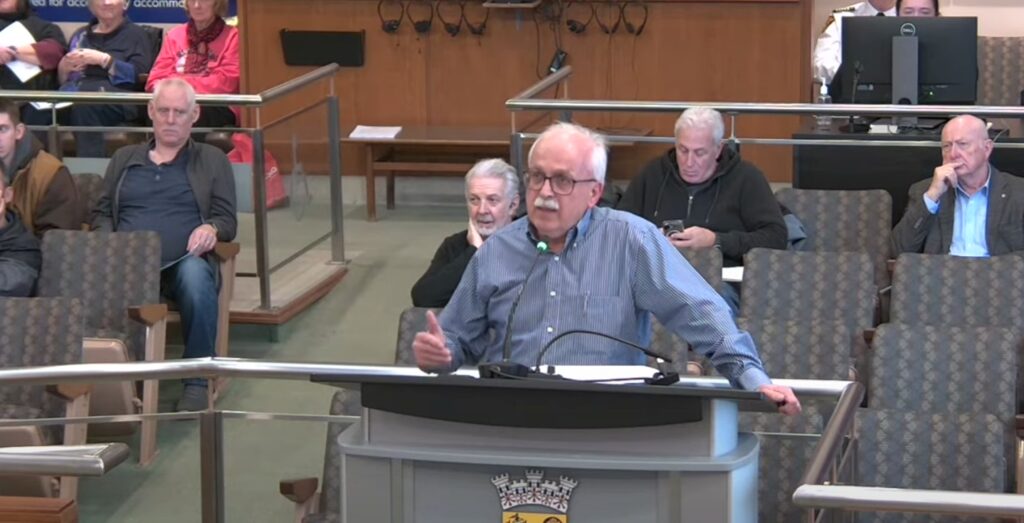
There was a moment during the Dec 15, 2025 council meeting that perfectly encapsulated the tension holding Sarnia back. It wasn’t a shouting match or a scandle, but a dry, frustrating exchange about what we are allowed to build and where.
Lou Longo, a long-time local developer, stood at the podium and practically begged for the city to get out of his way. He pointed out that the new draft zoning by-law designates a stretch of Confederation Street as “Prestige Employment”.
It sounds fancy. It sounds high-end. But in practice, it strips away the ability to put retail businesses on one of the busiest streets in the city.
Longo argued that Confederation Street is becoming the new London Road, a bustling corridor where people actually want to go. He wants to build things that people use. He wants to put shops and services where the traffic is.
But the city’s master plan—and the provincial policies it slavishly adheres to—says no. The planners explained that under the new provincial rules, retail is banned in employment zones to protect industrial lands.
This is the fatal flaw of modern municipal governance: the belief that a healthy city can be designed on a spreadsheet or dictated by a policy statement from Toronto.
We are obsessed with categorization. We draw lines on maps and declare “this is for working” and “this is for sleeping” and “this is for shopping,” ignoring the messy, vibrant reality that human life doesn’t fit into colour-coded boxes.
Councillor Bill Dennis, despite our frequent ideological differences, hit the nail on the head in this instance. He noted that we have become “obsessed with rules and not outcomes”. He questioned how adding layers of complexity to our zoning helps a city that is struggling to build enough homes or generate enough economic momentum.
He is right. When the map says one thing and the community’s behaviour says another, the map is wrong.
The pain in Longo’s voice was palpable. He talked about having “millions of dollars invested in the city” and bringing tenants to the table who want to set up shop now, only to be told they face six to eight months of rezoning uncertainty.
“We just need the tools,” Longo said.
The response from the city’s leadership was dishearteningly passive. The Mayor reminded everyone that this was just a meeting for input, not decision-making. The consultants politely noted that their hands are tied by provincial definitions.
It was a masterclass in bureaucratic deferral. Everyone pointed to a rule written by someone else as the reason why common sense could not prevail.
This is not leadership. Leadership is not managing the decline of a city according to a provincially mandated handbook. Leadership is looking at the reality on the ground—at the people trying to build, create, and invest—and clearing the path for them.
A truly flourishing city is not one that is master-planned to perfection. It is one that is allowed to emerge from the bottom up. It is built by the people who live and work here, responding to real needs and real opportunities.
If a developer wants to put retail on a busy street because that is what the market demands, the city’s job should be to ensure it is safe, not to debate whether it fits the definition of “prestige employment.”
We need to stop viewing the city as a project to be managed and start viewing it as an ecosystem to be tended. Ecosystems die when you try to force them into rigid structures. They thrive when you allow them to adapt.
The role of City Hall should be to dismantle the barriers that prevent us from taking care of ourselves. We need a planning philosophy that defaults to “yes” unless there is a compelling, immediate danger to public safety.
Until we stop letting the rule book overrule reality, we will continue to be a city of potential, stuck in a waiting room of our own design.
Mon, Oct 5 · 7:00 pm
St Andrew’s Presbyterian Church 261 Christina St N Sarnia, ON
Tue, Oct 6 · 5:30 pm
The Bridge Patisserie Café 12 Michigan Ave Point Edward Point Edward, ON
Tue, Oct 6 · 6:00 pm
Black Gold Brewery 395 Fletcher St Petrolia, ON
A division of Sarnia Media Group Inc.
Locally Owned and Operated
© 2026 The Sarnia Journal