Oct5
Scottish Country Dancing
Mon, Oct 5 · 7:00 pm
St Andrew’s Presbyterian Church 261 Christina St N Sarnia, ON

The Charter of Rights and Freedoms guarantees an objective standard of dignity and equality for every Canadian citizen, and efforts to create religious exemptions on hate speech—such as those debated in Bill C-9—threaten to undermine this foundational Canadian value.
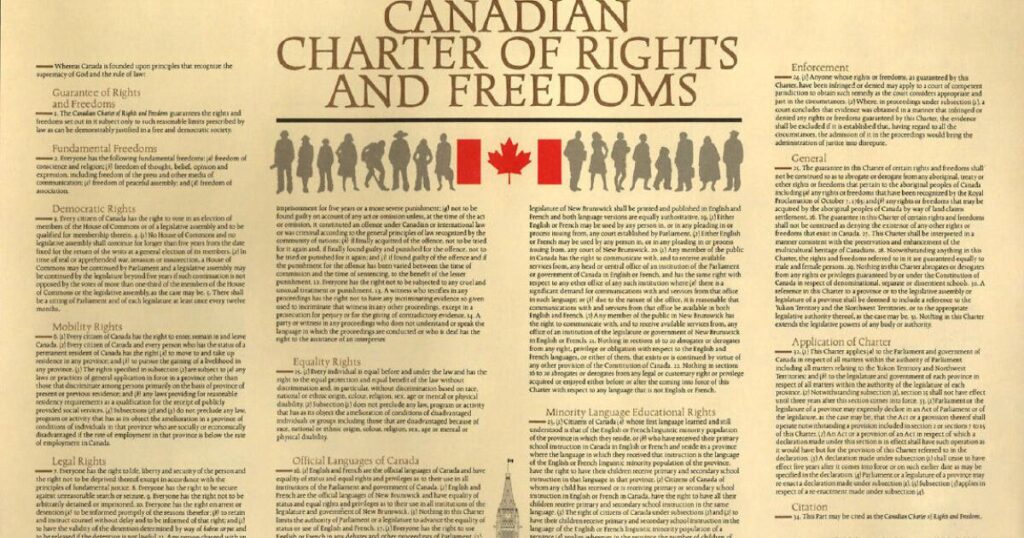
We often take our rights for granted, for most of us it is just a given that Canada is essentially a free country. While we often disagree on what exactly those rights give us licence to do, it is fairly universally accepted that the Charter of Rights and Freedoms is the ultimate authority in Canada. It lays the groundwork so that every Canadian can live a peaceful, dignified life, at least in theory.
Many of us can actually remember a Canada where the Charter did not exist at all; it is a fairly recent document, only being enshrined into federal law in 1982. Canada itself was founded in 1867 under the British North America Act, a colonial project rooted in Christian authority, with both Catholic and Protestant churches shaping policy and culture.
This structure grew out of earlier authoritarian ideas like the Doctrine of Discovery, a Church sanctioned idea that declared non-Christian lands and peoples inherently lesser and available for seizure. Despite Enlightenment ideas gaining traction in Europe, Canada was not built on those values. It was built as a Christian nation, and because of that, the Indigenous people of Canada who lived here first, who considered the land sacred, were subjected to our country's darkest legacy: an attempt to stamp out their beliefs and assimilate them into our Christian culture.
While Canadians at the time were busy weaponizing their faith against the Indigenous population, a radical shift in values was starting to take root in Europe. The Enlightenment was essentially a movement of educated citizens who had grown tired of powerful individuals wielding arbitrary authority, tired of having their lives ruled by the beliefs of others rather than by a set of universal values.
From here they began to sow the seeds which would grow into a vision that guaranteed every citizen inherent rights, and they paved the way for our own human rights revolution that began in the 1960s. All of this eventually culminated in the creation of the Charter of Rights and Freedoms in 1982, a moment that marked Canada’s first true embrace of modern human rights.
The Charter did not appear out of thin air; it was the product of decades of social pressure, legal reform, and a growing public understanding that rights cannot depend on tradition or the moral authority of the powerful. It took those Enlightenment principles that had slowly taken root here and placed them at the very heart of our Constitution, binding every level of government to a universal standard of dignity and equality. For the first time in our history, the rights of ordinary people were given priority over the beliefs of those in authority, and Canada committed itself to becoming a country where every individual could expect fair treatment under the law.
The creation of the Charter was not the end of our human rights push; like our Constitution it was intended to be a living document in order to guarantee that we would be able to continuously improve the wellbeing of our citizens. So on September 19th 2025, Sean Fraser put forward Bill C-9, a relatively straightforward piece of legislation that seeks to remove religious exemptions on hate speech.
C-9 reinforces that religious authority does not override the Charter, the Criminal Code, or anyone else’s rights. This is entirely consistent with our values as a country, there is nothing here that violates the freedom of others; it is just one more reasonable limit on free expression.
It should come as no surprise to anyone here that Marilyn Gladu has been extremely vocal about this bill, claiming once again that it violates religious rights. What Gladu refuses to understand is that while everyone has freedom of religion in Canada, we also have freedom from religion; we are for all intents and purposes a secular country now.
She has a duty to uphold the Constitution, to uphold the Charter as a public servant, and yet much like the time she fought a ban on conversion therapy, she is fighting once again to preserve the authority of faith over the Charter of Rights and Freedoms.
We simply have to accept the notion that some ideas are subjective, that they may hold great personal significance to an individual, but no level of belief can justify harming other people. Hate speech is not difficult to define; it is not difficult to discern when someone intends to use their language to cause harm.
The Charter of Rights and Freedoms guarantees a level of objective reality that will always take precedence over personal belief, and it is the foundation of our country, the foundation of our freedom. Non-religious citizens do not get these exemptions, we do not have the right to hate speech and then invoke religion to get out of it; that is awesome, let us just be consistent about it.
Mon, Oct 5 · 7:00 pm
St Andrew’s Presbyterian Church 261 Christina St N Sarnia, ON
Tue, Oct 6 · 5:30 pm
The Bridge Patisserie Café 12 Michigan Ave Point Edward Point Edward, ON
Tue, Oct 6 · 6:00 pm
Black Gold Brewery 395 Fletcher St Petrolia, ON
A division of Sarnia Media Group Inc.
Locally Owned and Operated
© 2026 The Sarnia Journal