
The Sarnia Journal has partnered with local photographer Art Connolly to feature his captivating “Humans of Sarnia” series as he delves into the lives and experiences of everyday people in Sarnia.
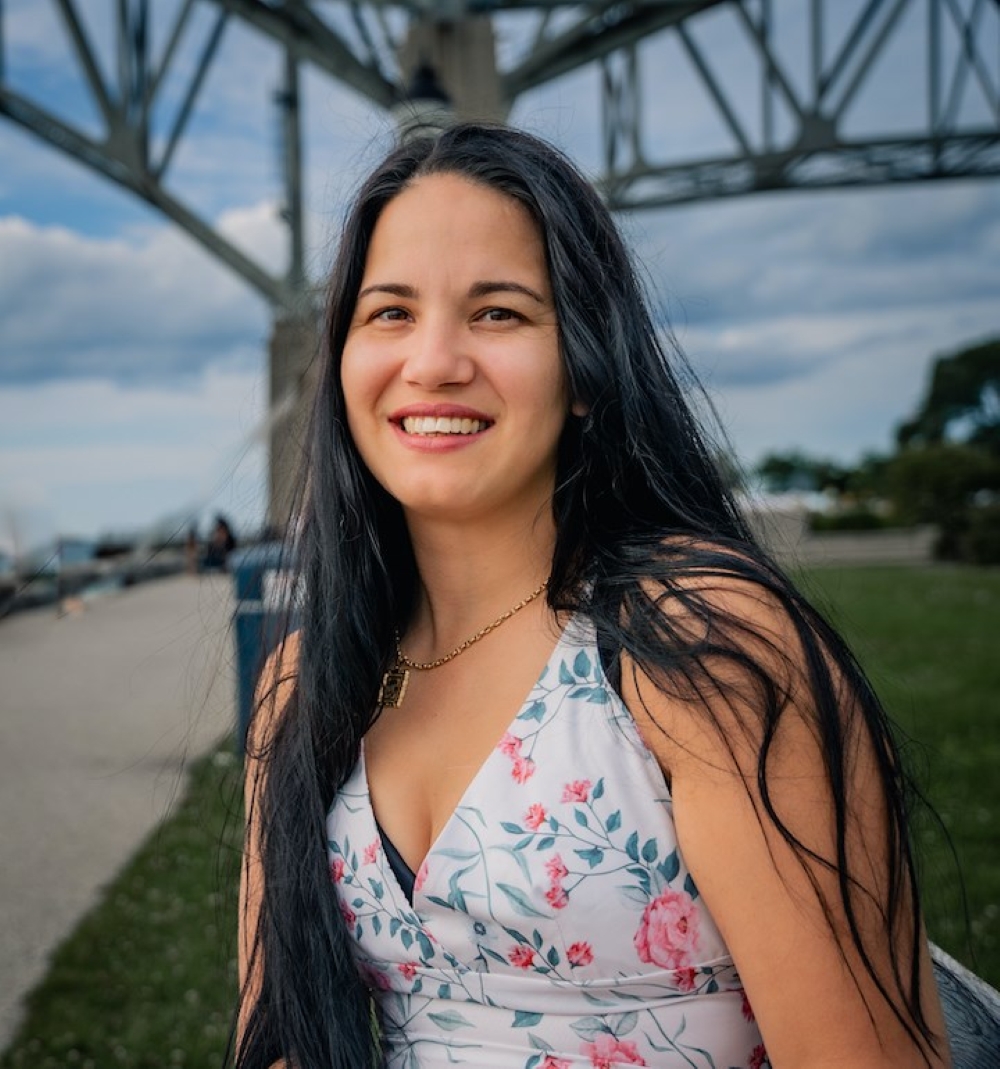
From time to time, certain stories deserve to be shared again. This profile of Maitte Martinez was previously published in Humans of Sarnia, and in revisiting it, we are reminded why her voice resonated so deeply with readers. As new members continue to join our community—and as conversations around belonging, opportunity, and freedom remain as relevant as ever—we are honoured to reprint Maitte’s story and reintroduce her journey to Sarnia.
A story of cultural transitions, love, and newfound freedom
When Maitte Martinez laughs, it is full and unguarded—the kind of laugh that tells you she has lived through contrast. She arrived in Sarnia from Camagüey, Cuba, stepping into a community that now feels, in her words, “like the place I was meant to build my future.”
Her journey to Canada began nine years earlier, with the birth of her son.
“Becoming a mother changes how you see everything,” she tells me. “You stop thinking only about today. You think about what will be possible ten years from now.” For Maitte, that long view made certain realities impossible to ignore. She loved her country, her culture, and her family—but she worried about opportunity, about freedom, and about the limitations she felt pressing in from all sides.
In Cuba, Maitte was nothing if not industrious. She worked as a secretary. She pursued photography. She modeled. Three jobs—each requiring skill, energy, and presence. Yet together, they earned her the equivalent of roughly $100 per month.
“You learn to survive,” she says simply. “You learn to be creative.” But survival and possibility are not the same thing.
Maitte speaks candidly about growing up in a political system where ideology permeated daily life. From childhood, she explains, messaging around communism was embedded in school lessons, songs, and stories. “It shapes how you think,” she says. “You don’t even realize how much at first.” She describes it as a kind of conditioning—ideas repeated so often they become unquestioned truths.
Corruption, she says, was widely understood but rarely openly confronted. Propaganda was persistent, passed from one generation to the next. She refers to it as “The Big Lie,” a phrase she uses carefully, not with bitterness, but with reflection. Yet her account is not one-dimensional.
“Cuba is not only negative,” Maitte insists. She speaks warmly about the country’s healthcare system, which she describes as strong and accessible. And more than anything, she highlights the strength of Cuban community life. “People take care of each other. Neighbours are family. If someone has little, they still share.”
It is this duality that defines her story—not rejection, but discernment. She can hold love for her homeland and still acknowledge why she needed to leave.
When she finally arrived in Canada, the transition was both exhilarating and disorienting. One of her first vivid memories is walking into a grocery store.
She laughs as she recalls it. “I stood in the bakery section for so long,” she says. “There were so many cakes.” Layered cakes. Iced cakes. Chocolate, vanilla, fruit-filled. Rows upon rows of choice.
In Cuba, food availability could be uncertain and inconsistent. Meals were often determined not by preference but by what happened to be available that day. Standing in that Canadian grocery aisle, Maitte experienced something deeper than delight—it was abundance made visible. “It felt like another world,” she says.
Today, Maitte works as an optician in Sarnia, a role she embraces with pride. There is symbolism in it, though she doesn’t frame it that way. Helping others see more clearly seems fitting for someone whose own life has been shaped by perspective.
She values her work not only for the income stability it provides but for the sense of contribution. “I like helping people,” she says. “When someone can see better, their whole day is different.” It is in these everyday interactions that Maitte has come to understand Canada not just as a country, but as a culture. She describes Canadians as welcoming, patient, and willing to help newcomers navigate unfamiliar systems. Small gestures—directions offered, doors held open, smiles exchanged—have accumulated into something larger: belonging.
But above all, what resonates most deeply with her is freedom. “The freedom to speak,” she says. “The freedom to choose.” She talks about open conversation—about being able to express opinions without fear. She mentions access to information, even something as ordinary as using Google without restriction. “People here don’t think about that,” she says. “It’s normal. But it is not normal everywhere.”
Freedom, for Maitte, is not abstract. It is practical. It is the ability to research, to question, to plan, to pivot. It is knowing her son will grow up with options. She also appreciates the infrastructure of daily life in Canada—the parks, campsites, and public spaces that are accessible and maintained. These details, which many lifelong residents might overlook, signal something important to her: investment in quality of life.
And then there is winter. When I ask how she has adjusted to Canadian winters, she laughs again, the same bright, unrestrained laugh. “I love it,” she says. Snow, cold air, bundled coats—these are not inconveniences but novelties. “It’s beautiful. It feels magical.”
Her enthusiasm is striking. Where some see hardship in grey skies and icy sidewalks, Maitte sees texture—another dimension of her new beginning. She misses her family in Cuba. She misses the cadence of Spanish in the streets, the music, the familiarity of shared history. Nostalgia surfaces in small ways. But regret does not. “I am grateful,” she says quietly. “This is home now.”
In speaking with Maitte, what becomes clear is that her story is not defined by departure, but by intention. She did not leave impulsively. She left deliberately—out of love for her son and belief in what could be built elsewhere. Sarnia, in turn, becomes part of that construction. Not as a backdrop, but as a participant. Every workplace interaction, every winter snowfall, every overwhelming bakery aisle contributes to the evolving narrative of who she is becoming.
In a community often described by industry and geography, Maitte’s story adds another dimension—one of global movement, personal agency, and quiet courage. Six months in, she stands at the intersection of past and future: Cuban by birth, Canadian by choice, Sarnians by community.
And somewhere between the optical counter and the grocery store bakery, between memory and possibility, she has found what she was searching for—not perfection, but freedom.
Welcome to Sarnia, Maitte. Your story is already part of ours.
“Humans of Sarnia” founder Art Connolly is a man fuelled by curiosity and a passion for connecting with people in Sarnia. Inspired by the renowned “Humans of New York” series, with a camera in hand, he captures the very essence of the individuals he encounters, preserving their stories through his lens.


