
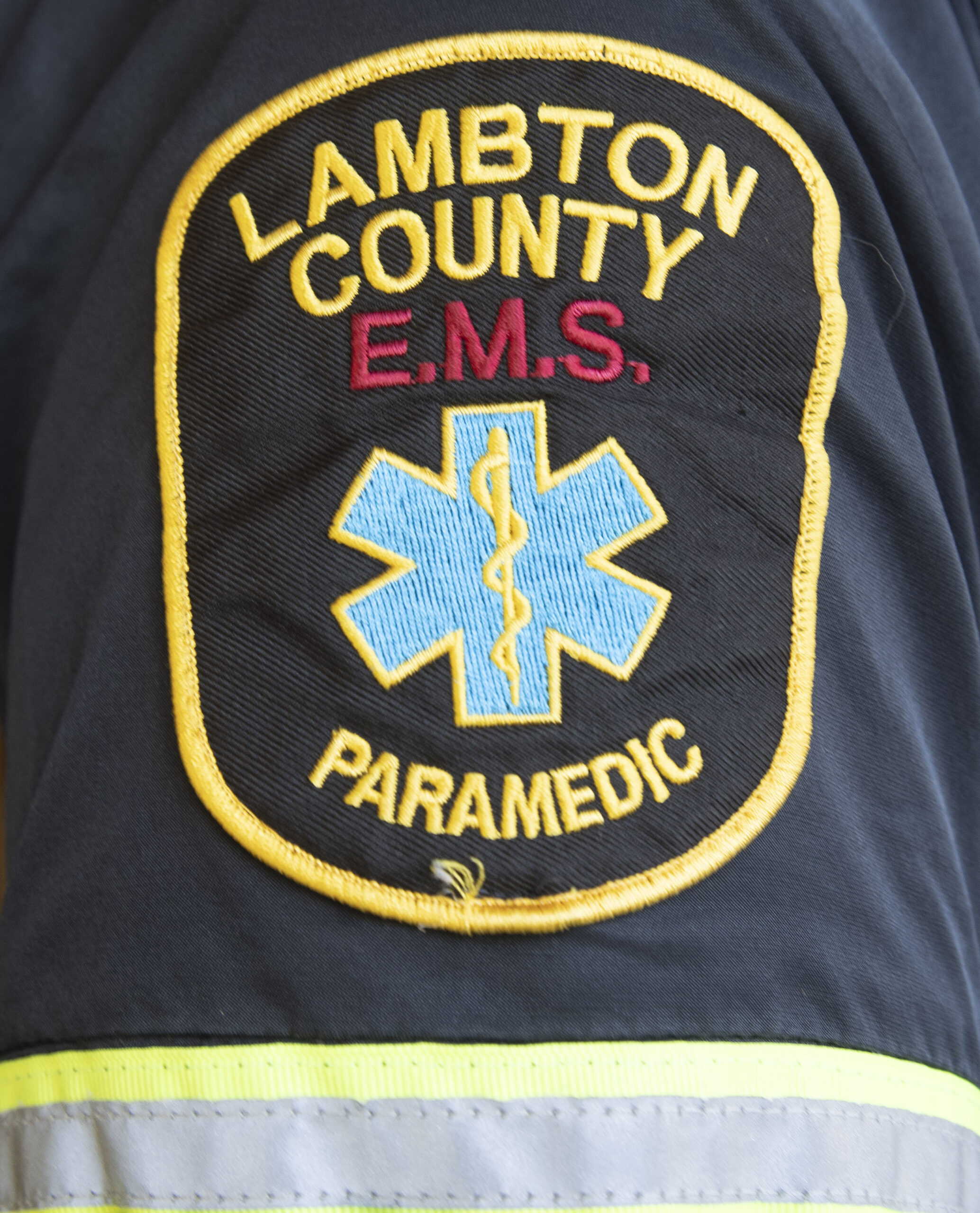
I’m an anomaly,” he tells me, almost matter of factly, as if he’s still wrapping his head around it himself. “Most guys don’t retire out of the truck.”
He’s right. After 30+ years as a paramedic, he’s one of the few who didn’t step out—didn’t burn out, didn’t move into management, didn’t leave for something with less emotional toll. “They’re out there, sure,” he says of paramedics who last the full career on the road, “but they’re few and far between.”
His journey into this profession started in the most unexpected of places—high school first aid class. No Power Points, no theory-heavy lectures—just stories, hands-on learning, and a paramedic who made it all feel real. “It was fun,” he says, smiling. “I looked forward to it every week.” That spark led him through a winding path: general arts, anatomy courses, and eventually a third-choice checkbox on a college application—ambulance attendant.
He almost missed the calling. But when he started doing ride-alongs in Sarnia, everything clicked. “I had a couple of great preceptors. They made it fun. They made the job feel like something I could actually love doing.”
He describes paramedicine as a profession where no two days are alike. “Even after all this time, I haven’t seen it all. Every year someone surprises me with something I’ve never seen before.”
But the unpredictability isn't always welcome. Drugs like fentanyl and meth have changed the job in terrifying ways. “Fentanyl is bad. Meth is worse. You don’t know what’s coming with someone on meth. I’ve been attacked more than once. Most of us have—physically, verbally—it’s part of the job now.”
Still, he talks about the people. Not just the patients, but the families, the co-workers, the partners he’s relied on through the years. “A good partner can save your career,” he says. He speaks of one who came back from PTSD leave, armed with new knowledge and resilience, and taught him the importance of processing the weight they carry. “You don’t always realize what’s affecting you. It builds up—and one day it all lets loose, and you don’t even know why.”
There’s a raw honesty to how he explains the emotional toll of the work. “A lot of people get into this job because they want to help. And that’s a great starting point, but the truth is—most of the time, you can’t help in the way you thought. That’s where people burn out.”
He shares a moment from years ago—he was in the ER, dropping off a patient. Nearby, a cardiac arrest had just been called. The medical team stopped resuscitating, and the doctor walked down the hall to tell the family. “I’ll never forget the scream from that room,” he says, his voice slowing. “That pain… it wasn’t even my call, but hearing it like that, from a distance—it hit me harder than I expected.”
I ask him if the job has made him hopeful or cynical. He pauses, longer than expected. “It’s both,” he finally says. “You have to compartmentalize so much just to do the job. You’re focused on your training, the steps. It’s easy to forget that this is a real person in front of you. But the second it’s over—when you have to turn and face the family—that’s when it gets real.”
Over the years, regulations changed. The training became more intense. “Advanced Care training was probably the most stressful thing I’ve ever done. Six weeks. Lectures in the morning, scenarios in the afternoon, exams at the start of every week. Every day, you’re being evaluated.”
Despite all of it, he stayed. Not because the job got easier—it didn’t. He stayed because he could still find meaning in it. Because he had people who reminded him how. Because, somehow, even after seeing humanity at its most fragile, he never stopped caring.
“Counselling helps,” he says, almost like an aside. “And partners. But so does just recognizing that it’s okay to feel it. You’re supposed to feel it. That’s what keeps you human.”
And being human, it turns out, is what kept him going.
"Humans of Sarnia" founder Art Connolly is a man fuelled by curiosity and a passion for connecting with people in Sarnia. Inspired by the renowned “Humans of New York” series, with a camera in hand, he captures the very essence of the individuals he encounters, preserving their stories through his lens. Follow his series on Instagram and Facebook.


