
The Sarnia Journal has partnered with local photographer Art Connolly to feature his captivating “Humans of Sarnia” series as he delves into the lives and experiences of everyday people in Sarnia.
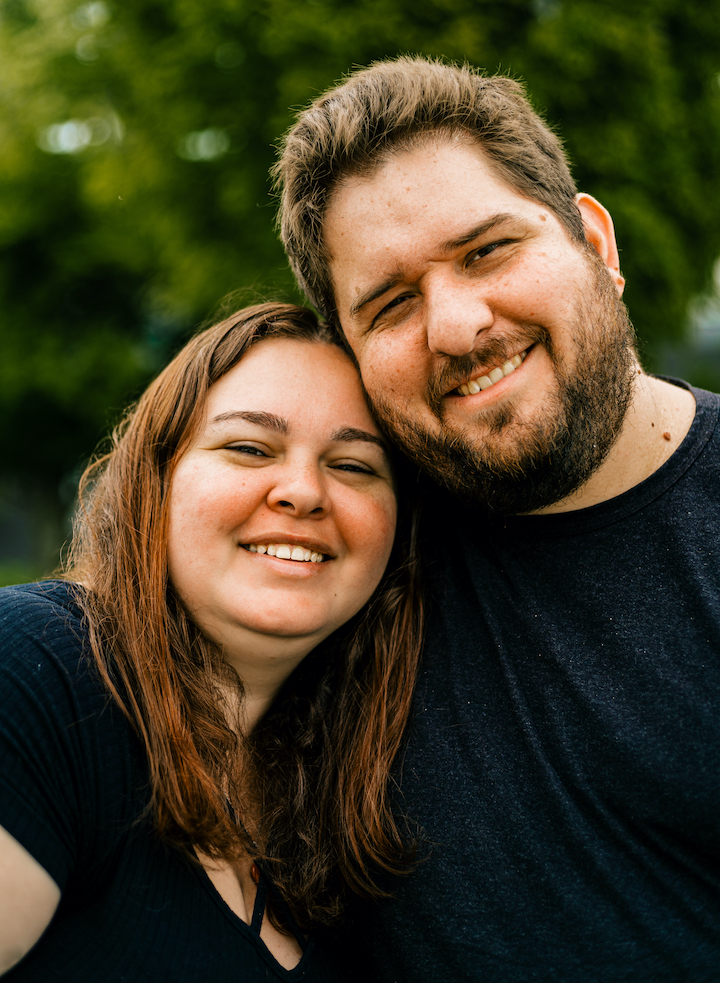
From time to time, certain stories deserve to be shared again. This profile of Aline and Jorge Rocha was previously published in Humans of Sarnia, and in revisiting it, we are reminded why they resonated so deeply with readers. As new members continue to join our community—and as conversations around belonging, opportunity, and freedom remain as relevant as ever—we are honoured to reprint Aline and Jorge's story and reintroduce their journey to Sarnia.
There’s a particular kind of quiet that settles over the St. Clair River in late summer—still, almost reflective. It’s the kind of place where people come not just to pause, but to begin again.
That’s where I met Aline and Jorge Rocha.
They sit close together when they speak, often finishing each other’s thoughts, their words shaped by both memory and intention. Just over a year ago, in August of 2022, they arrived in Sarnia from Rio de Janeiro—a city defined by movement, colour, and a population that never quite seems to sleep. Here, they found something different. Not better or worse, they’re careful to say—but different in ways that have changed how they think about life.
Back in Brazil, Aline was a lawyer. Jorge worked as an entrepreneur in the oil and gas supply chain sector. Their lives, on paper, were stable. Educated, established, and deeply rooted in their community. But as they describe it, stability began to feel uncertain in ways that went beyond career or finances.
“It wasn’t just one thing,” Aline explains. “It was everything together.”
They talk about the political climate in Brazil during the presidency of Jair Bolsonaro—a period they experienced not as a distant headline, but as something that filtered into everyday life. Policies shifted. Conversations changed. Trust in institutions, they say, began to erode.
Jorge leans in slightly when he speaks about it, choosing his words with care.
“There was a feeling that things were becoming more divided,” he says. “Not just politically, but socially—even within families.”
They describe a country grappling with rising inflation, increasing poverty, and a widening gap between those who had security and those who didn’t. In Rio, where beauty and hardship exist side by side, the contrast became more pronounced. Crime was not an abstract concern—it was something measured in daily reality.
“In some areas, you hear about violence every day,” Jorge says. “It becomes part of how you think. Where you go. What time you leave your house.”
For Aline, the shift was also cultural. She speaks about cuts to education, science, and the arts—not as policy points, but as losses that affected how people express themselves, how they learn, and how they imagine their future.
“You start to feel like your voice doesn’t matter as much,” she says quietly.
And then there was the economy. A changing industrial landscape meant layoffs. Opportunities became less predictable. For two people who had built careers through education and hard work, the path forward felt increasingly unclear.
“At some point,” Jorge says, “you ask yourself what kind of life you want—not just now, but in ten years.”
That question led them here.
They arrived in Sarnia without a network. No family waiting. No built-in community. Just two suitcases, a shared resolve, and the understanding that starting over would require both humility and patience.
Today, that rebuilding is already underway. Aline is enrolled in the Business Management program at Lambton College, stepping into a new chapter that reflects both her past experience and her future goals. Jorge has taken on a role as a Systems Specialist with a local company, applying his skills in a completely new context.
There’s a noticeable shift in their tone when they talk about Sarnia—not excitement exactly, but something steadier. Relief, perhaps.
“The first thing you notice is the size,” Jorge says, laughing. “Rio has more than 13 million people. Here… it’s very different.”
But it’s in the details where the contrast becomes most meaningful.
They talk about cost of living. About how something as simple as buying a car can represent an entirely different reality. In Rio, they explain, the same vehicle that might cost $5,000 here could be eight times that amount.
“You feel it in your daily life,” Jorge says. “Here, things feel more possible.”
They mention public transportation—something often overlooked by locals—as another unexpected advantage. In Brazil, long commutes were simply part of the routine. Hours lost in transit, every day.
“In Sarnia, everything is close,” Aline says. “You gain time. And time changes how you live.”
Still, the transition hasn’t been without its emotional weight.
They miss their families. That part is immediate, unfiltered. There’s no attempt to soften it.
“We talk all the time,” Aline says. “Video calls, messages… but it’s not the same as being there.”
And yet, they’re building something here.
Friendships are beginning to take shape—slowly, but meaningfully. Aline has found connection through volunteering at her church, a space that offers both familiarity and community. It’s in these smaller, quieter moments that Sarnia begins to feel less like a destination and more like a home in progress.
When I ask what the future looks like, they don’t hesitate.
They plan to stay.
Their goal is to become permanent residents of Canada—not just as a legal status, but as a reflection of something deeper: a commitment to the life they’re creating.
“It’s not just about leaving somewhere,” Jorge says. “It’s about choosing where you want to build.”
In a city like Sarnia, where stories often unfold quietly, Aline and Jorge’s journey feels both deeply personal and widely familiar.
Two people, educated and accomplished, choosing uncertainty over comfort—not because it was easy, but because it offered the possibility of something better.
And in that choice, they’ve found something that can’t be measured in population size or price comparisons.
They’ve found space.
Space to rebuild.
Space to breathe.
And, slowly, space to belong.
“Humans of Sarnia” founder Art Connolly is a man fuelled by curiosity and a passion for connecting with people in Sarnia. Inspired by the renowned “Humans of New York” series, with a camera in hand, he captures the very essence of the individuals he encounters, preserving their stories through his lens.


