Oct5
Scottish Country Dancing
Mon, Oct 5 · 7:00 pm
St Andrew’s Presbyterian Church 261 Christina St N Sarnia, ON

Community members share their thoughts while talk of NATO Spending and National Security is on the rise.
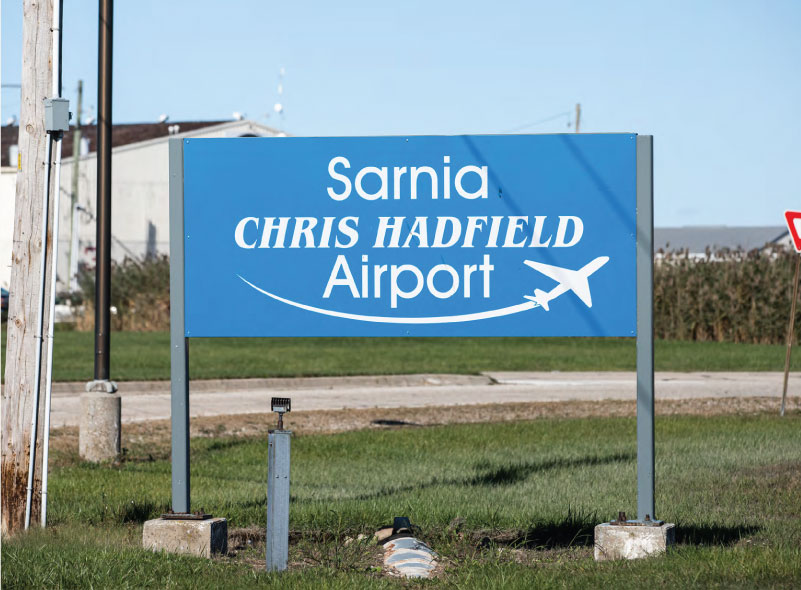
Once a regional hub for commercial flights, Sarnia’s Chris Hadfield Airport is now at the heart of a pivotal discussion. Not just about restoring air service, but about its role in national defence, economic development, and Canada’s evolving place on the world stage.
With the federal government announcing a sharp increase in defence spending to meet NATO’s 2% of GDP target by 2026, local leaders and aviation experts are exploring how this historic investment could reshape the airport’s future — potentially tying it to Canada’s national security, aerospace, and border infrastructure strategies.
The Sarnia airport, named after retired Colonel and Canadian astronaut Chris Hadfield, has long served the community as a civilian facility, providing pilot training, aircraft maintenance, and support for private businesses. But with the expiration of the operating agreement with Scottsdale Aviation looming in 2027, and growing pressure to align with national defence needs, some community members believe the airport could play a much larger role.
With the current operating agreement with Scottsdale Aviation set to expire in 2027, the City of Sarnia is actively reevaluating the airport’s long-term potential — not just for commercial use, but also as a base for defence-related operations. A growing group of aviation experts and community leaders argue that now is the time to act.
“There’s no reason Sarnia shouldn’t be part of the national conversation,” says retired RCAF pilot David Cooke, who previously served as the UAV Chief Pilot and Instructor for the International Test Pilots School. Citing the presence of the Coast Guard, RCMP, CBSA, and key transportation infrastructure, Cooke envisions the airport supporting border surveillance, DND helicopter operations, uncrewed aerial systems (UAS), VTOL (vertical takeoff and landing) aircraft, and search and rescue missions.
Chris Hadfield, the airport’s namesake, wrote to City Council earlier this year urging leaders to seize the opportunity for growth. He highlighted the increasing global demand for aviation services and underscored the airport’s potential to support aerospace R&D, hybrid-electric aircraft development, and advanced air mobility (AAM). His call to action has resonated with many in the community.
MP Marilyn Gladu has also thrown her support behind revitalization efforts, stressing the importance of restoring the airport’s commercial role. “We absolutely must restore the Sarnia airport to commercial use,” she said. “There are many ideas under development, including commercial pilot training schools, Porter links to Billy Bishop Airport, and even acquiring an aircraft for a Sarnia–Toronto route to connect through Pearson. I will continue to support, as I have, getting millions of dollars to keep the airport functional while we find a solution to restore connectivity.”
City Councillor Anne Marie Gillis sees a national security angle, stating, “In the short term, we could become one of the Canadian border security hubs for Southwestern Ontario.”
In early 2025, the City of Sarnia created a Municipal Services Corporation (MSC) to oversee the airport’s operations and attract new investment — a step Mayor Mike Bradley described as critical for long-term economic development. While infrastructure upgrades would be needed to accommodate higher traffic and potential military use, stakeholders believe the timing is right to secure federal support through Canada’s expanded defence procurement budget.
Despite the growing interest, there has been no formal proposal yet from the Department of National Defence or other federal agencies to make use of the airport for military operations. However, many local advocates see this as a strategic opportunity, not a limitation. By acting now, they argue, Sarnia can proactively position itself to support national priorities as new defence funding flows into infrastructure projects across the country.
“This isn’t just about restoring service,” said Councillor Gillis. “It’s about redefining the airport’s role in national resilience.”
Ultimately, the airport’s future remains undecided. Whether it returns to its role as a regional air travel hub, becomes a centre for military and security operations, or evolves into a hybrid facility serving multiple sectors, the decisions made in the coming year will shape the next chapter of this important community asset.
For now, all eyes are on the Chris Hadfield Airport — and whether it can take flight again, this time as a critical piece of Canada’s broader national strategy.
Mon, Oct 5 · 7:00 pm
St Andrew’s Presbyterian Church 261 Christina St N Sarnia, ON
Tue, Oct 6 · 5:30 pm
The Bridge Patisserie Café 12 Michigan Ave Point Edward Point Edward, ON
Tue, Oct 6 · 6:00 pm
Black Gold Brewery 395 Fletcher St Petrolia, ON
A division of Sarnia Media Group Inc.
Locally Owned and Operated
© 2026 The Sarnia Journal