Oct5
Scottish Country Dancing
Mon, Oct 5 · 7:00 pm
St Andrew’s Presbyterian Church 261 Christina St N Sarnia, ON

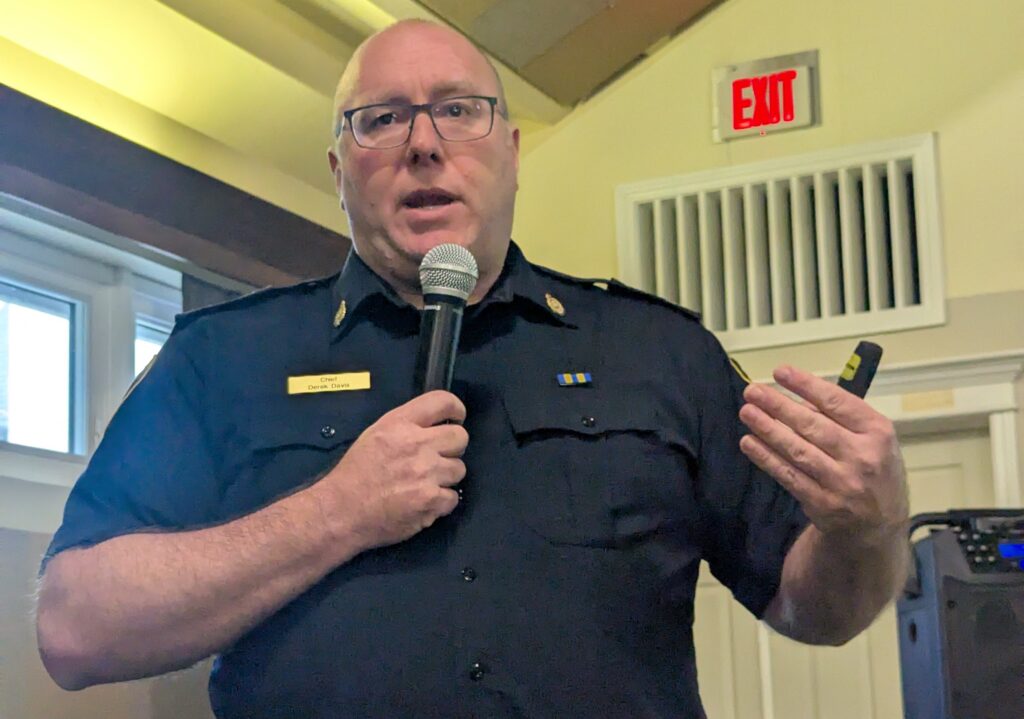
At a recent public town hall, Sarnia Police Chief Derek Davis made his case for a new headquarters by outlining a series of logistical and infrastructural problems with the current facility. However, an in-depth analysis of the consultant reports used to justify this move reveals a carefully constructed narrative of escalating crisis and a vision for future expansion designed to make a new, multi-million-dollar building seem inevitable.
Editor's Note: This is the second in a series of articles analyzing the Sarnia Police Service's public consultation for its next strategic plan. This piece is based on a detailed review of consultant reports obtained via the April 25, 2025, Sarnia Police Services Board meeting agenda and statements made at a public town hall on September 9, 2025.
Article 1 – Sarnia police board sidesteps accountability on record crime and budget increases.
At a public town hall this month, Sarnia Police Chief Derek Davis made his case for replacing the police headquarters at 555 Christina Street North. He spoke of a landlocked property, a crowded parking lot, failing infrastructure, and the operational needs of a modern police service. The foundation of his argument, he explained, rested on two independent consultant reports that concluded a new build was the most viable path forward.
An in-depth analysis of those reports—along with prior assessments and public statements from the Sarnia Police Services Board (SPSB)—reveals how a narrative was constructed to make a new, multi-million-dollar facility seem not only necessary, but inevitable. The documents and dialogue show a strategic pivot: from a building with manageable, age-related issues to a facility in unmanageable crisis; from a discussion about repairs to a mandate for total replacement; and from a solution for today's problems to a blueprint for a vast, un-debated future expansion of police power in Sarnia-Lambton.
The current narrative of a failing building stands in stark contrast to official assessments from just a few years ago. In a "High-Level Building Condition Assessment Survey" commissioned by the City of Sarnia and completed by WalterFedy on January 22, 2018, the Police Headquarters was given high marks. The report determined the "Overall Building Condition Rating" to be "Excellent (80)" and its "Overall Building Condition Index"—a metric of structural health—as "Excellent (95%)".
Yet, by 2023, the tone had shifted dramatically. A new "Headquarters Building Condition Assessment" by Dillon Consulting forms the basis of the current push. While this report does not use the "Excellent" rating, it details a series of necessary repairs common for a building constructed in 1987, estimating a total price tag of $4.43 million for repairs and code compliance.
A breakdown of these costs reveals standard, end-of-life maintenance projects: replacing exterior windows, upgrading HVAC systems, and repairing concrete. These are routine maintenance needs, but they are being framed as proof of a systemic building failure that can only be solved by abandonment and new construction. The police are conflating "needs significant repairs" with "is beyond repair"—a crucial distinction that allows them to dismiss the far cheaper solution presented in the very report they commissioned.
The narrative of crisis has been amplified by the civilian-led Police Services Board, which is legally responsible for police oversight. At the September 9 town hall, when presented with the $4.43 million repair option and asked why funds were not being prioritized for community-based care instead of infrastructure, Board Chair Paul Wiersma rejected the premise.
“I appreciate that you feel that we should allocate more resources into areas… more into a social area,” Wiersma said. “We disagree”.
Instead of engaging with the viability of the multi-million-dollar repair plan, Wiersma framed the choice not as one between repair and replacement, but between building now or building later at a higher cost.
“At some point, we're going to have to replace it, because all buildings have to be replaced at some point," Wiersma stated. "And my concern is the taxpayer is that in five years… the price is going to be doubled”.
This argument strategically sidesteps the immediate, consultant-approved repair option. It presents fiscal prudence not as choosing the most cost-effective solution available now (the repairs), but as preemptively spending tens of millions of dollars to avoid theoretical future inflation on a project whose necessity has been contested. This rhetorical framing presents the new build as an inevitability, making opposition seem fiscally irresponsible.
With the cheaper repair option dismissed as a short-term fix, the justification for a new build pivots to the building's functional purpose. Chief Davis made this clear at the town hall when he distinguished between the two main reports.
“One report deals with the building as a building,” he stated. “The second report is the police space needs assessment. This is the report that identifies the unique and specific needs of a Police Service…This four million one has nothing to do with what are the requirements of being a police service”.
That second report, the "Police Headquarters Space Needs Assessment" from March 2024, is instrumental. It redefines the problem not as one of maintenance, but of carceral architecture. The "unique needs" it identifies are overwhelmingly focused on the infrastructure of control:
Prisoner Handling Facilities
Forensic Identification Facilities
Seized Property Storage
Vehicle Bays for tactical units
Drive-through Sally port access for secure prisoner unloading
Most disturbingly, this logic is applied to the presence of children in police custody. At the town hall, Chief Davis used the legal requirement to separate children from adults in cells as a reason for expansion. “We're supposed to keep males separate from females. Children separate from adults. This is part of the requirement,” he explained.
Here, a systemic social failure—the presence of children in police custody—is reframed as an architectural problem to be solved with more, and better, cells.
A critical detail buried in the Space Needs Assessment reveals the push for a new facility is also based on a vision of future organizational growth and jurisdictional expansion.
The report explicitly states:
"The long-term potential of SPS taking over Point Edward policing and all of the county from the OPP would require approximately 75-100 additional officers, significantly impacting space requirements".
This is a stunning admission. The Board is justifying a massive capital expenditure based on a speculative, expansionist vision that has never been subject to public debate. The public is being asked to fund a facility built not for the Sarnia of today, but for a future where the SPS has absorbed policing for the entire county. This is reflected in the SPSB's request to the city for "20-25 acres" of land—a massive increase from the current footprint.
The Space Needs Assessment concludes by comparing only three large-scale capital project scenarios, dismissing additions or a secondary facility as "impractical and inefficient". The report never gives serious consideration to non-capital or smaller-scale solutions, such as leasing administrative space to ease overcrowding. By narrowly framing the problem and its potential solutions, the reports engineer a foregone conclusion.
The documents, taken as a whole, serve not as an objective exploration of options, but as a comprehensive justification for a pre-selected outcome. As the Sarnia Police Services Board proceeds, the case they present is not a simple matter of a failing building, but a complex narrative built to justify a specific, expensive, and expansive vision for the future of policing in Sarnia.
Mon, Oct 5 · 7:00 pm
St Andrew’s Presbyterian Church 261 Christina St N Sarnia, ON
Tue, Oct 6 · 5:30 pm
The Bridge Patisserie Café 12 Michigan Ave Point Edward Point Edward, ON
Tue, Oct 6 · 6:00 pm
Black Gold Brewery 395 Fletcher St Petrolia, ON
A division of Sarnia Media Group Inc.
Locally Owned and Operated
© 2026 The Sarnia Journal