Oct5
Scottish Country Dancing
Mon, Oct 5 · 7:00 pm
St Andrew’s Presbyterian Church 261 Christina St N Sarnia, ON

A new traffic safety pilot project on London Road has ignited a fierce debate, pitting data-driven arguments for pedestrian safety against sharp political pushback from a city councillor.
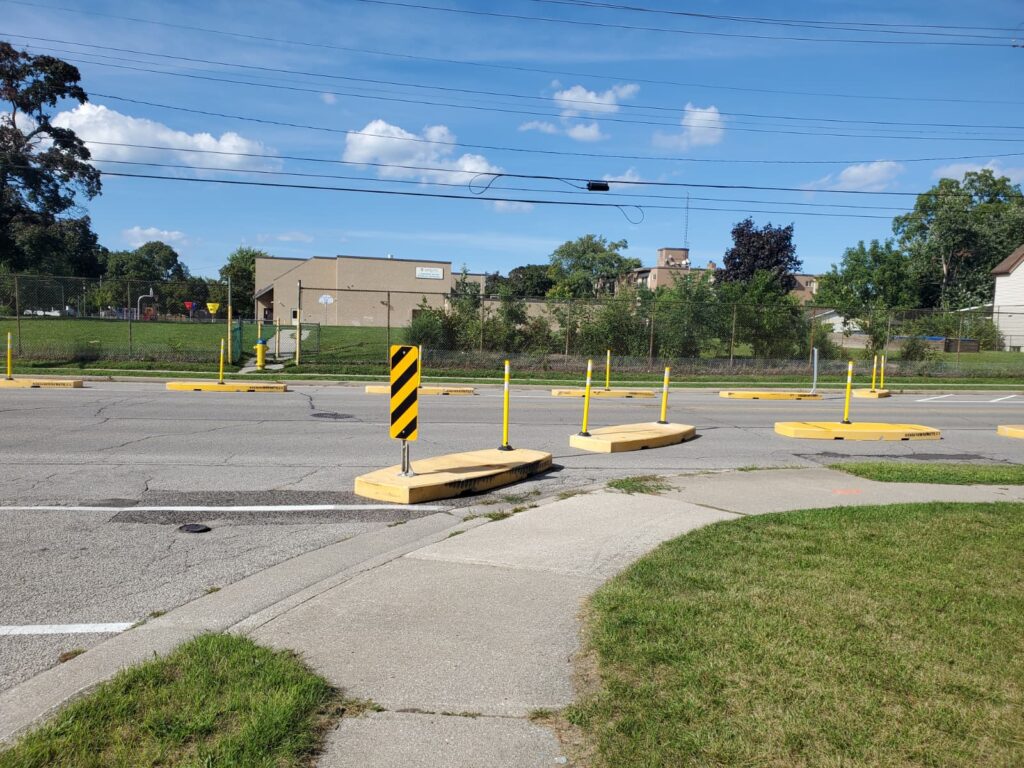
A temporary traffic-calming project on London Road has become a flashpoint in a larger Sarnia conversation about how city streets should be designed: for the safety of the most vulnerable, or for the convenience of drivers.
The pilot project, which consists of temporary yellow curbs, was installed on August 23, near the school crossing for London Road Public School. According to a report from David Jackson, the city’s General Manager of Engineering and Operations, the goal is to protect students by reducing the four-lane road to two, which shortens the pedestrian crossing distance.
The installation is the culmination of a six-year advocacy effort by resident Robert Dickieson, who presented to council in July about the dangers facing families in the area. During his presentation, Dickieson highlighted the high traffic speeds and narrow, uneven sidewalks that put children walking and scootering to school just inches from live traffic that often travels at 70 km/h in a 50 km/h zone.
Dickieson called the pilot a pleasing step in the right direction, adding that it shows it's possible to prioritize the safety of children walking to school over Sarnia's car-centric street design.
The project is also supported by community groups. The group nuSarnia, which has been working with the school on creating safe routes for students, endorsed the effort.
"This is an important, low cost step in protecting our community’s children," Tristan Bassett of nuSarnia told The Sarnia Journal. "This pilot project will provide the decision makers with appropriate data to make an informed decision, and that should be the focus," she continued.
The move has drawn sharp political and public condemnation. Coun. Bill Dennis, the only member of council to vote against the measure that led to the pilot project, has been a vocal critic. During the July meeting, he called the initiative a "knee-jerk reaction" and argued that "a lot of citizens that don't want our city to become Europe." He reiterated his opposition in a recent public Facebook post, calling the project an "abomination."
The councillor's post unleashed a torrent of online criticism, with the Journal's review of comments showing the majority echoed his opposition. The public’s concerns, which are common when traffic-calming measures are introduced, focused on several key themes.
Some residents said they fear the bump-outs themselves could become a hazard, particularly for larger vehicles such as buses and trucks. Another frequently cited concern was winter maintenance, with questions about how snowplows will navigate the curbs and whether they could become hidden dangers under snow. Others wondered why the city did not choose to install a pedestrian-activated crosswalk with flashing lights, a solution already used elsewhere in Sarnia.
A small number of commenters pushed back against the criticism, arguing the focus should remain on child safety. One resident, who recalled seeing vehicles speed through the crosswalk while students were present, summarized the view by stating, "if it saves one kid’s life, it’s accomplished its purpose."
The temporary installation will be evaluated by city staff, who are expected to bring a report to council’s September meeting. That report will summarize the project's initial performance and outline the timeline for a permanent solution, providing the first local data in a debate so far driven by anxiety and anecdote.
Mon, Oct 5 · 7:00 pm
St Andrew’s Presbyterian Church 261 Christina St N Sarnia, ON
Tue, Oct 6 · 5:30 pm
The Bridge Patisserie Café 12 Michigan Ave Point Edward Point Edward, ON
Tue, Oct 6 · 6:00 pm
Black Gold Brewery 395 Fletcher St Petrolia, ON
A division of Sarnia Media Group Inc.
Locally Owned and Operated
© 2026 The Sarnia Journal