Oct5
Scottish Country Dancing
Mon, Oct 5 · 7:00 pm
St Andrew’s Presbyterian Church 261 Christina St N Sarnia, ON

A decades-long community effort to build an accessible library and community hub in Bright’s Grove, now fully designed and “shovel-ready,” was brought to a halt this past week by Sarnia […]
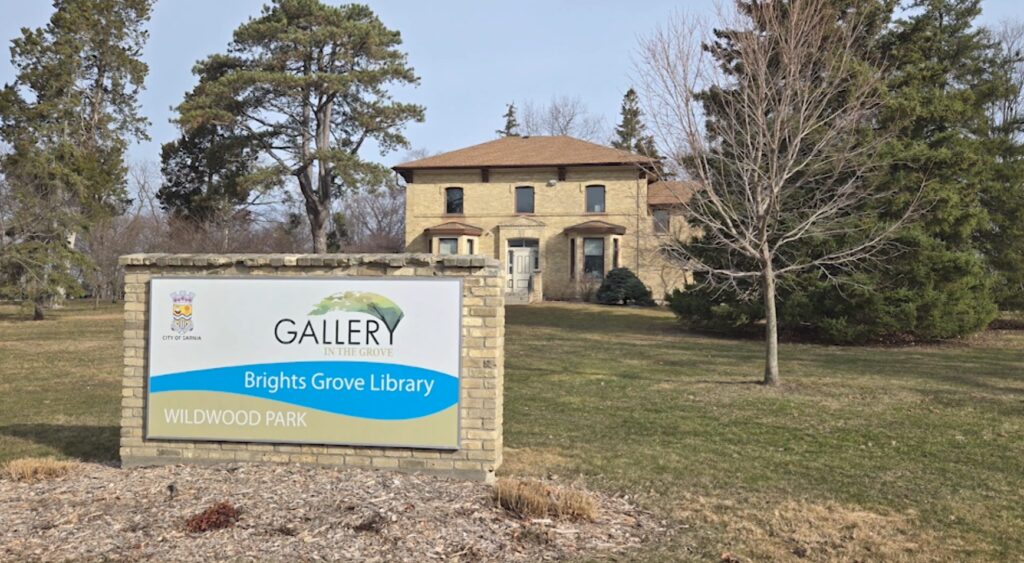
A decades-long community effort to build an accessible library and community hub in Bright’s Grove, now fully designed and “shovel-ready,” was brought to a halt this past week by Sarnia Mayor Mike Bradley.
Using “strong mayor powers,” the mayor unilaterally removed $2 million in funding for the project from the 2026 budget, moving it to the city’s “unfunded capital projects list”—a move proponents say effectively kills the project.
The decision has ignited a firestorm, moving from council chambers to social media, where a public battle over the facts is now being waged. The mayor and the project’s volunteer committee are presenting two starkly different realities.
Here is an explainer of the core claims and what happens next.
On Sunday, Mayor Mike Bradley released a public “Fact Check” on Facebook to justify his decision.
In response, Mark Moran, the volunteer Chair of the Bright’s Grove Library Committee, issued a lengthy, point-by-point rebuttal, accusing the mayor of presenting a misleading narrative.
Here’s a breakdown of the four key arguments.
Mayor's Claim: "My recommendation to Council was to defer not to delete the project till all of the above issues are sorted out… a reasonable request on behalf of the taxpayers of Sarnia."
Committee's Rebuttal: Moran calls this distinction disingenuous. "Then why would you put it into the unfunded category with zero budget?" he wrote. "That is not delaying the project by a year, or two, or six… You know as well as I do that if this project doesn't happen now… it will likely never happen."
Proponents argue that a "deferral" at this stage is a "kill shot" because the project's $1 million community fundraising campaign is contingent on a firm "yes" from the city. Moran noted that one foundation, which has pledged $250,000, has already stated it "will need to walk away if there are any further delays to this project."
Mayor's Claim: "Four million from Federal Government… was never officially committed and isn't now."
Committee's Rebuttal: Moran argues this is a misleading half-truth. He states the federal Minister of Housing, Communities and Infrastructure "made the announcement himself in front of 40-50 people and called you personally to inform you."
Moran clarifies the grant was later rejected because the design was not "net zero"—a technicality the committee was allegedly told would not be the sole basis for rejection.
Most importantly, Moran argues the grant is a red herring: "this project was never dependent upon a grant." The core funding plan was always the city's $4 million commitment plus the $1 million community fundraising goal.
Mayor's Claim: "The architect now wants another $212,000 dollars," implying runaway costs and poor management.
Committee's Rebuttal: Moran counters that this fee is the result of city-caused delays, not committee mismanagement. He claims the architectural firm (hired by the city via an RFP) has been working for six years on a project that has evolved and stalled.
Critically, Moran states that City Staff reviewed the fee and "have recommended… council approve the payment… and found to be 'fair market value.'" The mayor is framing a fee that his own staff have reportedly vetted and approved as a sign of committee failure.
Mayor's Claim: "There has been little concern about cost control… Staff kept flagging the big issues of project management and costs. They were ignored by the Chair and Committee."
Committee's Rebuttal: Moran called this allegation "offensive." He argues the opposite is true: the committee has been stalled by city administration and kept in the dark, not the other way around. "Cost control has always been a vital factor," he wrote, "but constant delays and attempts to derail this have increased the cost… This has been completely out of the control of our committee."
He notes that as chair of the committee, he is "not allowed to contact" the architect directly, and that the administration "wasted countless months" while insisting the project would cost $8 million to $10 million, far above the architect's own $5.3 million to $5.8 million estimate.
This is now a two-front political battle that will be decided at City Hall. For the project to move forward, two things must happen.
The Architect Payment: Council must first vote to approve the $212,000 payment to the architect. Moran claims the mayor is using this as a "second way to kill this project," separate from the budget.
The Veto Override: The project's supporters must rally a two-thirds "super-majority" (six of nine) council votes to override the mayor's veto and reinstate the $2 million in funding for the 2026 budget.
A council meeting is scheduled for tomorrow, November 17. Community supporters are being organized to email all council members and to attend the meeting "Wearing Blue" to show support.
Mon, Oct 5 · 7:00 pm
St Andrew’s Presbyterian Church 261 Christina St N Sarnia, ON
Tue, Oct 6 · 5:30 pm
The Bridge Patisserie Café 12 Michigan Ave Point Edward Point Edward, ON
Tue, Oct 6 · 6:00 pm
Black Gold Brewery 395 Fletcher St Petrolia, ON
A division of Sarnia Media Group Inc.
Locally Owned and Operated
© 2026 The Sarnia Journal