
Officials with the Canadian and U.S. Coast Guards are once again urging residents on both side of the border to skip the annual Port Huron Float Down event. “This is an inherently dangerous activity,” the agencies noted in a joint statement this week. “As first responders, the U.S. Coast Guard and the Canadian Coast Guard […]
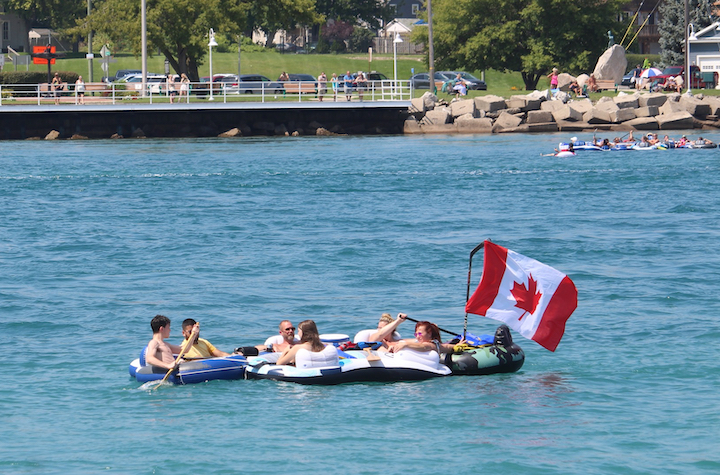
Officials with the Canadian and U.S. Coast Guards are once again urging residents on both side of the border to skip the annual Port Huron Float Down event.
“This is an inherently dangerous activity,” the agencies noted in a joint statement this week. “As first responders, the U.S. Coast Guard and the Canadian Coast Guard recommend that people do not take part in this event.”
The unsanctioned float down annually sees thousands of participants gather from both sides of the border to make their way down the St. Clair River on various inflatables and rafts, on the third Sunday of August.
On the U.S. side, participants generally gather at Lighthouse Beach, directly north of the Blue Water Bridge, for the 7.5 mile/12 km course, to Chrysler Beach in Marysville.
The event went smoothly thanks to ideal weather conditions, officials said, noting one person was rescued.
Environment Canada is calling for clouds, 70% chance of showers and a high of 24 degrees C for Sunday.
“High risk factors such as the fast-moving current, weather conditions, water temperature, the large number of participants, lack of life jackets, alcohol consumption, and limited rescue resources can create challenging emergency response scenarios that can result in serious injuries or fatalities,” the Coast Guard officials added. “The risks are real.”
They add that water temperatures from recent float down events averaged from 60-66ºF/17-19ºC.
“Immersion in water below 70ºF/21ºC can lead to hypothermia that impairs a person’s ability to swim or help themselves. Early signs of hypothermia include shivering, loss of coordination, and poor judgment.
“Additionally, the marine environment accelerates the effects of alcohol consumption and can increase fatigue and susceptibility to hypothermia – further impairing one’s judgment, vision, and reaction time.”
In 2016, high winds and heavy rains led to approximately 1,500 participants requiring assistance when they landed on the Canadian shoreline at Sarnia and Corunna, leaving them stranded and subject to Canadian and U.S. border security with no identification, money, or means of communication. Some had injuries and suffered from hypothermia.
In 2014, a 19-year-old, experienced swimmer drowned during the event. The U.S. Coast Guard as well as local, state, and federal partners including the Canadian Coast Guard mounted a significant search and rescue effort that was suspended after 36 hours.
“The U.S. and Canadian Coast Guards, supported by a large number of federal, state, provincial, and local agencies, are highly trained, but have limited resources,” officials added. “We embrace this responsibility, but cannot be everywhere at once. We rely on users of the marine environment to look out for one another, act responsibly, wear life jackets, and refrain from alcohol consumption while on the water to improve the likelihood they return home safely.”
If you choose to participate, you are strongly encouraged to take several precautions:


