What Alberta Changed When It Followed Ontario Into Regulated Online Casinos
Ontario gave Alberta a Canadian example when it came time to open its own regulated online gambling market. Ontario launched its competitive iGaming market in April 2022, while Alberta followed on July 13, 2026.
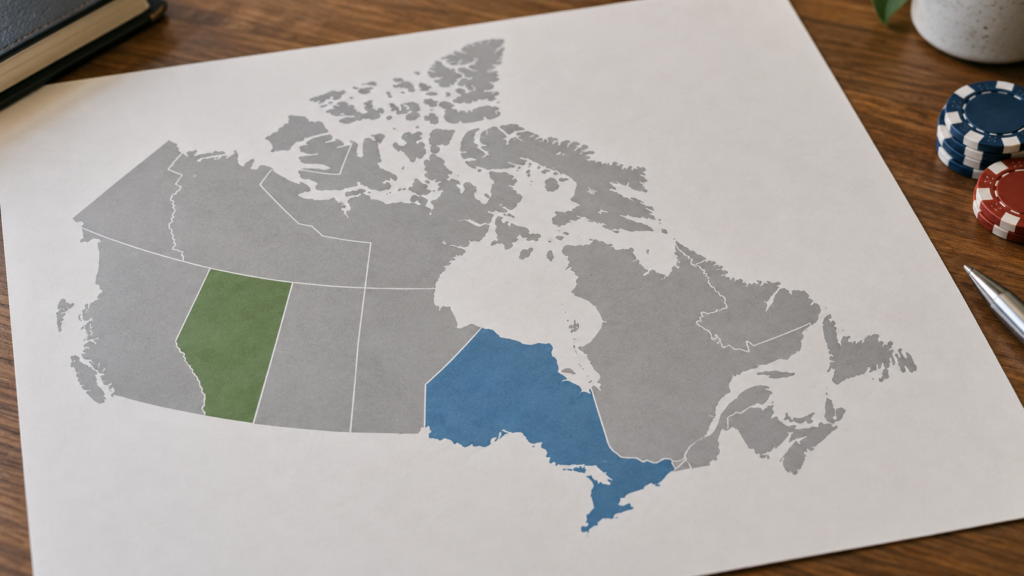
Ontario gave Alberta a Canadian example when it came time to open its own regulated online gambling market. Ontario launched its competitive iGaming market in April 2022, while Alberta followed on July 13, 2026. The two systems now allow private online casino and sports betting operators to take part under provincial regulation.
The basic setup is the same in both provinces: one body regulates the market, and another manages the business side. In Ontario, the Alcohol and Gaming Commission of Ontario (AGCO) is the regulator, while iGaming Ontario signs agreements with operators and manages the commercial relationship.
Alberta uses a similar two-body structure. Alberta Gaming, Liquor and Cannabis (AGLC) acts as the regulator, while the Alberta iGaming Corporation (AiGC), a Crown corporation created for the new market, conducts and manages it. AiGC enters into operating agreements with approved companies and oversees areas such as revenue sharing, anti-money laundering compliance and financial reporting.
That makes the two markets similar in many respects. However, Alberta did not simply reproduce every Ontario rule. Its approach includes several differences that affect players directly, as well as others that mainly matter to operators and how money moves through the regulated system. Three differences stand out in particular.
The most visible difference is age. In Alberta, you can gamble online from age 18. In Ontario, the minimum age is 19.
That difference was not created specifically for online gaming. Each province sets its own gambling age, and both kept the limits they already had. Alberta has long allowed people into casinos at 18, which matches the province’s age of majority. Ontario has used 19 for land-based gambling for years, and its online market follows the same rule.
Ontario players must also be physically located in the province when placing wagers through its regulated market. The same applies in Alberta, where operators must verify a player’s location before allowing real-money wagering. This means someone aged 18 or over who is physically in the province meets the requirements to access regulated Alberta online casinos.
In both markets, licensed sites must confirm a player's age and identity. Meaning that the minimum-age requirement is enforced as part of the account and verification process, rather than simply being a box to tick at sign-up.
2. Self-Exclusion Goes Further
A bigger difference appears in how the two provinces handle self-exclusion.
Ontario introduced BetGuard in May 2026. Before that, self-exclusion was handled by the operators, with individual sites running their own programs. BetGuard brought those separate systems together by giving players a single way to opt out of all regulated online gambling sites in Ontario. Once someone self-excludes, existing accounts become inaccessible, new accounts cannot be created, and operators cannot send them direct marketing.
Alberta’s system covers more ground, and it was ready from day one. Alberta built centralized self-exclusion into its market before launching, and every operator had to connect to it before going live. When someone signs up through AGLC’s program, they can choose to exclude themselves from Alberta’s casinos and racing entertainment centres, from regulated online platforms, or from both.
That is where the main difference lies. Ontario’s system currently covers regulated online gambling, while casinos and charitable gaming centres fall under the OLG’s separate My PlayBreak program. Alberta connects online and land-based self-exclusion through the same program. This means someone in Alberta can make one decision that applies across different forms of gambling rather than treating online and physical venues separately.
3. Alberta Shares Gaming Revenue Differently
Not every difference is something a player will see when opening an online casino account. How gaming revenue is divided mostly happens behind the scenes.
At first glance, the two markets are quite similar here too. Ontario’s model gives operators an 80% share of adjusted gross gaming revenue. The remaining 20% is iGaming Ontario’s share before expenses and other stakeholder payments are taken into account. Alberta also uses an 80/20 split, with 80% of net iGaming revenue going to operators and 20% retained by the government.
Alberta, however, makes another allocation before that 80/20 division. A total of 2% of gross gaming revenue is allocated to support First Nations, while another 1% goes towards social-responsibility initiatives such as gambling research, prevention, education and treatment. The remaining net revenue is then divided between operators and the government.
Ontario also makes First Nations revenue-sharing payments connected to its regulated iGaming market, although the arrangement is less straightforward. Since April 2023, the province has directed iGaming Ontario to make payments based on 1.7% of the previous fiscal year’s unadjusted gross gaming revenue. However, the iGaming Ontario 2026-2029 Business Plan confirms that discussions are still ongoing about how the existing Gaming Revenue Sharing and Financial Agreement applies to the online gambling market. As a result, payment figures in the future years may change.
Therefore, the two provinces both share gaming revenue beyond the operator-government split, but they do so through different arrangements.
Where the Rules Match and What It Means for Players
For all these differences, both markets still share more than they differ on. Alberta followed many of the principles already used in Ontario’s structure, particularly around operator oversight, responsible gambling and advertising.
Advertising is the clearest example. Both provinces ban public advertising of bonuses and other gambling incentives. Operators can only share these offers on their own websites and apps, or directly with players who have agreed to receive marketing messages. This means public advertising gives players less opportunity to compare casinos simply by who is promoting the biggest bonus.
With these regulations, players interested in playing at Ontario licensed casinos had to start using other criteria to decide where to play. They began to focus more on factors such as payment options and minimum deposit limits, game selection, brand familiarity and other players’ experiences.
After several years of regulation, Ontario players are more familiar with making these comparisons. Players in Alberta are likely to become more accustomed to doing the same as the market develops. In practice, this means the two markets may start to feel quite similar in day-to-day use, even though some of the underlying rules are different.
Alberta had the benefit of seeing Ontario’s regulated market operate for several years before opening its own. The result is not a completely different system. It is a closely related model with a few choices of its own, and those differences show where Alberta decided Ontario’s starting point could be taken in a slightly different direction.