The Sarnia Journal has partnered with local photographer Art Connolly to feature his captivating “Humans of Sarnia” series as he delves into the lives and experiences of everyday people in Sarnia.
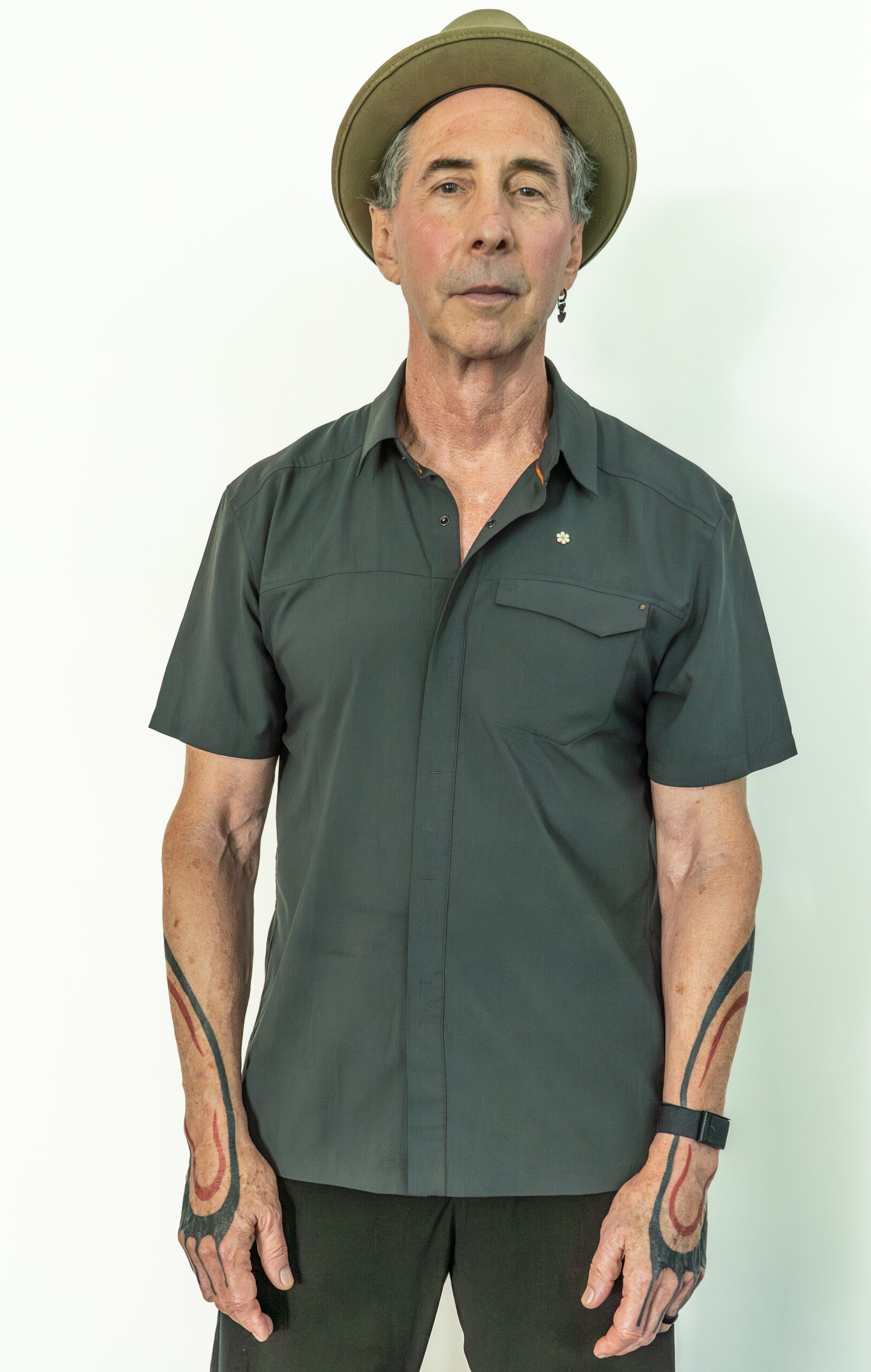
Mike Stevens was just six or seven years old when he discovered something that would shape the rest of his life. He found a harmonica in his home, picked it up, and made a sound. It wasn’t structured. It wasn’t melodic. But it felt good.
“I didn’t know anything about music,” he says, reflecting. “It wasn’t about making music. It was that it felt really good. So that was the beginning.”
And what a beginning it was. That small, satisfying moment sparked a journey that would stretch across more than fifty years—across countless stages and continents, into the hearts of communities in need, and into the lives of thousands of people.
But even from the start, it was never about where it might lead. “By the time I was 16 or 17,” Mike says, “I was playing harmonica for 12 hours a day. Not for a goal or a career or anything like that. Just because it still felt good.”
That pursuit—simple, intuitive, and rooted in feeling—would remain a constant in his life. Music wasn’t something to master or control; it was something to experience and follow.
As Mike continued developing as a musician, he came to understand that his relationship with sound was unique. Eventually, he realized that everyone didn't process the world the way he did and realized that was because of synesthesia, a neurological condition where the stimulation of one sense involuntarily triggers another. In Mike’s case, sound isn’t just sound—it’s layered, textured, and intensely sensory.
“Everything’s music,” he explains. “The sound of a waterfall, the sound of wind—over grass, over trees—they all have a different pitch to me. It’s all music because that’s how my brain processes it.”
This sensory cross-wiring creates a continuous soundscape that most of us can’t begin to imagine. “I have to turn it off or I wouldn’t be able to be in public,” he says. “It’s involuntary. It’s like a burp. It’s just how I’m wired.”
But when he’s on stage, or deep in a recording session, he can flip the switch and let it all in. “For me, it was always about something bigger that connects,” he says. “And if you’re open to it, it can go through you.”
Mike went professional in his early twenties. And from there, the road opened wide. Over the next 45 years, he would perform more than 300 times at The Grand Ole Opry, tour internationally, and share his music with audiences of every kind. His work earned him recognition and awards from across the cultural and humanitarian landscape: the Meritorious Service Medal, the Queen’s Diamond Jubilee Medal, the YMCA Canada Peace Medal, and the Slaight Music Humanitarian Award from the Canadian Country Music Association, among many others. He was named an Honorary Kentucky Colonel, and between 1990 and 1994, he was awarded Entertainer of the Year by the Central Canadian Bluegrass Awards so consistently that the category was eventually retired in his honour.
But if you were to sit down with Mike Stevens, you likely wouldn’t hear any of that from him directly.
There’s something else that hits you first when you meet him—something quieter and harder to describe. It’s an energy. A kind of groundedness. Mike radiates a calm humility and deep presence. When he speaks with you, he listens in a way that makes you feel seen. Not many people have that gift, but Mike does. It’s that same capacity to connect that makes his music so honest—and his life’s work so profound.
In the year 2000, that connection took on a new direction.
While on a tour visiting Canadian Peacekeepers in Northern Labrador, Mike made a stop in Sheshatshiu, a remote Indigenous community grappling with deep challenges, including youth addiction and gas-sniffing. It was there, on a cold northern day, that his path took an unexpected turn.
“I saw a group of kids, maybe 9 to 17 years old,” he recalls. “They were out in the open, sniffing gasoline. I didn’t know what to do, so I just started talking to them. Then I pulled out my harmonica.”
As he played, the atmosphere began to shift. Faces changed. Some started to smile. That one interaction—quiet and spontaneous—would change the course of Mike’s life.
Out of that moment grew ArtsCan Circle, https://www.artscancircle.ca/ an organization that connects Indigenous youth with professional artists, providing musical instruments and creative mentorship in remote communities across Canada.
“Even before we were officially organized,” he says, “I had brought thousands of musical instruments up to lots of communities.” It was never easy. Financially, emotionally, logistically—it was an uphill battle. But it was necessary.
Though he stepped back somewhat from the pace of his performing career to build ArtsCan Circle, Mike never left music behind. He continues to record and perform when he can, bringing the full force of his synesthetic creativity to every note.
And then, in 2025, something remarkable happened. On April 17, Mike Stevens was appointed an Officer of the Order of Canada, one of the nation’s highest civilian honours. When he got the call, he was told the award was “for his music.”
“I completely fell apart,” he says. “I thought instantly about being a 10-year-old kid trying to make my parents proud.”
It’s a powerful image—this world-class musician, this humanitarian and teacher and creator, still connected to the simple, earnest longing of childhood.
To anyone who has heard his music, met him in person, or witnessed the transformative power of ArtsCan Circle, there is no question: Mike Stevens has done something that matters.
What started as a single sound that “felt good” grew into a life of extraordinary depth and contribution. His harmonica may be small, but through it, Mike has created something enormous—a lifelong symphony of service, sound, and human connection.
And as he continues to play, teach, and advocate, you get the sense that he’s still chasing the same thing that started it all—not a career or a legacy, but a feeling. One that still, after all these years, feels really good
"Humans of Sarnia" founder Art Connolly is a man fuelled by curiosity and a passion for connecting with people in Sarnia. Inspired by the renowned “Humans of New York” series, with a camera in hand, he captures the very essence of the individuals he encounters, preserving their stories through his lens. Follow his series on Instagram and Facebook.