Oct5
Scottish Country Dancing
Mon, Oct 5 · 7:00 pm
St Andrew’s Presbyterian Church 261 Christina St N Sarnia, ON

Four men at River City Vineyard describe a medical system that treats them like numbers. While a new national report warns against “forced treatment,” these men say high-accountability community saved their lives.
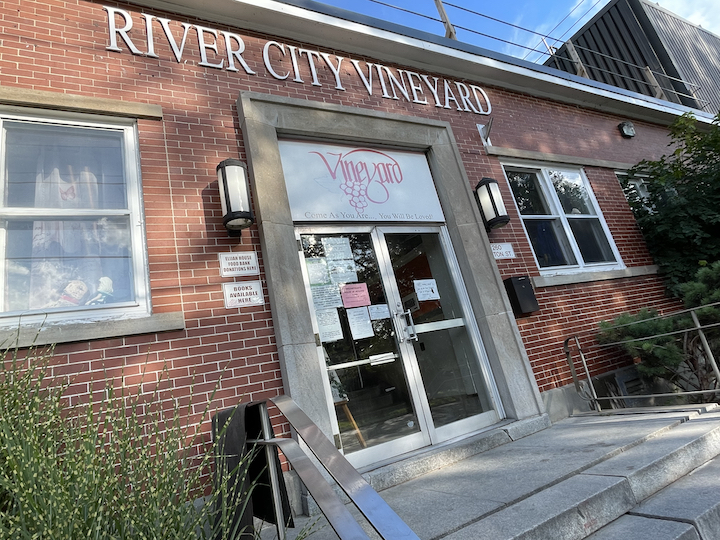
Editor’s Note: This story is based on an extended group interview with four current and former residents of River City Vineyard. To allow for an honest discussion about medical history, legal struggles, and the barriers to accessing local care, The Journal agreed to use only first names or pseudonyms.
In the common room of River City Vineyard, the "system" is viewed with deep skepticism.
Four men—Matt, Terry, Bill, and Kalan—sit in a circle to discuss the realities of surviving addiction in Sarnia. To distinguish their voices on the recording, they introduce themselves by the last thing they ate: Ramen noodles, chili Fritos, and black coffee. It is a moment of levity before they dig into a much heavier reality: a government "machine" that they say dispenses pills but offers little hope, waitlists that stretch for weeks, and a medical model that treats them like numbers rather than people.
"It’s a machine man. Money and drugs man," says Bill (a pseudonym), who has been sober for over two years. "If you want to cure their appetite for drugs, you gotta figure out what caused them to want to do drugs to begin with."
Their lived experience stands in stark contrast to the official narrative emerging from City Hall and Bluewater Health this week, as Sarnia prepares to launch its new Homelessness and Addiction Recovery Treatment (HART) Hub on Monday.
The HART Hub represents a major shift in provincial strategy. Fueled by a new ban on safe supply and supervised consumption sites, the Ford government is pivoting entirely to "treatment-first" models.
A new report released Dec. 30 by the Canadian Drug Policy Coalition (CDPC) warns this approach is dangerous. The report argues that without immediate access to voluntary care, "treatment-first" becomes "treatment-only," effectively displacing vulnerable people from public view without solving the root causes of their homelessness.
In a statement to The Journal, Bluewater Health defended the local system, noting they now operate seven acute withdrawal beds and 12 stabilization beds, with 30 new transitional beds coming online through the HART Hub.
"Even when a bed isn’t immediately available, people are not left on their own," the hospital statement read, citing "care navigation" and outpatient support.
But at the kitchen table, Bill tells a different story.
"I called, and there was a waiting list," he recalls of his attempt to enter detox. "They said, 'If you really want it, you got to keep calling.' I kept calling… I didn't hear from them."
He never got the bed. Instead, he found sobriety through the strict, community-led model at River City Vineyard.
For Matt, the "system" didn't ignore him; it trapped him. He spent 13 years on a Suboxone program—a medication used to treat opioid addiction—that he says left him feeling "lost."
"They’d say [you could taper off], but they’d never be like, 'Hey, if you want to go down…'" Matt says. "I had a doctor tell me you could be on this for the rest of your life, and it's not a big deal. That was a big deal."
He describes a clinical environment where success was measured by a urine sample and a renewed prescription, not by his actual quality of life. "It was like, 'Here you go. You're on this, that we'll put you in the corner and move on to the next one.'"
The CDPC report critiques "coercive" or forced treatment, arguing it fails to produce long-term recovery. Yet the men at Vineyard credit their success to a different kind of force: high-accountability community.
Terry admits he only got clean because he had to. When the Vineyard shelter expanded its drug-free mandate, he was faced with a choice: get sober or leave.
"I didn't get clean by choice… but it was the right thing to do for my own good," Terry says.
Unlike the 30-day limits typical of government-funded shelters, the Vineyard allows residents to stay indefinitely, provided they follow the rules. This "time to heal" proved crucial for Matt, who stayed for a year and a half, saving money and fixing his relationships before moving out on his own terms.
"The government, if they were smart, they would just fund this," Bill says. "It’s good if you need 30 days or if you need a year."
The disconnect between the system’s capacity and the community’s need is a math problem.
Melissa Fitzpatrick, General Manager of Social Services for the County of Lambton, confirmed to The Journal that the new HART Hub includes 30 transitional beds and 26 permanent supportive housing units. She notes the County facilitates over 200 housing placements annually, keeping the homeless list "relatively stable."
But stability is relative. With over 200 people entering the system each year to replace those who leave, the demand remains relentless.
For the men at Vineyard, the solution isn't just more beds or more pills. It's the one thing the "machine" struggles to manufacture: connection.
"I took and took and took from my community," says Kalan, who now volunteers at the shelter. "Now I'm able to finally give back… That makes me feel so good inside. I don't even care about the paycheck."
Mon, Oct 5 · 7:00 pm
St Andrew’s Presbyterian Church 261 Christina St N Sarnia, ON
Tue, Oct 6 · 5:30 pm
The Bridge Patisserie Café 12 Michigan Ave Point Edward Point Edward, ON
Tue, Oct 6 · 6:00 pm
Black Gold Brewery 395 Fletcher St Petrolia, ON
A division of Sarnia Media Group Inc.
Locally Owned and Operated
© 2026 The Sarnia Journal