

Oct21
Honouring the St. Clair River
Wed, Oct 21 · 5:30 pm
Bogey’s Inn & Venue 2845 St. Clair Parkway Sombra, ON
Tuesday night’s council debate revealed sharp differences over what City Hall should actually be responsible for, from housing and social services to transportation and economic growth. We pulled out the exchanges that best showed how candidates would approach those choices.
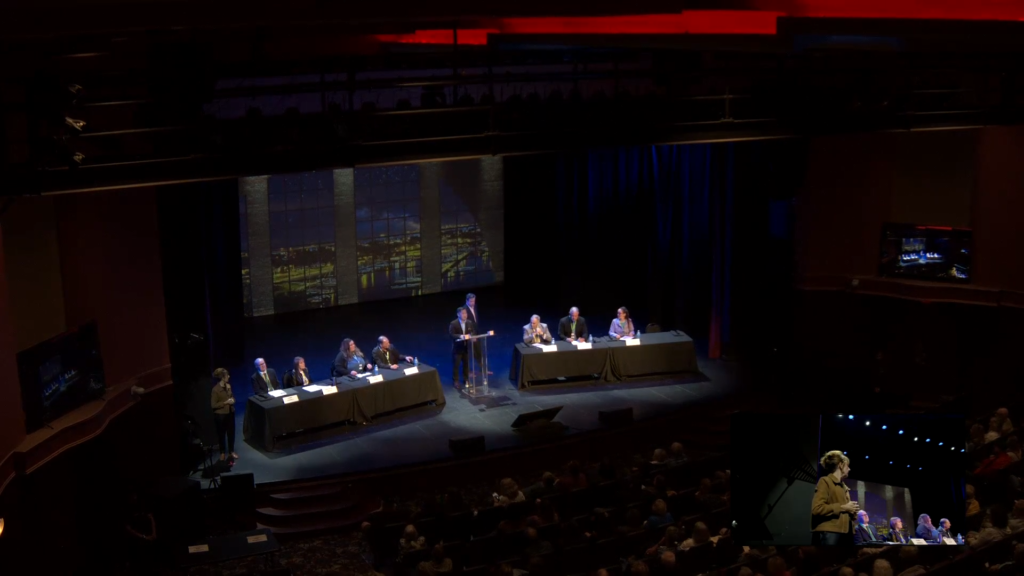
Tuesday night’s council all-candidates debate was sprawling, but a handful of answers and exchanges cut through the campaign language and revealed real differences in how candidates see Sarnia and the role of municipal government.
One of the clearest disagreements came over a basic question: what is the city actually responsible for?
Terry Burrell rejected the premise that Sarnia should supplement social services administered by Lambton County.
“Each level of government should stay in its own lane,” Burrell said, arguing housing and social services are county responsibilities and that the city’s limited property-tax dollars are already needed for police, fire, transit, sewers and roads.
“Let’s keep our money where we’re supposed to be and look after what we’re supposed to do and do it well.”
Anne Marie Gillis answered from almost the opposite direction.
“You can’t turn a blind eye to the reality of the world you live in,” she said.
Even where the county formally controls a service, Gillis argued, Sarnia still experiences the consequences of homelessness, addiction and public drug use. She pointed to treatment, renoviction protections and anti-eviction rules as areas where the city could act.
That divide ran through much of the night: whether jurisdiction should define City Hall’s responsibility, or whether problems become municipal problems simply by playing out on Sarnia streets.
Lo-Anne Chan gave one of the clearest examples of why that distinction can become difficult to maintain in practice.
Chan described someone who had been housed in Brooke-Alvinston and removed from the county’s By-Names List while the services they needed remained in Sarnia.
The person had a bicycle, Chan said, but no realistic way to repeatedly travel between the two communities. The result was that they stayed on Sarnia’s streets to remain close to services despite technically having housing elsewhere.
“So whether this is a county problem, it’s still a city problem,” Chan said.
Earlier, Chan had taken a clear position that “having housing is a human right,” while arguing that supportive housing should not be treated as though it refers only to people experiencing addiction.
Ray McMaster made the housing discussion personal, telling the audience he had been renovicted in May after a Toronto company bought his building. He said he had paid just over $770 for his apartment and that the two-bedroom unit was expected to return to market at $1,800.
“You can put lipstick on a pig, but it’s still a pig,” McMaster said of the changes made to the building.
Josh Coutts-Smith raised another issue often missing from public debates over addiction: the people being discussed are not always involved in the decisions being made about them.
If he were struggling with addiction, Coutts-Smith said, it would be harder to recover if every proposed solution became “a huge debate that a whole bunch of other people talked about” without involving him in decision-making or giving him space to recover.
John Richardson and Brian White pushed the discussion toward how City Hall itself works.
Richardson said council has become too reactionary and argued councillors should use Sarnia’s master plans and strategic plans to establish a long-term direction, set policy accordingly, allow staff to carry it out and then hold implementation accountable.
On homelessness and addiction, Richardson argued governments are already paying for the problem, only in the most expensive way possible, through policing and crisis responses after things have already gone wrong.
He connected that back to development, arguing Sarnia has repeatedly made it difficult to build everything from supportive housing to conventional apartments.
White focused more on the machinery between institutions.
He said the city should stop making “social work feel like dirty words,” reconsider zoning and parking requirements that do not make sense for some forms of housing, and make it easier for organizations and developers trying to build solutions.
Later, White proposed what he called a “no wrong door” approach.
People in crisis, he said, do not care whether their problem technically belongs to the city or county. If someone arrives at City Hall with an issue administered elsewhere, White argued, the city should still be able to facilitate a “warm handoff” rather than simply redirecting them.
Paul Wiersma offered a related proposal: have city and county staff work together earlier, producing more unified approaches before separate proposals make their way through two governments, while improving shared project tracking and data.
Collaboration was a recurring theme throughout the debate, but Richardson, White and Wiersma were among the candidates who tried to explain what it could actually look like.
Transportation produced another useful disagreement about the role of government.
Mario Fazio argued the Sarnia Chris Hadfield Airport had deteriorated through years of inadequate investment and poor management, then made an explicit case for privatization.
“Private people run things better than the public and the government does,” he said.
Adam Kilner pushed back.
“Privatization is likely not the way,” Kilner said, arguing the airport should instead be treated as a wider transportation and commercial hub. Developing its commercial side, he suggested, could help strengthen the aviation side rather than giving up on the public asset.
Mike Stark took a related but more fiscally focused position, questioning the continuing public subsidy and suggesting airport lands could generate more revenue through logistics and other commercial uses.
Claire James raised a different question: what does the airport, in its current form, actually offer the ordinary taxpayer?
She acknowledged the importance of corporations and private aircraft using the facility, but questioned what value everyday residents receive from the public money spent keeping it operating.
Wiersma broadened the transportation discussion beyond the airport and VIA Rail entirely.
He talked about whether residents can reach the places they need to reach within Sarnia, pointing to walkability, cycling, transit and “first mile, last mile” connections. He also raised the possibility that some transportation needs could be better served through on-demand service rather than relying entirely on fixed bus routes.
That was useful because “reconnecting Sarnia” did not mean the same thing to everyone. For some candidates it meant restoring passenger flights or improving rail. For others it also meant making it easier to move around the city without owning a car.
The same ideological differences surfaced again when candidates returned to poverty and affordability.
Kilner said more full-time workers are having to use shelters and food banks and proposed experimenting with food hubs, even initially as small pilot projects, aimed at lowering the price of basic staples.
Patrick Coutu rejected that kind of intervention as treating symptoms rather than the disease.
Council, he argued, should operate at the macro level: make Sarnia more prosperous, remove red tape, create shovel-ready residential and industrial land and expand the tax base.
Stark, despite emphasizing fiscal responsibility elsewhere in the debate, then gave one of the evening’s most unequivocal arguments for putting housing first.
“The first solution to the drug epidemic is making sure that people are housed,” Stark said, pointing to a small-home approach in St. Thomas as one example.
The candidates did not divide neatly into predictable camps.
Some argued City Hall should stay closely within its jurisdiction, control costs and grow the tax base. Others said Sarnia cannot meaningfully separate zoning, transportation and infrastructure from housing, poverty and addiction when those problems converge on the same streets. Still others focused on making the governments and agencies already responsible work together better.
For all the individual promises made Tuesday night, that may be the more important choice facing voters: not simply what the next council should do, but what kind of role City Hall should play when the problems facing Sarnia do not fit neatly inside municipal boundaries.
Wed, Oct 21 · 5:30 pm
Bogey’s Inn & Venue 2845 St. Clair Parkway Sombra, ON
Wed, Oct 21 · 7:00 pm
Refined Fool Brewing Co. Refined Fool Brewing Co Kids with Fur, 1308 London Rd, ON N7S Sarnia, ON