Oct22
The ring around Cargill: How a provincial buffer could reshape Sarnia and Point Edward
Cargill wants Ontario to restrict new housing around its Sarnia grain terminal. But unpublished technical work and concerns raised by local planners leave major questions about who would control development, and who would bear the cost.
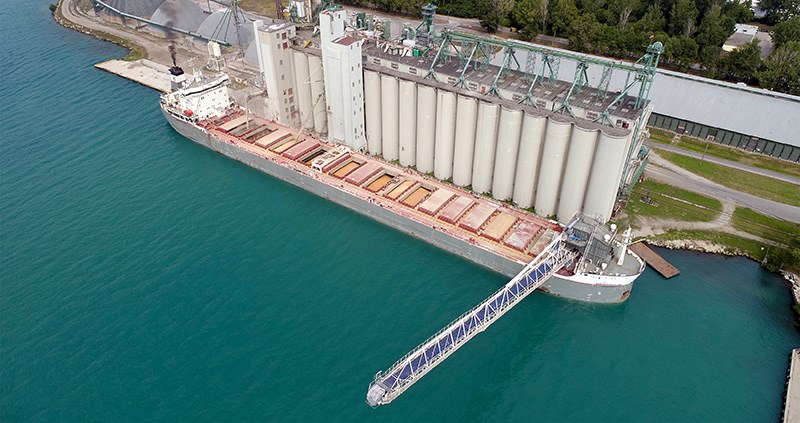
Cargill wants Ontario to draw a development-control zone around its Sarnia grain terminal that would stretch across parts of two municipalities and shape what can be built there for decades.
The company has asked for a Minister’s Zoning Order prohibiting new housing, schools, daycares, health facilities and other sensitive uses within 300 metres of its Exmouth Street property.
Between 301 and 650 metres, larger developments would face additional studies covering noise, vibration, dust, odour, emissions and traffic before they could proceed.
The province, not Sarnia or Point Edward, would make the final decision.
Cargill says the order is needed to protect a major grain and fertilizer terminal from being gradually surrounded by residential development. Agricultural groups supporting the request argue that new residents could lead to complaints, stricter environmental limits and, eventually, restrictions on the terminal’s operations.
That concern is credible. Grain terminals generate truck traffic, industrial noise, vibration and dust, even when pollution controls are in place.
But the documents behind Cargill’s request raise a more difficult question: whether protecting the terminal requires giving one company unusual influence over surrounding land.
The proposed 650-metre boundary comes from a technical memorandum prepared for Cargill by RWDI Air Inc.
Ontario’s general industrial compatibility guideline recommends a 300-metre separation around a facility of this type and identifies a potential influence area extending farther. It also allows development within the recommended distance where site-specific studies show that impacts can be addressed.
The precise 650-metre boundary is Cargill’s consultant’s conclusion.
The province has not published the full RWDI memorandum.
Instead, the public consultation includes Cargill’s planning report summarizing the study, along with a static map. The underlying noise modelling, receptor locations, emissions analysis and assumptions used to draw the boundary are not included.
The public is therefore being asked to comment on a buffer without seeing the technical work that determined its size.
The provincial posting also does not identify every affected property, calculate the amount of developable land involved or estimate how many future housing units could be prevented or delayed.
Several major developments sit near the terminal, including 156 proposed townhouses on Point Edward’s Exmouth Street marina lands, a massive redevelopment proposal for the former Holmes Foundry property, a 105-unit Tricar development at the former Stokes site and a previously approved 100-unit Water Street apartment tower.
Not all of those units would necessarily be blocked. Some projects have existing approvals, and some may sit partly outside the proposed zones.
But the scale of nearby development explains why the conflict has become urgent.
The most serious concerns about Cargill’s proposal came from Lambton County and Point Edward staff, who submitted technical comments without formally supporting or opposing the order.
They warned that parts of the draft are vague, difficult to administer and potentially inconsistent with the Planning Act.
They also identified an apparent loophole. Buildings containing four or fewer homes would be exempt from the outer-zone requirements, as would residential buildings no taller than three storeys. As written, staff said, a three-storey building might contain far more than four units and still avoid the studies.
A more consequential problem involves access to information.
Developers inside the outer zone would be required to study the terminal operating at peak capacity, using Cargill’s operational data where that information is reasonably available.
The order does not require Cargill to provide it.
County and Point Edward staff warned that this could leave Cargill controlling information needed to determine which nearby developments proceed. They also said the company had already declined to provide baseline noise information for an active proposal in the area.
That could create a circular process: Ontario requires a developer to prove compatibility with Cargill’s maximum operations, but Cargill controls some of the information needed to do so.
The proposed warning clause is equally revealing.
Future property owners would be told that the terminal may operate around the clock during seasonal periods, may expand or alter its operations, and may continue producing noticeable noise, dust, odour or emissions despite mitigation.
The warning then says the terminal’s owner and operator will not be responsible for related complaints or claims.
It is unclear how much legal protection that wording would provide. What is clear is that it seeks to place future residents on notice while preserving Cargill’s ability to continue and expand its operations.
The history of the site also complicates the idea that Sarnia and Point Edward simply grew around a Cargill terminal that was always there.
A grain elevator opened on the site in 1927, after local investors purchased waterlots and the federal government dredged the harbour. Much of the industrial land was created through filling, while Canadian National built rail infrastructure to serve the elevators.
Cargill did not purchase the terminal until 1988.
The surrounding waterfront was never fixed. Governments and private companies repeatedly reshaped it through dredging, landfill, railway construction, industrial development, park creation and later residential redevelopment.
Local governments have also already used the ordinary planning process to address compatibility concerns.
Sarnia appealed Point Edward’s 156-unit development to the Ontario Land Tribunal. The resulting settlement required phased development, technical studies, holding provisions and traffic measures intended to protect harbour operations.
The Tricar project was similarly approved with requirements for dust, noise, risk and compatibility studies.
Cargill is now asking Ontario to replace that project-by-project process with a permanent provincial regime spanning both municipalities.
The terminal may need protection. But the province has not publicly shown that this particular order is the narrowest or fairest way to provide it.
There is no published comparison with stronger site-specific controls, a binding data-sharing agreement, narrower modelled boundaries, additional terminal mitigation or compensation for owners whose development rights may be reduced.
Ontario has spent years promising to remove barriers to housing. In Sarnia and Point Edward, it is considering using one of its most powerful planning tools to create new ones.
Before making that decision, the province should release the technical study behind the 650-metre boundary, identify every affected property and explain how neighbouring owners will obtain the information required to comply.
The grain terminal has occupied the harbour for nearly a century.
The ring Cargill wants placed around it could determine what surrounds it for much of the next one.
More to read
 Sarnians4Palestine asks candidates how they would support First Nations consultation on pipeline
 Ontario Command takes control of Sarnia Legion Branch 62
 Sarnia and Point Edward receive $482,274 in casino revenue payments
 W.W.G.D? (What Would Gladu Do?) By SPROINK!
 Vote for Mario Fazio for City/County Council
Events
Oct22
Oct22
Oct22
Oct22
Music Night at Black Gold Brewery
Thu, Oct 22 · 7:00 pm
Black Gold Brewery 395 Fletcher St. Petrolia, ON