
The Sarnia Journal has partnered with local photographer Art Connolly to feature his captivating “Humans of Sarnia” series as he delves into the lives and experiences of everyday people in Sarnia/Lambton.
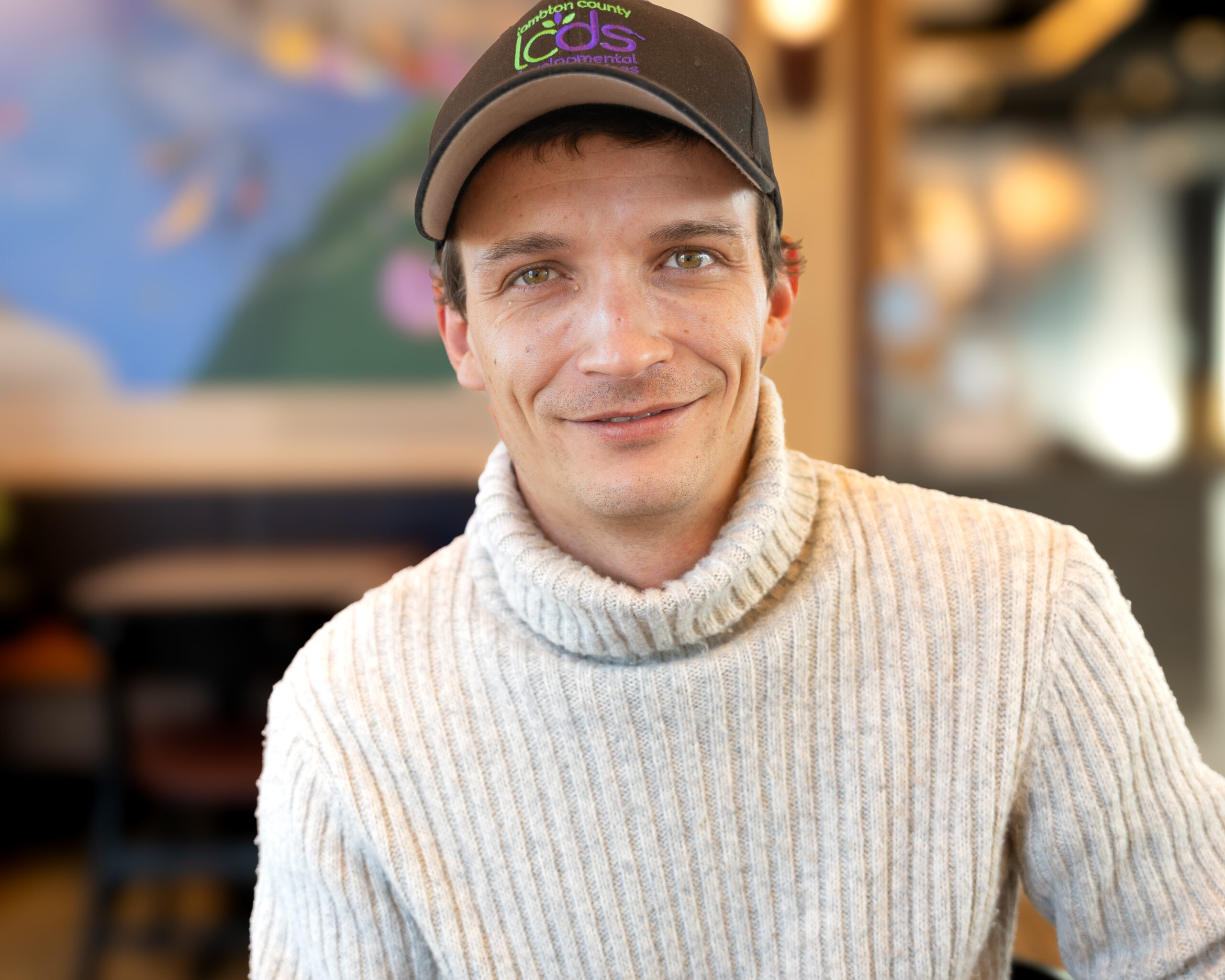
When Mitch talks about the earliest chapters of his life, he moves through them with care—like someone turning pages in a book they’re finally strong enough to read. Some moments settle heavily between us; others brighten his eyes with the warmth of something almost lost.
He begins in Thorsby, Alberta, inside a church that doubled as a home. His mother had fled an abusive relationship in British Columbia, bringing him to the safety of his grandparents, who lived in the church basement.
“It sounds odd now,” he says, “but it was the closest thing to stability we had. Every year we had Wood Day. Everyone stopped what they were doing, went into the bush, and cut wood for the winter. That whole building ran on one stove.” He smiles at the memory, a small island of simplicity in a childhood that rarely offered it.
Things shifted when his mom reconnected with an old boyfriend. They moved to Sarnia, where the atmosphere changed in ways he couldn’t yet name. “He didn’t know how to talk to kids,” Mitch says quietly. “If I didn’t wash a dish perfectly, he’d throw it back and ask why I was crying. I didn’t know what emotional abuse was. I just knew something felt wrong.” So, he stayed busy. Soccer, volleyball, hockey, track—anything that kept him out of the house.
At sixteen, everything collapsed at once. His mother left her partner and moved them back to Edmonton. Suddenly Mitch found himself starting over. While attending his new high school he would eat lunch alone behind an apartment building so no one would see him sitting by himself. “My confidence was gone,” he says. “I didn’t have friends. My mom was working nonstop. I’d wake up alone and come home alone.” The more time he spent alone, the easier it was to drift into trouble. Parties. Drugs. A crowd that mistook recklessness for rebellion.
He tried to maintain a long-distance relationship with a girl from Sarnia, but he ended it, convinced it couldn’t work. Months later, his mom called: “You need to come home. Your ex had a baby. It’s yours.” He remembers the shock more than the conversation.
“I didn’t even know how to hold a baby. But I knew I had to show up.”
Still, the boredom and loneliness in Edmonton pulled him toward dangerous habits—skipping school, using drugs, numbing himself through the days. The turning point wasn’t dramatic. “One afternoon I took ecstasy at school. And mid-high I realized, I’m destroying everything. I walked home and said, ‘I’m done.’ And I quit.”
Two things steadied him. Jeraldine, a classmate whose family embraced him as one of their own. And a religion teacher who saw past the skipped classes and drifting grades. “He told me he didn’t think I’d pass. I told him why. He just looked at me and said, ‘You’re a good kid.’ Then he adjusted my marks enough to get me through. I wouldn’t have graduated without him.”
Years later, Mitch is still unlearning the echoes of those early years—still reminding himself that it’s okay to take up space, okay to be imperfect, okay to ask for help. He is maintaining a relationship with his son. “I’m trying to be the father I never had,” he says. “I want my son to know he can tell me anything.”
But life kept testing that resilience.
He describes the last stretch of years as a kind of collapse—marriage dissolving, finances tightening, home slipping away. Al-Anon meetings steadied him while he tried to navigate paternity questions, a relationship unraveling, and the crushing realization that the life he’d been pushing toward wasn’t going to materialize. “The paternity test confirmed what we already knew,” he says. “But nothing got easier after that.”
Rock bottom arrived quietly: “I went from a three-bedroom home to a room the size of a garage. My son turned seventeen. And I didn’t have a place to offer him. That’s what broke me.”
Then came a call from Alberta. His mother’s new partner—someone who brought light back into her life—collapsed and died suddenly. Mitch spent months out west helping her rebuild, repairing floors, sorting through memories she wasn’t ready to face alone.
“It was heavy. Every corner of that house held something.”
While there, he collapsed himself. Kidney stones, doctors said. But that didn’t explain the deeper, chronic pain that followed him for years. He tried every test, diet, and procedure available. No answers. “Acceptance was the only thing that helped,” he says. “Not fighting it made the pain easier to carry.”
Slowly, the bachelor apartment transformed from a symbol of loss into a place of quiet rebuilding. He began walking to the water. Picked up drawing again. Bought a drafting table. “Art was the only thing that made me feel like myself.”
A friend encouraged him to apply for a position at Lambton County Developmental Services. “I didn’t think I was qualified,” he says. “But he kept pushing.” He got the job—and found himself surrounded by colleagues who supported him, checked in on him, and wanted him to succeed. “For the first time in a long time, I felt like I was somewhere I belonged.”
The rebuilding didn’t happen in big, cinematic moments. It was slow, almost unremarkable at times: a reliable car, a healthier environment, boundaries he’d never drawn before, a sense of peace he’d never allowed himself to want.
“I gave everything I had to everyone else for so long,” he says. “Now I’m learning to give some of it back to myself.”
He pauses, and something in his posture loosens—the faintest unspooling of weight finally sets down.
Mitch says. “I’m figuring it out as I go. But I’m trying. Every day, I’m trying.” As he tells me of a recent phone call, he received from his son his smile is infectious. His son called to suggest they go out for lunch. A small gesture to most but to Mitch it was everything.
And in that small gesture, he’s found something he never expected: hope.
Humans of Sarnia founder Art Connolly is a man fuelled by curiosity and a passion for connecting with people in Sarnia. Inspired by the renowned “Humans of New York” series, with a camera in hand, he captures the very essence of the individuals he encounters, preserving their stories through his lens. Follow his series on Instagram and Facebook.


